

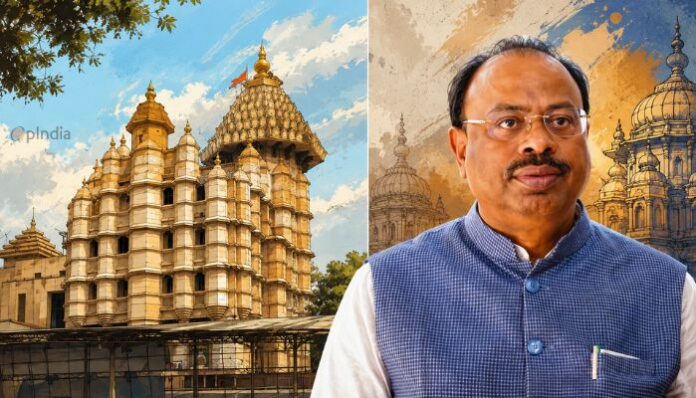
On 6th June, the Maharashtra government put the proposed law on Devasthan Inam lands on hold after strong opposition by Hindu activists, temple organisations, trustees and Hindu groups. While interacting with media in Nagpur, Revenue Minister Chandrashekhar Bawankule said that the draft law had been withdrawn for now and hearings on the objections would continue till 15th August.
🟧 06 – 06 – 2026 | 📍नागपूर | माध्यमांशी संवाद
— Chandrashekhar Bawankule (@cbawankule) June 6, 2026
देवस्थानांच्या अतिक्रमित जमीनी देवस्थानांना परत मिळाव्या याकरिता सरकारने महाराष्ट्र देवस्थान इनाम निर्मूलन कायदा आणण्याचा विचार केला होता. पाच मे रोजी कायदा नागरिकांच्या सूचना व हरकतींसाठी प्रसिद्ध करण्यात आला. एक महिन्याच्या… pic.twitter.com/Y8tvmOeEmo
Notably, the Maharashtra government had put the draft legislation, titled “Maharashtra Devasthan Inam Abolition Draft 2026”, in the public domain on 7th May. The government had invited suggestions and objections till 5th June. According to the state government, the proposed law was aimed at protecting Devasthan lands, removing encroachments and providing legal protection to temple properties.
In his statement, Bawankule said the draft had led to misconceptions and that a consultation process would help remove confusion. He also stated that a large portion of Devasthan lands could not be used due to encroachments. He said that the government wanted to make such lands encroachment free.
Temple bodies call it a major victory
The draft law had drawn strong opposition from several temple organisations, including the Maharashtra Mandir Mahasangh, Ashtavinayak Temple Committee, Vishva Hindu Parishad and temple trustees from across the state. These organisations had argued that some provisions of the proposed law could affect the ownership and control of temple lands by granting rights to existing occupants, cultivators, priests, managers and others associated with such lands.
🚩 देवस्थान इनाम निर्मूलन कायदा स्थगित केल्याबद्दल महाराष्ट्र शासनाचे आणि महसूलमंत्र्यांचे आभार!
— Sunil Ghanwat 🛕🛕 (@SG_HJS) June 6, 2026
🙏
महाराष्ट्र मंदिर महासंघ, अष्टविनायक मंदिरांचे विश्वस्त, विश्व हिंदु परिषद आणि राज्यभरातील मंदिर प्रतिनिधी यांनी केलेल्या सातत्यपूर्ण व संघटित लढ्याला हे मोठे यश मिळाले आहे. 🚩… pic.twitter.com/DFgd4RwAfm
OpIndia spoke to Sunil Ghanwat, national organiser of Maharashtra Mandir Mahasangh. He welcomed the decision and called it a major success of the united struggle of temple trustees and Hindu organisations.
He said, “This is a temple friendly decision and we welcome it wholeheartedly. The decision is a major success of the organised efforts of Maharashtra Mandir Mahasangh, Ashtavinayak Temple Committee, Vishva Hindu Parishad and temple trustees across the state.”
Demand to protect temple lands
Ghanwat added that the stand taken by the Revenue Minister on returning Devasthan Inam lands to temples, removing encroachments on the lines of the Waqf Board, seeking advice from reputed lawyers for legal battles and ensuring that temples do not suffer losses in cases of 100 to 200 year old possession was welcome.
He added that temple representatives should be included in the proposed 15 member committee headed by the Additional Chief Secretary, Revenue, for the hearing process till 15th August.
Ghanwat further said that while the government had taken several temple friendly decisions, important demands of temple trustees must be included in the new process. He said funds donated by devotees should be used only for the propagation of Hindu Dharma, renovation of temples and religious needs of Hindu society, and not for secular or government schemes.
He also demanded that political misuse of temple funds should stop, funds of bigger temples should be used for the reconstruction of smaller and neglected temples, and priests, Guravs, Purohits and other temple sevadars serving in villages should receive a monthly honorarium of Rs 10,000 to Rs 15,000.
