

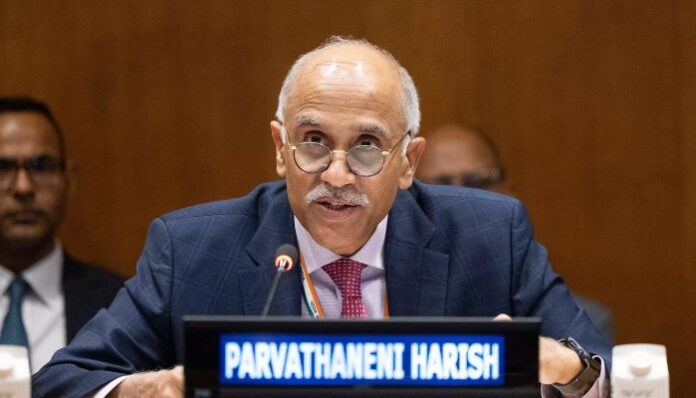
On 8th June, India sharply criticised Pakistan at the United Nations, accusing it of spreading state-backed misinformation by describing terror groups operating within its own territory as “Fitna al Hindustan.” New Delhi said the term is being used to shift attention away from Pakistan’s internal problems and to falsely blame India for security issues inside Pakistan.
Speaking during a United Nations Security Council meeting on Afghanistan, India’s Permanent Representative to the UN, Ambassador Parvathaneni Harish, rejected Islamabad’s claims that these terrorist groups were working under Indian direction. He noted that Pakistan had not provided any evidence to support such accusations.
Officially sponsored misinformation
Ambassador Harish said Pakistan had even issued official notifications instructing government agencies to refer to certain terror organisations as “Fitna al Hindustan.” According to him, this was a deliberate attempt to create a misleading narrative.
He described the move as “officially sponsored misinformation and disinformation dressed in religious terminology,” adding that it was designed to mislead both Pakistani citizens and the international community.
The Indian envoy said the campaign was part of a larger effort to keep anti-India sentiments alive and divert public attention from Pakistan’s political and economic challenges. He called the system behind such messaging “an organised factory of hate.”
India questions military influence in Pakistan
During his remarks, Harish also pointed to the growing influence of Pakistan’s military in the country’s governance structure. Referring to recent constitutional amendments, he argued that they reflected increasing military control over civilian institutions.
According to India, Pakistan has a long history of blaming neighbouring countries for its own internal difficulties rather than addressing the root causes of those problems.
Strong remarks on Afghanistan airstrikes
The Indian representative also criticised Pakistan’s military actions across the Afghanistan border. He held Islamabad responsible for civilian deaths caused by air operations inside Afghan territory.
“Let me reiterate. Dressing up a massacre as a military operation does not absolve the perpetrator. Killing, maiming and orphaning civilians is not counter-terrorism,” Harish said during the UNSC session.
He further accused Pakistan of hypocrisy, saying, “Espousing high principles of international law and Islamic solidarity while mercilessly carrying out air strikes during the holy month of Ramadan is the perfect example of hypocrisy.”
Rising Pakistan-Afghanistan tensions
The diplomatic exchange comes at a time when relations between Pakistan and Afghanistan remain highly strained.
Earlier this year, UN records showed that Pakistani airstrikes inside Afghanistan killed at least 13 civilians, including women and children. The incident triggered one of the most serious confrontations between the two countries in recent years.
By March, the United Nations reported that cross-border strikes and military movements had resulted in at least 42 civilian deaths and 104 injuries. More than 100,000 people were also forced to leave their homes because of the fighting.
Hundreds killed in border conflict
Tensions escalated further after Afghan officials blamed Pakistan for an airstrike that struck a drug rehabilitation centre in Kabul, causing more than 400 deaths. The United Nations independently confirmed at least 269 fatalities linked to the incident.
Although both sides later stepped back from the brink of a full-scale conflict, clashes and security incidents continue to occur along the Pakistan-Afghanistan border, keeping the situation volatile.
India also slammed Pakistan’s attempts to label terror groups as “Fitna al Hindustan” as part of a broader strategy to shift blame externally while avoiding responsibility for its own domestic and regional challenges.
