

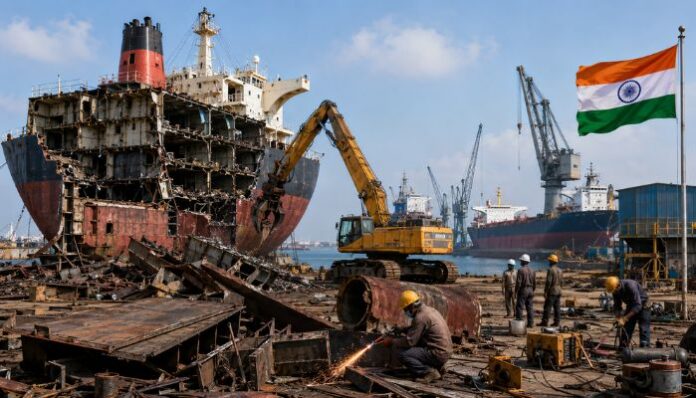
India has emerged as the world’s leading ship recycling nation in 2025, achieving a major milestone five years ahead of the target set under the Maritime India Vision (MIV) 2030. According to the latest report by the United Nations Conference on Trade and Development (UNCTAD), India’s share of global ship recycling increased to 35.4% in 2025 from 30.1% in 2024, making it the top country in the sector.
✴️India Becomes World’s Top Ship Recycling Nation in 2025
— PIB India (@PIB_India) June 22, 2026
✴️India's Ship Recycling Share Jumps to 35.4% in 2025, Highest in the World as per UNCTAD
✴️India Achieves Maritime India Vision 2030 Ship Recycling Target Five Years Ahead of Schedule
✴️Prime Minister @narendramodi’s…
Sharp rise in ship recycling activity
The country’s ship recycling volume witnessed strong growth during the year. India recycled 2.99 million gross tons (GT) of ships in 2025, compared to 1.86 million GT in 2024, recording an increase of nearly 60%. The achievement highlights India’s growing role in the global maritime industry and reflects the impact of policy reforms introduced over the past few years.
Government push and industry reforms
To strengthen the ship recycling sector, the Ministry of Ports, Shipping and Waterways (MoPSW) has taken several important steps. India enacted the Recycling of Ships Act, 2019, after ratifying the Hong Kong International Convention for the Safe and Environmentally Sound Recycling of Ships (HKC). The law aims to ensure that ship recycling activities follow international safety and environmental standards.
The government has also provided financial assistance of ₹53.5 crore to modernise ship recycling yards. As a result, 115 facilities have become compliant with HKC standards.
Incentives for ship owners
MoPSW introduced the Ship-breaking Credit Note Scheme to encourage both ship recycling and domestic shipbuilding. Under the scheme, ship owners receive a credit note worth 40% of the scrap value of a recycled vessel. This credit can be used to pay up to 5% of the value of a new ship built in an Indian shipyard.
The ministry has also maintained regular discussions with the Gujarat Maritime Board, the Ship Recycling Industries Association, international shipping companies, classification societies, cash buyers and global organisations to address industry challenges and improve competitiveness.
Focus on global recognition and expansion
India is actively seeking inclusion of its ship recycling yards in the European Union Ship Recycling Regulation (EUSRR) approved list. Discussions with relevant authorities are continuing to secure approvals.
Meanwhile, the Gujarat government has prepared a master plan to expand the Alang Ship Recycling Yard. The expansion aims to nearly double India’s recycling capacity to around 9 million light displacement tons (LDT), helping the country meet future demand.
Strong future outlook
According to the Baltic and International Maritime Council (BIMCO), more than 16,000 ships are expected to be recycled worldwide over the next decade. With a global market share of 35.4%, India is well placed to handle around 500 to 600 vessels annually.
Union Minister for Ports, Shipping and Waterways, Sarbananda Sonowal, said India’s rise to the top position reflects sustained policy reforms, industry participation and adherence to international environmental and safety standards under the leadership of Prime Minister Narendra Modi.
India’s growing ship recycling sector is expected to support sustainable maritime development, strengthen the circular economy and further enhance the country’s position as a global maritime hub.
