

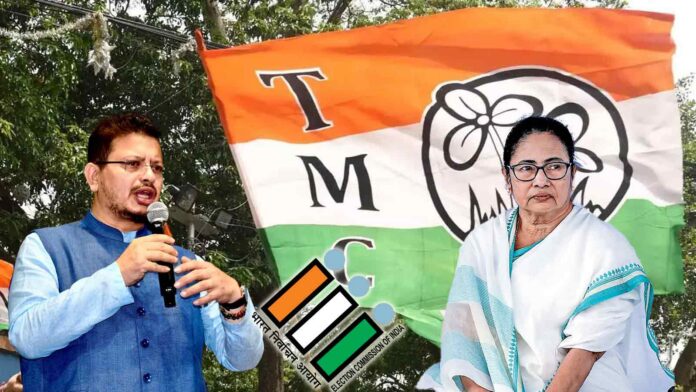
The Election Commission of India (ECI) has written to Trinamool Congress supremo and former West Bengal Chief Minister Mamata Banerjee as well as rebel leader Ritabrata Banerjee, seeking their detailed responses on rival claims over the party’s organisational structure, authorised signatories, name and its iconic two-flowers-and-grass election symbol. The notices, issued on July 2, 2026, direct both factions to submit comprehensive replies by 5:30 pm on July 6, clarifying which group represents the “real” All India Trinamool Congress (AITC) entitled to the party’s identity, bank accounts and administrative control.
The development comes hours after the Ritabrata Banerjee-led faction met the full bench of the EC in New Delhi, staking claim to being the “real” Trinamool and asserting its entitlement to the party’s name and election symbol. Ritabrata Banerjee said after the meeting that his faction enjoyed the support of more than two-thirds of the party’s MLAs, a majority of former ministers, councillors and zilla parishad members.
“We have not come here to make any demands because we ourselves are the real party,” he said. According to Ritabrata Banerjee, the EC has assured the delegation that all documents submitted by the faction would be examined before an appropriate decision was taken.
However, the Mamata Banerjee camp has questioned the EC’s decision to meet the rebel delegation. TMC MPs such as Saugata Roy and Sagarika Ghose have questioned why the ECI granted a hearing to expelled members in the first place, reiterating that the Commission’s own guidelines require only designated representatives of a recognised political party to seek meetings or submit claims. The Mamata faction maintains that organisational authority rests with the established leadership and that numerical strength in the legislature alone cannot override the party’s constitutional framework or its grassroots structure.
The development follows a sharp split in the party after its defeat in the recent West Bengal Assembly polls. A faction led by Ritabrata Banerjee, claiming the backing of more than two-thirds of the party’s 80 MLAs along with a large number of councillors and zilla parishad members, broke away and elected him as Leader of the Opposition in the Assembly. The rebels held a special organisational session on June 22, 2026, during which they removed Mamata Banerjee as party chairperson, elected veteran MLA Arup Roy in her place, suspended Abhishek Banerjee and constituted a 30-member National Working Committee. A 10-member delegation from this faction recently met the ECI’s full bench in New Delhi and submitted documents asserting that their actions were in keeping with party rules.
The rebel camp has alleged that the Trinamool Congress under Mamata Banerjee’s leadership failed to follow its own party constitution in managing internal organisational matters and holding proper elections, thereby justifying their parallel structure and claim to legitimacy. Ritabrata Banerjee has maintained that his group constitutes the real AITC and that questions of “claiming” the name or symbol do not arise since they are the party itself.
In contrast, Mamata Banerjee’s loyalists have dismissed the rebels as having “no credibility”, pointing out that Ritabrata Banerjee was earlier expelled from the party and that only authorised signatories recognised by the ECI can represent it or engage with the Commission. They have cited the Supreme Court’s judgment in the Shiv Sena case, the anti-defection law and the Election Symbols (Reservation and Allotment) Order, 1968, to argue that a breakaway group of legislators cannot appropriate a recognised party’s name or symbol.
The ECI is now examining the documents submitted by both sides to determine the rightful claimants to the party’s name, symbol and resources. The poll panel’s decision is expected to have significant implications for the political landscape in West Bengal, where the rival camps are locked in a bitter contest over control of the Trinamool Congress’s identity and assets.
