

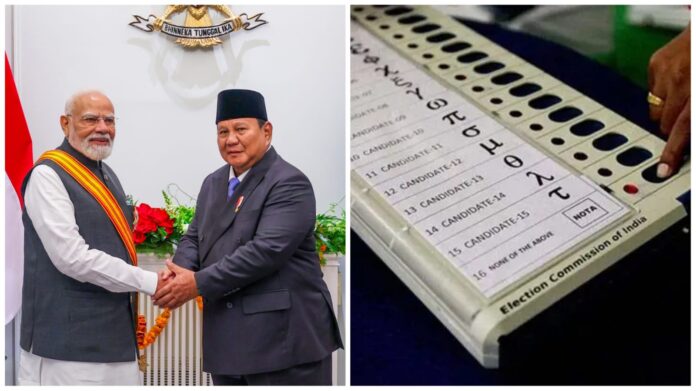
While India’s Electronic Voting Machines (EVMs) continue to remain a subject of political controversy at home, the technology is increasingly finding acceptance abroad. Indonesia, the world’s third-largest democracy, is now looking to adopt a customised version of India’s EVMs as part of its plan to transition from paper ballots to electronic voting.
The development comes during Prime Minister Narendra Modi’s two-day visit to Jakarta, where India and Indonesia are expected to expand cooperation across several strategic sectors. Among the key agreements under discussion is a Memorandum of Understanding (MoU) on election management that will pave the way for collaboration in election technology, capacity building and the possible export of Indian-made EVMs.
Indonesia plans shift to electronic voting
According to sources, the proposed agreement will cover cooperation in election technology, human resource development, institutional capacity building and the exchange of best practices in conducting elections.
Indonesia, with a population of nearly 288 million, currently conducts nationwide elections using paper ballots. However, the country is preparing to introduce electronic voting beginning with the 2029 elections and is looking towards India for both technological expertise and institutional support.
Officials from Indonesia have already undertaken multiple study visits to understand India’s election ecosystem, including the design of EVMs, election management systems, voter awareness campaigns and digital governance tools used by the Election Commission of India.
Indonesian election officials observed Bihar polls
Indonesia’s interest in India’s electoral processes has been growing over the past few years.
During the 2025 Bihar Assembly elections, officials from Indonesia’s election commission were part of an international delegation that observed the polling process firsthand.
Following the visit, Indonesia Election Commissioner Idham Holik praised India’s electoral management.
“Everyone could see that the elections were free and fair. India is truly a land of democracy,” he reportedly remarked, describing the experience as “very inspiring.”
The observation visit is understood to have reinforced Indonesia’s confidence in India’s electoral technology and administrative processes.
India has decades of experience with EVMs
India has one of the world’s longest-running experiences with electronic voting.
Electronic Voting Machines were first introduced on a limited scale during elections in the late 1980s. After years of testing and phased implementation, they were deployed across all 543 Lok Sabha constituencies for the first time during the 2004 General Elections. Since then, EVMs, along with the Voter Verifiable Paper Audit Trail (VVPAT) system, have become a standard feature of elections across the country.
Despite repeated allegations raised by sections of the political opposition regarding the reliability of EVMs, the Election Commission of India has consistently maintained that the machines are standalone, non-networked devices that cannot be connected to the internet or manipulated remotely. The Supreme Court has also, on multiple occasions, upheld the integrity of the EVM-VVPAT system while directing procedural safeguards to enhance transparency.
Not the first country to seek Indian EVMs
Indonesia is the latest addition to a growing list of countries that have explored or adopted Indian election technology.
Bhutan became the first country to use customised Indian EVMs with technical support from India. Nepal also received specially designed machines for pilot projects along with institutional assistance.
Namibia went a step further by becoming India’s first commercial success story in the field of election technology. The African nation used Indian-manufactured EVMs in its national elections and later adopted Indian VVPAT units as well.
The proposed India-Indonesia cooperation signals another step towards exporting India’s electoral expertise beyond its borders. If finalised, the partnership would not only deepen bilateral ties but also position India as a key provider of election technology and democratic governance solutions for one of the world’s largest democracies.
