

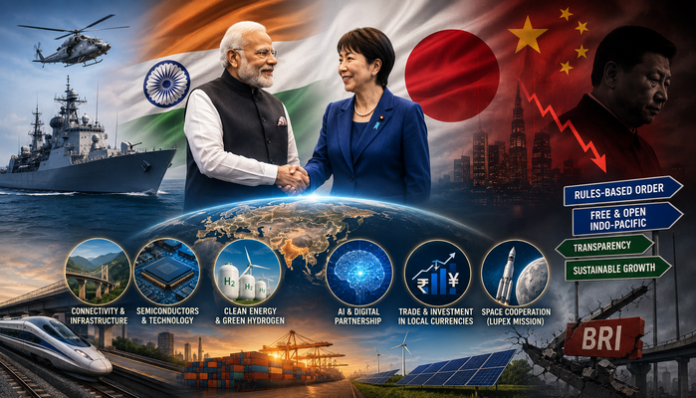
The meeting between Indian Prime Minister Narendra Modi and Japanese Prime Minister Sanae Takaichi on the steps of Hyderabad House was much more than a routine diplomatic photo opportunity. When Prime Minister Modi referred to Takaichi as his “younger sister,” the gesture symbolised the growing trust and warmth between the two nations. Today, the India–Japan Special Strategic and Global Partnership has evolved beyond diplomatic declarations and is emerging as one of the strongest strategic partnerships shaping Asia’s changing political landscape. However, this meeting appears to have significantly heightened concerns in Beijing.
The visit generated the greatest unease in China. This was clearly reflected in the reporting of the Global Times, the official newspaper of the Chinese Communist Party (CCP). By attempting to link the Japanese Prime Minister’s visit to India with a trivial and unsubstantiated controversy over ‘tap water,’ the publication demonstrated that China’s state media increasingly resembles a social media troll rather than a serious journalistic institution.
The Global Times’ Propaganda: A Decline in Chinese Journalism
The Global Times claimed that members of the Japanese delegation neither drank tap water in India nor even used it for rinsing their mouths, and instead relied on bottled water. However, the report appears less like factual journalism and more like an attempt to construct a political narrative through propaganda. Such targeted media campaigns have been employed repeatedly by Chinese state media in the past.
In reality, it is not unusual for foreign delegations to carry their own drinking water or arrange for special meals during official visits. Such practices are generally part of established security, health, and diplomatic protocols. Interpreting them as an insult to the host country is both inaccurate and misleading.
History offers a comparable example. In 1902, when Maharaja Sawai Madho Singh II travelled to London, he carried approximately 4,000 litres of water from the Ganga River in two massive silver urns. His decision was motivated by religious faith rather than any intention to offend Britain. At the time, the world viewed this as an expression of cultural and religious devotion.
Against this backdrop, creating controversy over the Japanese delegation’s use of bottled water appears to be a weak and unconvincing argument. It raises no legitimate questions about India’s image; instead, it suggests that the Global Times sought to transform a routine diplomatic protocol into a political controversy.
The newspaper attempted to portray the Japanese Prime Minister’s decision not to drink tap water as an insult to India. However, this claim withstands neither journalistic scrutiny nor common sense.
Across the world, it is standard practice for foreign delegations to follow predetermined health and security protocols during official visits. Associating such measures with a nation’s dignity or prestige reflects an effort to advance a political narrative rather than present objective facts.
For this reason, the Global Times report appears more like propaganda than journalism. It also reflects a broader tendency within China’s political communication framework to portray personal preferences, institutional protocols, or security-related decisions as political statements. The primary objective of such reporting seems less about informing the public and more about shaping a particular perception.
What Is the Real Reason Behind China’s Unease?
China’s discomfort is not merely the result of a diplomatic meeting. The deeper reason is that the relationship between India and Japan has evolved far beyond traditional friendship. The two countries are now rapidly expanding cooperation in defence, technology, economic development, and the Indo-Pacific strategy. It is this growing strategic partnership that has become a source of concern for China.
1. Defence and Strategic Cooperation: A Growing Challenge for China
India and Japan are growing closer than ever in the field of maritime security. The two countries have agreed to jointly develop the UNICORN (Unified Complex Radio Antenna) naval radio antenna system for the Indian Navy. The project is expected to significantly strengthen the Navy’s operational capabilities, particularly in stealth operations.
At the same time, India’s Act East Policy and Japan’s Free and Open Indo-Pacific (FOIP) vision are complementing each other. The objective of this partnership extends beyond strengthening relations with Southeast Asian nations and seeks to integrate India’s northeastern states with Asia’s economic and strategic networks.
To advance this objective, the two countries established the Act East Forum (AEF), through which Japan has been making substantial investments in roads, bridges, and connectivity projects in states such as Assam, Meghalaya, and Mizoram.
One of the most significant examples is the Dhubri–Phulbari Bridge across the Brahmaputra River. This infrastructure project is expected to transform the economic landscape of Northeast India by improving the movement of people and goods, facilitating trade, and creating new investment opportunities across the region.
Its significance, however, extends beyond economic development. Improved road and transport connectivity will enable India’s northeastern region to connect more directly with Southeast Asia. This will accelerate the implementation of India’s Act East Policy while simultaneously strengthening the country’s strategic presence in the Indo-Pacific.
The shared objective of India and Japan is to reinforce a rules-based order in the Indo-Pacific region. Such cooperation naturally increases pressure on China’s expanding military activities in the region.
Although India and Japan face different security challenges, many of their concerns stem from the same source, which is China’s increasingly assertive behaviour.
For India, the principal challenge lies in China’s military activities along the Line of Actual Control (LAC) and the growing pressure on the disputed border. For Japan, one of the most significant strategic concerns is the security of the Senkaku Islands in the East China Sea, where China has consistently sought to expand its territorial claims and military presence.
Consequently, the security interests of India and Japan have become increasingly complementary. Both countries recognise that peace and a rules-based order in the Indo-Pacific can only be maintained through strong strategic cooperation among regional partners.
It is within this broader strategic framework that the roles of India and Japan in the Quadrilateral Security Dialogue (Quad) have steadily expanded. Together with the United States and Australia, the Quad supports a free, open, secure, and rules-based maritime order in the Indo-Pacific.
China, however, views the grouping as a significant strategic challenge to its expanding maritime influence and regional ambitions. As a result, the Quad has evolved beyond a diplomatic forum into an important security framework aimed at maintaining the regional balance of power in the Indo-Pacific.
2. Semiconductors and Supply Chains: Reducing Dependence on China
India and Japan are also rapidly expanding their cooperation in the technology sector. Both countries are working together in strategically important areas such as semiconductors, electronics, and critical minerals to reduce global dependence on Chinese supply chains.
One notable example is Renesas Electronics’ semiconductor project in Sanand, Gujarat, valued at approximately ₹7,600 crore, along with growing Japanese investments in India’s northeastern region. These initiatives are widely regarded as components of a broader strategy to diversify global manufacturing and supply chains.
If these efforts prove successful, multinational companies may gain a strong alternative to China for advanced manufacturing and technology production.
3. Economic Cooperation: Toward a New Economic Powerhouse in Asia
India and Japan are also exploring mechanisms to expand bilateral trade using their respective national currencies, the Indian Rupee (INR) and the Japanese Yen (JPY). The objective is to simplify commercial transactions while strengthening economic cooperation.
The two countries are examining the possibility of establishing direct INR–JPY trade, thereby reducing reliance on the U.S. dollar for bilateral transactions. Such an arrangement would do more than facilitate trade. It carries significant strategic implications by helping both countries reduce exchange-rate risks, lower transaction costs, and strengthen their economic sovereignty.
For this reason, the prospect of direct Rupee–Yen trade is increasingly viewed as an indicator of India’s expanding role in the global economy and its strengthening position within the evolving international financial system.
From China’s perspective, this development is particularly significant. India represents one of the world’s largest and fastest-growing consumer markets, while Japan remains a global leader in advanced technology and high-end manufacturing. If the strengths of these two countries are effectively combined, they have the potential to reshape Asia’s economic and strategic landscape.
The Pillars of the India–Japan Partnership
The relationship between India and Japan is no longer confined to diplomacy alone. It is expanding rapidly across multiple sectors, including investment, technology, clean energy, and the future economy. This is why the partnership is increasingly regarded as one of the most significant strategic relationships for both countries.
1. Investment and Economic Cooperation
India and Japan have set ambitious goals to elevate their economic partnership over the coming years. While the earlier target was 5 trillion Japanese yen in investment, discussions are now underway to increase this figure to 10 trillion Japanese yen (approximately US$68 billion) over the next decade.
India is already home to 11 Japanese Industrial Townships (JITs), demonstrating that Japanese companies view India not merely as a consumer market but as a long-term destination for manufacturing and investment.
This growing economic engagement reflects a shared commitment to strengthening industrial cooperation and creating resilient supply chains.
2. Partnership in Clean Energy
The two countries are also deepening cooperation in the energy sector. Japan possesses advanced expertise in emerging technologies such as green hydrogen, while India is implementing its own National Green Hydrogen Mission to accelerate the transition toward clean energy.
If bilateral cooperation continues to expand, India and Japan could together establish a model for sustainable energy development that may serve as an example for the rest of the world.
3. Technology and the Digital Future
China’s long-standing technological dominance is gradually facing increasing competition. In this changing environment, India’s greatest strengths lie in its software ecosystem, engineering talent, and rapidly expanding digital infrastructure. Japan, on the other hand, remains a global leader in hardware, electronics, and high-precision manufacturing.
The combination of these complementary strengths creates the possibility of developing a Sovereign AI Network, an artificial intelligence ecosystem that is not dependent on any single foreign company or country, but instead is built upon the technological capabilities, data resources, and computing infrastructure of India and Japan.
Such collaboration could eventually lead to the development of Large Language Models (LLMs) that are not exclusively trained on Western datasets but are capable of understanding Asian languages, cultures, societies, and local contexts more effectively.
This would allow India and Japan to move beyond being mere consumers of advanced technologies and emerge as significant contributors to the global development of artificial intelligence.
Beyond AI, the partnership also holds considerable promise in fields such as quantum computing, sixth-generation (6G) telecommunications, and other advanced technologies. Recognising these opportunities, both countries continue to strengthen their digital partnership.
Challenges Facing the Partnership
Like every major strategic partnership, India–Japan relations also face practical challenges. Several issues remain unresolved, including achieving a more balanced bilateral trade relationship, differences in foreign policy approaches, particularly regarding Russia, and legal and regulatory complexities surrounding the transfer of advanced defence technologies.
Despite these differences, both governments continue to develop institutional mechanisms designed to encourage investment, facilitate technology sharing, and strengthen industrial collaboration. As a result, many analysts believe that the India–Japan partnership will continue to grow stronger in the coming years.
A Bitter Reality for China
China appears reluctant to recognise that the international system is no longer unipolar. Today’s world is increasingly multipolar, with several major powers shaping the global order.
India is no longer simply a large consumer market; it is emerging as a major global power. Against this backdrop, the Global Times’ emphasis on the so-called ‘tap water controversy’ is nothing but a reflection of China’s growing anxiety over its diminishing strategic influence.
At the same time, India and Japan are rapidly advancing the strategy of friend-shoring by relocating critical industries, supply chains, and investments to trusted partners that share political stability, transparency, and strategic confidence.
The COVID-19 pandemic and subsequent geopolitical tensions demonstrated the risks of excessive dependence on a single country for essential goods and manufacturing. Learning from this experience, India and Japan are working together to establish supply chains that are more secure, diversified, and resilient during future crises.
Against the backdrop of Japan’s technological excellence, symbolised by its high-speed bullet trains, and India’s expanding economic influence, China’s growing concern appears understandable.
Together, India and Japan possess the potential not only to balance China’s expanding regional influence and unilateral strategic ambitions but also to shape the future global agenda. Their partnership represents more than an economic arrangement; it is increasingly emerging as a new strategic security framework for Asia.
China’s Concerns, Strategic Realities, and the Road Ahead
China’s state-run newspaper, Global Times, appears unable or unwilling to recognise how rapidly Asia’s strategic landscape is changing. India is steadily progressing toward becoming one of the world’s largest economies, and with this economic rise, its global strategic role continues to expand.
At a time when India and Japan are broadening cooperation in critical sectors such as defence, space exploration, and advanced technologies, it is only natural that their partnership will have implications for the broader Indo-Pacific region.
One notable example is the Lunar Polar Exploration Mission (LUPEX), under which India and Japan are jointly working toward the exploration of the Moon’s polar regions. At the same time, collaboration in semiconductors, artificial intelligence, and resilient supply chains continues to deepen.
These developments constitute precisely the kind of transformation that concerns China. If India and Japan succeed in building credible alternatives in strategic sectors such as defence, space technology, high-tech manufacturing, and semiconductors, they could challenge China’s long-standing dominance in several critical industries.
Against this backdrop, some analysts interpret the emphasis on issues such as the ‘tap water controversy’ as an indication that China is attempting to divert attention away from more substantive strategic and economic developments.
At the same time, China’s Belt and Road Initiative (BRI) has faced increasing criticism in recent years over concerns related to debt burdens, project viability, and geopolitical influence in several participating countries. In contrast, the India–Japan partnership, with its emphasis on transparency, rules-based cooperation, and technology-driven development, is increasingly being viewed as an alternative model for regional growth in Asia.
Challenges: A Realistic Assessment
The India–Japan partnership is not without its practical limitations. China’s Belt and Road Initiative remains one of the world’s largest infrastructure and financing programs. In terms of capital investment and the number of projects, India and Japan have yet to match their scale.
Similarly, issues such as legal complexities surrounding defence technology transfers and bilateral trade imbalances continue to present challenges. However, the objective of India and Japan has never been to replicate the Belt and Road Initiative. Instead, their approach emphasises infrastructure that is transparent, financially sustainable, beneficial to local economies, and free from unsustainable debt obligations.
In recent years, several BRI projects have encountered difficulties arising from excessive debt, escalating costs, political resistance, and limited economic returns. Consequently, many developing countries are increasingly seeking not only financial investment but also reliable, transparent, and long-term strategic partners.
The geopolitical environment has changed considerably. China may eventually need to move beyond its traditional revisionist approach and acknowledge the emerging framework of regional cooperation.
Indeed, the foreign policies of India and Japan are not identical. Japan’s security architecture has long been anchored in its alliance with the United States, whereas India follows a policy of strategic autonomy, seeking to avoid formal alignment with any single geopolitical bloc. Their distinct responses to the Russia–Ukraine conflict are an illustration of these dissimilarities.
Nevertheless, the success of a strategic partnership should not be measured by whether two countries agree on every international issue. Rather, its true strength lies in their ability to cooperate consistently on areas of shared strategic interest.
In the case of India and Japan, this shared foundation is evident. Their interests converge on several critical issues, including responding to China’s growing assertiveness, preserving a free and rules-based Indo-Pacific, strengthening secure supply chains, advancing semiconductor manufacturing, promoting emerging technologies, and building reliable long-term economic partnerships.
For this reason, despite differences over issues such as Russia, bilateral cooperation has continued to expand in areas including defence collaboration, the Quad, semiconductor development, the Act East Forum, digital partnerships, and infrastructure development.
The strength of the India–Japan partnership therefore, does not rest upon any single international crisis. Instead, it is built upon multiple pillars of shared strategic interests, making it increasingly resilient and well-positioned for the future.


