

For decades, one of the least discussed problems in India’s criminal justice system has been the misuse of First Information Reports (FIRs). The law rightly favours registering complaints quickly so that genuine victims are not denied justice. However, the same system has often been misused to settle personal scores, influence property disputes, intimidate rivals or put pressure on people during family and financial disagreements.
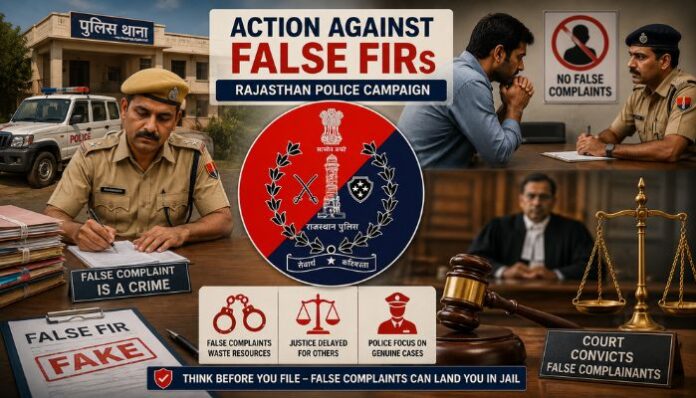
Against this backdrop, a recent campaign launched by Rajasthan Police against those filing false criminal complaints could mark an important shift in the way such cases are handled.
Rajasthan launches action against false complainants
The purpose of the campaign is to ensure that people who deliberately mislead investigating agencies by filing fake complaints also face legal consequences. The numbers from June suggest that the campaign is already having an impact. Courts across Rajasthan convicted complainants in 75 cases after finding that the allegations made by them were false. Those found guilty were awarded both prison terms and fines.
Perhaps more significantly, courts took cognisance of 1,870 cases where police investigations concluded that the complaints were false. This has opened the door for criminal proceedings against the complainants themselves.
The campaign is being implemented across the state. Nagaur recorded the highest number of such cases, with courts taking cognisance in 292 matters during June. Jaipur Rural followed with 247 cases, while Alwar recorded 212. Significant action was also seen in Jaipur South, Kotputli-Behror, Hanumangarh, Jaipur West and Jaipur North.
Courts are now beginning to convict complainants
The campaign is also leading to convictions in several districts. Hanumangarh Police secured convictions in 18 cases, the highest in the state. Pratapgarh recorded nine convictions, while Jaipur Rural recorded six. Courts in Kota City, Alwar, Banswara and Beawar also convicted several complainants after investigations established that the allegations were fabricated.
This marks a major change in institutional thinking. For years, police investigations often ended with a final report stating that a complaint was false, but very few complainants faced legal action for making false accusations.
Even when courts believed that complaints had been filed with malicious intent, further proceedings against complainants rarely followed.
Why false FIRs often go unpunished
Prosecuting a false complainant meant another criminal trial, more paperwork, repeated court appearances and additional responsibilities for police officers and government lawyers who were already handling heavy workloads. As a result, simply closing the investigation was often considered the easier option.
However, this approach came with its own cost. Legally, an FIR only marks the beginning of a criminal investigation and does not establish guilt. But in public perception, the registration of an FIR itself often creates an impression that the accused has committed the offence.
Courts have repeatedly held that police must register FIRs in cognisable offences to ensure that genuine complainants are not turned away. Magistrates also have the power to direct police to register FIRs if officers refuse to do so.
Need to maintain a balance between protection and misuse
These safeguards remain essential for protecting genuine victims. At the same time, they have sometimes allowed criminal law to be used as a tool for pressure and harassment.
False criminal complaints have frequently surfaced in disputes related to land, business competition, financial transactions, family disagreements and local politics. Even when investigations eventually establish innocence, the legal process itself can become a punishment for the accused.
Officials believe that if Rajasthan continues implementing this campaign consistently, it could reduce unnecessary criminal litigation, ease pressure on police and courts and ensure that investigative resources remain available for genuine victims.
The failure of a case in court does not automatically mean that the complaint was false. Genuine cases can collapse because of lack of evidence, hostile witnesses or the inability to prove charges beyond reasonable doubt.
Maintaining a clear distinction between intentionally fabricated allegations and unproven complaints will therefore be crucial. Otherwise, fear of prosecution could discourage genuine victims, especially women and vulnerable groups, from approaching the police.
Rajasthan’s latest initiative is being seen as an attempt to restore that balance. If implemented carefully, it could eventually become a model for police forces across the country dealing with the growing problem of false criminal complaints.
