

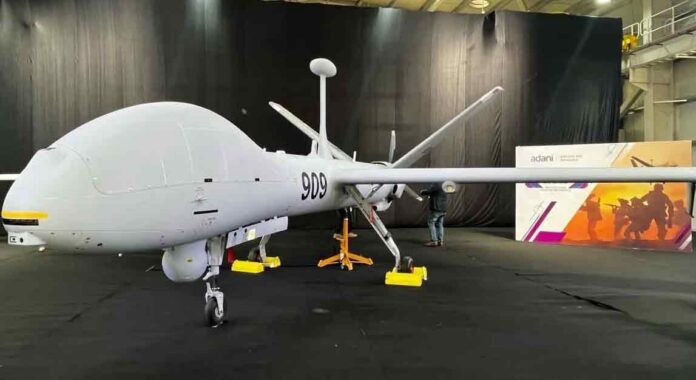
The Indian Navy on Wednesday confirmed the crash of its Uncrewed Aerial Vehicle (UAV) Drishti-10 off the Porbandar airfield in Gujarat during a routine training sortie in the afternoon. In an official statement issued by the Navy Spokesperson, it was clarified that no injury or loss of life has been reported on the ground and that a thorough investigation into the cause of the incident has been ordered.
The Indian Navy posted on X, “Indian Navy confirms the crash of Uncrewed Aerial Vehicle Drishti-10, off Porbandar airfield during a training sortie this afternoon. NO INJURY OR LOSS OF LIFE has been reported on ground. The cause of the incident is being investigated.”
Indian Navy confirms the crash of Uncrewed Aerial Vehicle Drishti-10, off Porbandar airfield during a training sortie this afternoon. NO INJURY OR LOSS OF LIFE has been reported on ground. The cause of the incident is being investigated.
— SpokespersonNavy (@indiannavy) July 8, 2026
The Navy didn’t comment on the probably cause of the crash.
The Drishti-10 Starliner is a medium-altitude long-endurance (MALE) UAV manufactured in India by Adani Defence and Aerospace under licence from Israel’s Elbit Systems. It is essentially the Indian variant of the proven Hermes 900 platform and is primarily employed for intelligence, surveillance and reconnaissance (ISR) missions over maritime and coastal areas.
The drone offers an endurance of up to 36 hours, a substantial payload capacity of around 450 kg, and the ability to operate reliably above 30,000 feet. It carries NATO’s STANAG 4671 certification, which permits operations in both segregated and unsegregated airspace, and supports beyond line-of-sight control through SATCOM links. These capabilities make it a valuable force multiplier for persistent maritime domain awareness.
This is the second hull loss of a Drishti-10 UAV involving the Indian Navy. The first incident took place on 14 January 2025, when one such drone ditched into the sea off Porbandar during pre-acceptance trials being conducted by the manufacturer before formal induction into naval service. That airframe, valued at approximately ₹140-145 crore, was subsequently recovered. As the drone had not yet been formally inducted, the Navy did not suffer any financial loss at the time, and the vendor had committed to providing a replacement unit.
The Drishti-10 has been inducted into the Indian Navy’s inventory to strengthen surveillance along the western seaboard, with aircraft operating from the Porbandar naval air enclave. The service has been progressively building its fleet of these UAVs, with plans to induct additional platforms in the coming years. The latest crash comes even as the Navy continues to rely on the type for routine training and operational sorties.
