

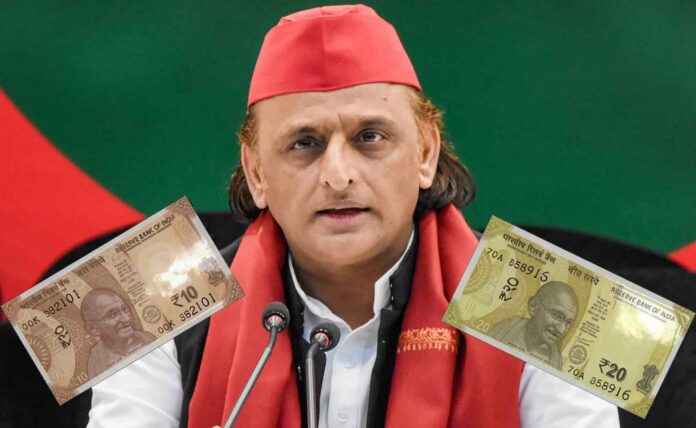
Samajwadi Party president and former Uttar Pradesh Chief Minister Akhilesh Yadav, in a post on X today, questioned whether banknotes are being privatised under the BJP regime. Citing a tender notice issued by the Bharatiya Reserve Bank Note Mudran Private Limited, inviting bids for the manufacturing and supply of opacified polymer substrate sheets suitable for printing Indian banknotes, he alleged that “commission-eating model has sunk to such depths that the country’s people never imagined”
He questioned, “When the nation’s currency itself won’t be self-reliant, how can the economy and the country be self-reliant? Will the government now be outsourced too?” Akhilesh Yadav also questioned the short, 180-word tender notice, calling it a ‘petty, stingy tender for such a massive and sensitive task’, and asked, ‘is there some sinister intent to quietly fulfil formalities on the sly’. He claimed that this means that a backroom deal has already been reached, and it is only being implemented, adding that the BJP government is a partner of profiteers.
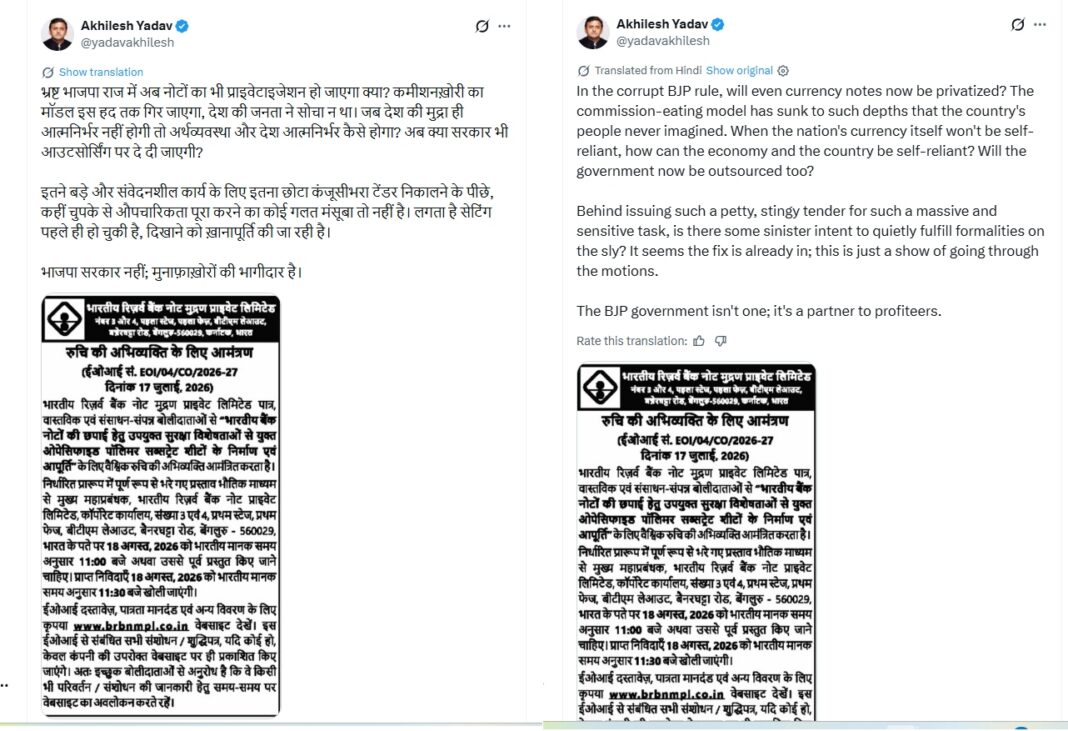
The tender notice in question is an Expression of Interest dated 17 July 2026 issued by Bharatiya Reserve Bank Note Mudran Private Limited (BRBNMPL) is for inviting bids for the manufacturing and supply of opacified polymer substrate sheets suitable for printing Indian banknotes. Akhilesh Yadav’s claim that this amounts to the privatisation of banknotes is completely incorrect and misleading.
The tender is simply a procurement exercise by BRBNMPL, which is a wholly owned subsidiary of the Reserve Bank of India, for sourcing a specialised raw material or base substrate. It has nothing to do with handing over the printing, design, security features or issuance of currency notes to any private entity. Printing of Indian banknotes continues to be carried out exclusively at the existing RBI-controlled presses located in Mysuru and Salboni under BRBNMPL as well as Nashik and Dewas under the Security Printing and Minting Corporation of India Limited.
The Reserve Bank of India has been examining the possibility of introducing polymer-based banknotes for some time, especially for lower-value notes, as they become soiled very soon, and the RBI has to keep printing notes in large quantities to replace older notes. In June 2026, RBI Governor Sanjay Malhotra stated that a proposal for polymer notes is under consideration at a preliminary stage and that the central bank is studying the pros and cons before making a decision. There has been no announcement of a full switch to polymer notes yet, and any such move in the future would still involve printing at the same government facilities, not privatisation.
As India currently does not issue polymer notes, there are no manufacturers of polymer substrate sheets needed to print the notes. Only a few countries in the world currently issue such notes, and therefore, the supply of the sheets is also limited. Like cotton paper used for conventional banknotes, the polymer sheet also needs to incorporate security features during its manufacturing, and therefore, it is a specialised product made by only a few manufacturers in the world. For this reason, BRBNMPL has invited the global Expression of Interest from eligible bidders.
Notably, while many countries such as Australia, the United Kingdom, Canada, New Zealand, Romania and Vietnam have successfully introduced polymer banknotes for all or most denominations, they do not manufacture the specialised opacified polymer substrate sheets themselves. These sheets are imported from a small number of highly specialised private companies that possess the necessary technology, security clearances and production expertise.
The leading global supplier is CCL Secure, based in Australia, which produces the widely used Guardian substrate, along with the newer Spartan variant. Its base film is manufactured by its sister company, Innovia Films, after which CCL Secure applies the opacification layers and integrates advanced security features as per the customer central bank’s specification. Another major supplier is De La Rue of the United Kingdom, which offers its own Safeguard polymer substrate and also prints finished banknotes.
The Guardian polymer technology was originally developed in the late 1980s through a collaboration between Australia’s Reserve Bank and Innovia Films, with Australia becoming the first country to issue circulating polymer banknotes in 1988. Other companies that have entered or are active in this niche include Q&T Hi-Tech Polymer of Vietnam, which supplies its PolySecure substrate to its domestic banknote printing plant, as well as Covestro of Germany with its recently launched Autentium substrate and Spectra Systems with its Fusion range.
Central banks and their printing presses procure these ready-to-print polymer sheets from such specialist suppliers rather than producing them in-house.
While Akhilesh Yadav is concerned about ‘privatisation of banknotes’ because polymer sheets are being imported, the fact is that India’s paper currency notes were printed on imported security paper till recently. RBI depended heavily on imported currency paper from countries such as Germany and the United Kingdom. While the Security Paper Mill at Hoshangabad provided limited domestic capacity for many years, a major boost to self-reliance came with the operationalisation of Bank Note Paper Mill India Private Limited at Mysuru. This joint venture between SPMCIL and BRBNMPL commenced commercial production in 2016 after the Modi govt came to power, adding significant capacity and substantially reducing India’s dependence on imported banknote paper in line with the Make in India initiative.
This means that when Akhilesh Yadav’s party was part of the ruling alliance in the centre, India was printing banknotes on paper imported from foreign countries.
In short, the tender represents a routine step towards exploring advanced materials for potential future use, fully under RBI oversight. The imported sheets will be used for printing a limited number of notes for a pilot run with ₹10 and ₹20 denomination banknotes. It does not signal any privatisation of banknotes or dilution of sovereign control over currency. When the RBI starts full-scale printing of polymer notes, it is reasonable to believe that the government will take steps to produce the sheets in India under the Make in India initiative.
As the world’s most populous country still uses a massive quantity of banknotes, despite the progress in the digital economy, India will require a large quantity of polymer sheets if the proposal is implemented. Therefore, foreign manufacturers will be happy to collaborate with Indian companies, private or PSU, to set up plants in India to make the sheets in the country.
Notably, the introduction of polymer notes will not result in the withdrawal of existing paper notes. In fact, RBI will continue to print both versions of notes after polymer notes are introduced.
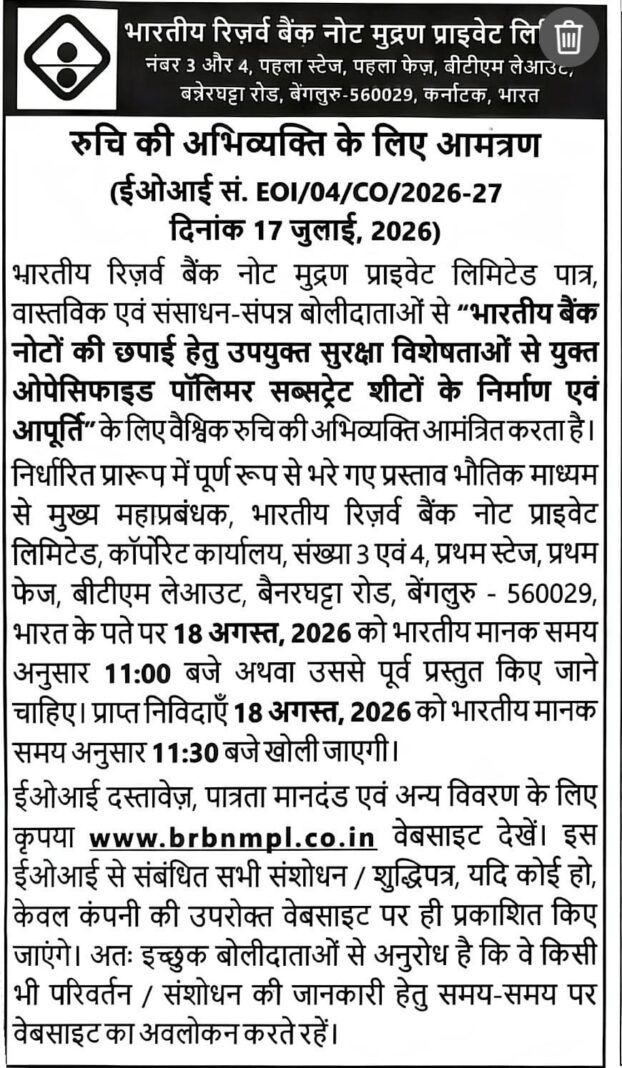
Coming to Akhilesh Yadav’s observation that a ‘tiny’ ad has been issued for an important procurement, that is how tender advertisements are published nowadays. Detailed bid documents and details are published on the website of the relevant department/agency, and only a small ad is published on newspapers to refer to the website for details. This helps in keeping costs low as larger newspaper ads mean more price. In this ad too, interested bidders have been asked to visit the website www.brbnmpl.co.in for the EOI document, eligibility criteria, and other details.
