

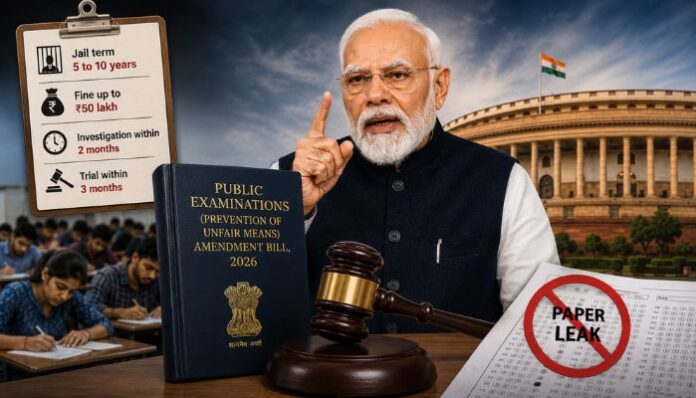
The Centre has proposed sweeping changes to the country’s anti-cheating law, aiming to make investigations faster, ensure time-bound trials and impose much tougher punishment on those involved in paper leaks and examination malpractice. The Union Cabinet has approved the Public Examinations (Prevention of Unfair Means) Amendment Bill, 2026, and Prime Minister Narendra Modi has directed that it be treated as a priority. The Bill is expected to be introduced in the Lok Sabha on Monday, 27th July, after copies of the proposed legislation were circulated among Members of Parliament on Saturday, 25th July.
Union Minister Dr Jitendra Singh to introduce The Public Examinations (Prevention of Unfair Means) Amendment Bill, 2026 in the Lok Sabha on Monday, July 27
— ANI (@ANI) July 25, 2026
According to the legislative business agenda, he will introduce a Bill to amend the Public Examinations (Prevention of… pic.twitter.com/PL7dECRpSA
The proposed legislation seeks to strengthen the provisions of the existing Public Examinations (Prevention of Unfair Means) Act, 2024, which was enacted to curb unfair means in public examinations and protect the integrity of recruitment and entrance tests.
The amendment increases punishments for examination-related offences, introduces strict timelines for investigations and trials, creates a framework for Special Fast Track Courts and Special Task Forces, and strengthens accountability for organisations and individuals involved in organised examination fraud.
Centre moves to tighten anti-cheating law
The proposed amendments come at a time when several public examinations in recent years have been hit by allegations of question paper leaks, organised cheating rackets and other malpractices. According to the Statement of Objects and Reasons accompanying the Bill, the government believes that stronger legal provisions are necessary to restore confidence in the examination system.
The government has said that while the 2024 Act created a legal framework to deal with organised examination fraud, recent incidents have shown the need for faster investigations, quicker trials and stricter punishment to deter offenders. The proposed law is intended to strengthen the integrity, transparency and credibility of public examinations while ensuring that cases are resolved within fixed timelines.
Copy of the Public Examinations (Prevention of Unfair Means) Amendment Bill, 2026. The Bill is listed for introduction and consideration in the Lok Sabha today pic.twitter.com/3BwgsurdOV
— IANS (@ians_india) July 27, 2026
Jail terms and fines proposed to increase sharply
One of the biggest changes proposed in the Bill is a substantial increase in punishment for offences related to examination fraud.
Under the existing law, those convicted face imprisonment ranging from three to five years, along with a fine of up to ₹10 lakh. The amendment proposes raising the minimum imprisonment to five years, while the maximum jail term will increase to ten years. The maximum fine will also rise fivefold, from ₹10 lakh to ₹50 lakh.
The government believes that increasing the punishment will act as a stronger deterrent against organised paper leak syndicates and others attempting to manipulate public examinations.
Tougher action against service providers involved in malpractice
The proposed law also targets service providers entrusted with conducting examinations.
If a service provider is found involved in examination-related offences, it may now face a penalty of up to ₹5 crore, replacing the existing maximum fine of ₹1 crore.
The Bill also proposes extending the period during which such organisations can be barred from conducting public examinations. Instead of the current four-year ban, offending service providers may now be prohibited from conducting examinations for eight years.
The amendments further make directors, senior management officials and other responsible persons personally accountable. They will face a minimum imprisonment of five years, along with fines of up to ₹5 crore, if found guilty of examination fraud.
Organised examination fraud to invite even harsher punishment
The government has proposed even stricter penalties for organised examination fraud involving criminal networks or large-scale conspiracies.
Under the amended law, such offences will carry a minimum prison sentence of seven years, compared to the existing minimum of five years. The minimum fine for organised examination fraud has also been increased substantially, from ₹1 crore to ₹10 crore.
The proposal reflects the government’s view that organised paper leak rackets require stronger legal consequences than individual acts of malpractice.
Special Task Force to speed up investigations
To ensure quicker investigation of examination-related offences, the Bill empowers the Central Government to constitute a Special Task Force (STF) whenever required.
At present, cases can be referred to a central investigating agency. Under the amendment, the Centre will also have the power to notify a Special Task Force specifically for investigating offences under the Act.
The Bill further provides that once an STF is constituted for a particular case, the investigation will be carried out only by that Special Task Force.
Perhaps the most significant procedural reform is the introduction of strict timelines. Every investigation under the Act must now be completed within two months. This deadline will apply whether the investigation is conducted by a police officer, a Central Investigating Agency or a Special Task Force.
Special Fast Track Courts for speedy trials
The proposed legislation also seeks to prevent examination fraud cases from remaining pending for years.
Every State Government and Union Territory Administration will be required, in consultation with the concerned High Court, to designate a Court of Session as a Special Fast Track Court exclusively for cases under the Act.
These courts will hear proceedings on a day-to-day basis, with adjournments permitted only in exceptional circumstances that must be recorded in writing.
The Bill mandates that every trial should be completed within three months from the date the chargesheet is filed.
The Special Fast Track Courts will also be empowered to try other offences connected with examination fraud, including offences under the Bharatiya Nyaya Sanhita, 2023, during the same trial.
The legislation further provides that all pending cases under the Act will automatically stand transferred to these designated courts, and the proceedings will continue from the stage at which they were transferred. Such transferred cases must also be completed within three months.
Special prosecutors and new appeal mechanism
To strengthen prosecution, every State and Union Territory will appoint one or more Special Public Prosecutors for each Special Fast Track Court. These prosecutors will exclusively handle cases under the Act and will function as Public Prosecutors under the provisions of the Bharatiya Nagarik Suraksha Sanhita, 2023.
The Bill also introduces a separate appeal mechanism.
Any appeal against the judgment, sentence or order of a Special Fast Track Court will lie before a Division Bench of the concerned High Court consisting of two judges. The High Court has been asked to make every effort to dispose of such appeals within three months of their admission.
Appeals must ordinarily be filed within 30 days, although the High Court may condone delays for sufficient cause. However, the Bill makes it clear that no appeal can be entertained after 90 days.
The proposed law also allows appeals against orders granting or refusing bail passed by the Special Fast Track Courts.


