

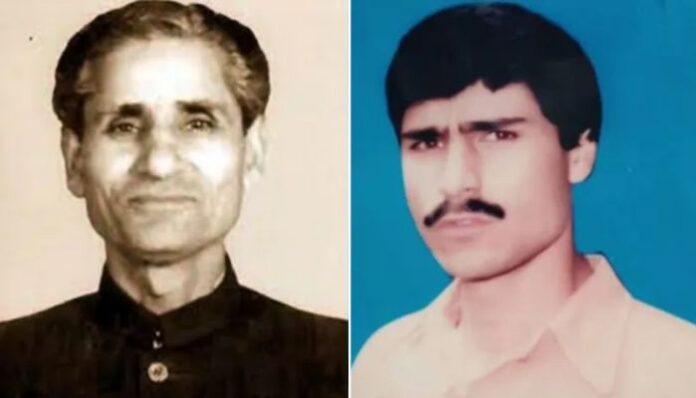
More than 36 years after Kashmiri Pandit poet and scholar Sarwanand Koul Premi and his son Virender Koul were kidnapped and killed, the State Investigation Agency (SIA) Kashmir has stepped up its investigation. On Wednesday, 12th August, the agency carried out searches at nine locations across Jammu and Kashmir as it works to identify and arrest those connected with the 1990 killings.
Jammu : The State Investigation Agency (#SIA) of J&K Police is conducting raids in the 1990 Sarwanand Koul Premi killing case. pic.twitter.com/HUV8ix0jka
— JK Media (@jkmediasocial) August 12, 2026
The searches were conducted at six locations in Rajouri district, two in Jammu and one in Kashmir. The case was first registered at Police Station Dooru in Anantnag and has now been taken over by the SIA. The agency is examining properties and people linked to the conspiracy behind the abduction and murder. Officials have not yet shared details about the material recovered during the searches.
A case that remained unsolved for decades
Premi and his son lived in Soaf Shali village of Kokernag in Anantnag. In 1990, they were taken from their home, tortured and shot dead. Their bodies were later found hanging from a tree.
The killing became one of the most remembered cases from the period of militancy in Kashmir and came at a time when Kashmiri Pandits were being targeted across the Valley. The SIA investigation has now uncovered details about the planning and execution of the crime and identified people connected with the killings and the wider conspiracy.
The development is being seen as an important step in a case that had remained unresolved for decades.
Family seeks justice in all cases
Rajender, another son of Premi, welcomed the SIA action and said that all such cases should receive the same attention.
“My father and my younger brother were kidnapped and assassinated. We all support the raids,” he said, recalling how the killing was described in 1990 as a murder of Kashmiriyat, secular trust and humanity.
Rajender also appealed to the government to hand over all such cases to the SIA for faster and effective investigation. He said he became emotional after hearing about the raids and wanted every affected family to receive justice and those responsible to be punished.
SIA’s recent breakthrough
The raids come soon after another major development in a 1990 killing case. In June 2026, the SIA filed a 737-page chargesheet naming jailed JKLF chief Yasin Malik as the mastermind behind the abduction, torture and murder of SKIMS nurse Sarla Bhat.
Bhat was abducted near the hospital where she worked and was later tortured and shot dead at Omer Colony, Malbagh, on April 18, 1990. Her case had remained frozen for 34 years before the investigation was reopened.
A wider pattern of targeted killings
Premi’s murder came during a period when several prominent Kashmiri Pandits were targeted. Lawyer Tikka Lal Taploo, High Court judge Justice Neelkanth Ganjoo and Doordarshan broadcaster Lassa Kaul were among those killed. These attacks created fear among the community and contributed to the large-scale migration of Kashmiri Pandits from the Valley.
Community organisations estimate that 1,500 to 2,000 Kashmiri Pandits were killed in the years after 1989. There is still no complete official record of all the deaths. More than half a million members of the community were displaced, making it one of independent India’s biggest internal exoduses. Pandit organisations have long demanded a formal inquiry into the killings and displacement, with several describing the events as ethnic cleansing.
Who was Sarwanand Koul Premi?
Sarwanand Koul Premi was a respected Kashmiri poet, writer, scholar, school headmaster and social worker. He was also a freedom fighter and spent much of his life writing about Kashmir, communal harmony and peaceful relations between different communities.
Premi wrote more than two dozen books and translated works such as the Bhagavad Gita, Ramayana, Rabindranath Tagore’s Geetanjali and Russian folk tales into Kashmiri. Among his unfinished works were translations of Harivansh Rai Bachchan’s Madhushala and works by Russian poet and playwright Alexander Pushkin.
His importance went beyond his literary work. When communal tensions rose in Kashmir in 1986, Premi publicly spoke for communal harmony. According to his son Rajender, his words helped give confidence to minority Hindus at a time when fear was growing in the Valley.
Despite the growing tensions and the exodus of many Kashmiri Pandits, Premi and his family chose to remain in Kashmir. His belief in Kashmir’s shared culture and the goodwill he had built over the years gave him confidence that he could continue living there.
Premi’s brutal killing
On the night of 29th April and 30th April 1990, armed militants entered Premi’s home in Soaf Shali village. The family was reportedly looted, with even pashmina shawls taken from the house. The men then ordered 66-year-old Premi to accompany them to meet a “commander”.
His 27-year-old son Virender decided to go with him. Both father and son were then taken away from their home.
On May 1, their bodies were found hanging from a tree in a forested area around 20 km from their home. Reports from the time described severe signs of torture. Their bones had been broken, their eyes had been gouged out, and nails had been hammered into their foreheads. The bodies also bore cigarette-burn marks and gunshot wounds.
The brutal manner of their killing shocked the Kashmiri Pandit community.
For a man who spent his life writing about Kashmir, communal harmony and peaceful coexistence, his death became a painful symbol of the violence that engulfed the Valley in the early 1990s. The latest SIA searches have once again brought his long-pending case into focus, with his family and the wider community hoping that those responsible will finally face justice.
