

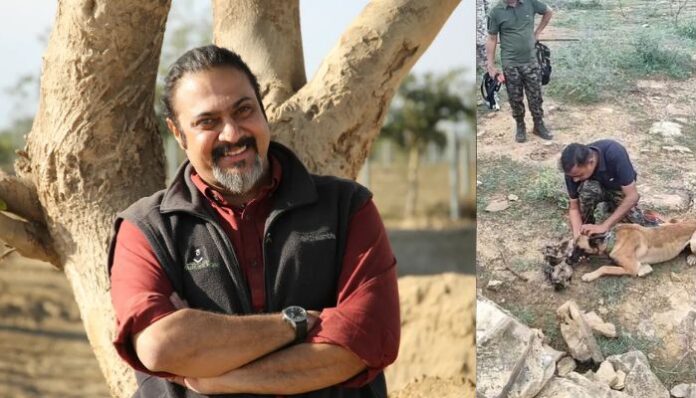
Two men arrested in connection with a leopard poaching network in Madhya Pradesh have told investigators that they were connected to Wildlife SOS, a Delhi-based NGO that works for wildlife rescue and conservation. Bhagwan Singh alias Salim and his associate Wasim, both arrested by the Madhya Pradesh State Tiger Strike Force (STSF), have reportedly told investigators that they were working on the instructions of Wildlife SOS CEO Kartick Satyanarayan, as reported by The Indian Express.
Following their statements, the STSF has asked Satyanarayan to appear before the Investigating Officer in Shivpuri on 17th August. Investigators are also examining digital evidence that they say links him to the operation and are checking whether the network was being run for personal financial gain.
The probe is also looking into whether poaching and wildlife seizures were organised to strengthen the anti-poaching image of Satyanarayan and Wildlife SOS, and whether there was any involvement in wildlife trafficking.
Two arrests led investigators to the NGO
The STSF arrested Bhagwan Singh on 11th August and Wasim on 13th August. Singh is described by forest officials as a wildlife trader with a long history in the trade. A senior Madhya Pradesh forest official said Singh had been on the payroll of Wildlife SOS for at least five years, while Wasim was also working with the NGO.
The investigation started after four people were arrested on 23rd July on the Gwalior-Agra highway with 10 leopard skins. At that time, Wildlife SOS credited its Forest Watch anti-poaching team for months of surveillance that helped in the arrests.
Since the skins were believed to have come from Madhya Pradesh, the STSF began a separate investigation. Its teams searched forest areas in Shivpuri and Morena and found several places where leopard remains had been buried. The remains have been sent to the Wildlife Institute of India in Dehradun for DNA testing to check whether they match the skins seized on 23rd July.
Investigators also recovered three leg-hold traps. The trail from the traps eventually led them to Singh and then to Wasim.
Wildlife SOS vehicle and traps under scanner
According to sources familiar with the investigation, Singh and his associates used a Wildlife SOS vehicle to move through forest areas around Shivpuri and Morena. The vehicle is now in STSF custody.
Investigators say the group distributed leg-hold traps sourced from Haryana to selected local hunters. Singh is also said to have arranged for the four men carrying the 10 leopard skins to meet a decoy buyer near a dhaba on the Gwalior-Agra highway, where Uttar Pradesh Police arrested them.
A forest department source said the network had been operating in the Shivpuri area since last year. The department is now questioning why the operation continued until 10 leopards had been killed if it was only meant to identify and catch poachers.
Officials are also concerned about the use of traps in a sensitive forest area where cheetahs are present. Bhopal sources said the department has not ruled out the possibility of tigers also being caught in the same trapping network, even though tigers are seen only occasionally in the Shivpuri landscape.
Questions over the purpose of the network
A retired forest official said the case could match a known pattern in wildlife trafficking, where valuable wildlife products are traded for money while some seizures are used to show success against other people involved in the trade.
The official also linked this possibility to Wildlife SOS’s fundraising efforts for rescued bear cubs at Bhopal’s Van Vihar zoo. The organisation is working with the state under a memorandum of understanding (MoU), which is due to expire next month.
The Madhya Pradesh forest department is coordinating with the Wildlife Crime Control Bureau (WCCB) as the investigation continues.
Chief Wildlife Warden Sameeta Rajoura said both key accused had named Satyanarayan during questioning and that he had therefore been asked to appear before the Investigating Officer.
Earlier Tamil Nadu case comes under scanner
Singh’s past activities are also being examined. A former Delhi Police officer who was later dismissed from service, Singh was reportedly present with Wasim in Tamil Nadu’s Sathyamangalam forest area in 2023.
During that period, forest officials seized a tiger skin, a leopard skin and a tiger skeleton, according to Tamil Nadu forest department sources. Wildlife SOS had then claimed credit for the seizure and the subsequent conviction of the people arrested in the case.
The earlier case is now being looked at again because of Singh’s reported connection with Wildlife SOS and his arrest in Madhya Pradesh.
About the Wildlife SOS
Wildlife SOS was founded in 1995 by Kartick Satyanarayan and Geeta Seshamani. The organisation started with a bear rescue centre in Agra and later expanded its work to elephants and other wildlife.
It operates an elephant facility in Mathura and has expanded its work to different parts of India through MoUs with state governments and various centres. Its Forest Watch unit is involved in wildlife crime monitoring and anti-poaching work.
The NGO has also worked with government agencies in wildlife rescue, rehabilitation and conservation programmes. Its activities include rescuing animals, supporting wildlife protection and creating awareness about wildlife crimes.
The current Madhya Pradesh investigation has now put two people associated with the organisation under scrutiny. Investigators are examining their role in the leopard killings, use of traps, movement through forests and the seizure of wildlife skins.
Satyanarayan has not responded to emails, messages or phone calls seeking his response. Wildlife SOS co-founder and secretary Geeta Seshamani was also unavailable for comment.
The DNA test results, digital evidence and Satyanarayan’s questioning are expected to help investigators establish how the network operated and whether the arrested men were acting as part of an authorised anti-poaching effort or were involved in a wider wildlife trafficking network.
