

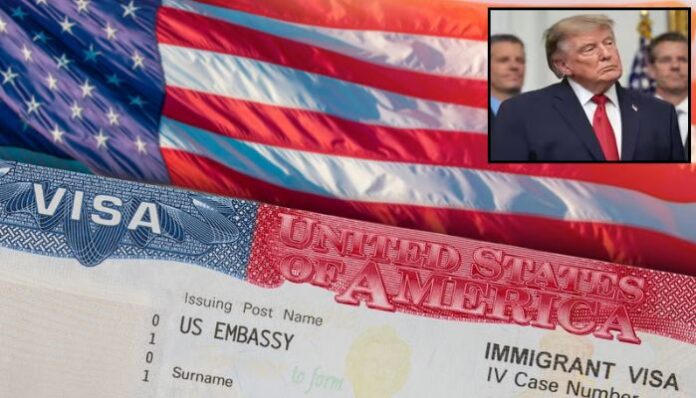
The Donald Trump administration has paused immigrant visa applications worldwide, saying the move is needed to give US consular officers “in-depth training” on how to screen applicants.
The immigrant visa pause announced by the Trump administration on Tuesday (25th August) has already affected people who had scheduled visa interviews at US embassies and consulates, with several applicants receiving emails informing them that their appointments had been cancelled or rescheduled.
The US State Department has not announced when the interviews will resume. Applicants whose appointments were affected have been told that they will receive further information about a new date and time.
NEW – The Trump administration has paused immigrant visa applications worldwide to accommodate “in-depth training” for consular officers as it seeks to screen out individuals deemed likely to need US assistance — FT pic.twitter.com/Tov5htGyAE
— Insider Paper (@TheInsiderPaper) August 25, 2026
US cites ‘public charge’ concerns
According to a report by the Financial Times, the US State Department said the training aims to ensure officers can examine visa applications more closely and consistently. A department spokesperson said that the administration wants to ensure that people granted immigrant visas are unlikely to depend on government assistance.
“A more prosperous America means ensuring that visa applicants are not likely to become a public charge, as defined under US law and regulation, and not likely to become dependent on US public benefits reserved for qualified Americans in need,” the spokesperson said.
The department also said it had launched “a global training initiative” to “ensure all consular officers are fully equipped to evaluate every visa applicant comprehensively and consistently”.
The move means applicants who may have already spent significant amounts of money preparing for their interviews now face further uncertainty. Brian Simmons, an attorney at immigration law firm Fragomen in Washington, said many applicants had “already spent thousands of dollars and disrupted their lives to attend scheduled interviews, only to have their appointments cancelled at the last minute”.
Latest move in Trump’s immigration crackdown
The visa pause is the latest in a series of immigration measures introduced by the Trump administration. Trump has made immigration enforcement one of the key priorities of his presidency, particularly targeting undocumented immigrants. His administration has also introduced tighter restrictions on visas and green cards and moved to end almost all refugee resettlement.
The latest decision also comes after a federal judge struck down another Trump administration policy that had paused immigrant visa applications from 75 mostly poorer countries. The administration had argued that applicants from those countries could be more likely to require government assistance.
US District Judge Jeannette Vargas ruled last week, on Friday, 21st August, that the policy went beyond the authority given to consular officers by Congress. She said the policy overrode the “discretion and decision-making” that Congress had assigned to consular officials.
Vargas also struck down the policy and visa refusals based on it. Both sides have been given until 11th September to suggest how the remaining issues in the case should be resolved.
Immigration policies face legal challenges
Trump’s immigration policies have repeatedly faced challenges in US courts. During his first presidency, federal courts blocked an early attempt to stop nationals from seven majority-Muslim countries from entering the United States. The US Supreme Court later allowed a modified version of the restrictions to take effect.
The latest pause is therefore likely to add another layer of uncertainty for people seeking to settle permanently in the US.
Since last year, the Trump administration has also required immigrant visa applicants to process their applications in the country where they hold citizenship. This has affected people who may have been legally living and working in the US for years, including some who are married to US citizens or have American-born children.
