

A fresh war of words has broken out between the Congress and the Cockroach Janata Party (CJP) over who should take credit for the Supreme Court’s decision to quash FIRs registered against protesters involved in the 20th to 25th July demonstrations. The court’s order has turned into a public fight between Congress supporters and CJP representatives, with both sides highlighting their own role in the developments.
The row started after Ratna Singh, who describes herself as the legal affairs head of the CJP, shared a post on social media. In the post, Singh said, “We never said that Rahul Gandhi didn’t go to the Supreme Court but all major Congress IG handles thanked him for the victory.” She also shared screenshots of Instagram posts in which Rahul Gandhi and Congress were credited for the Supreme Court’s decision.
We never pointed this out coz we don’t care who takes the credit.
— Ratna Singh (@whattalawyer) September 4, 2026
We never said that Rahul Gandhi didn’t go to the Supreme Court but all major Congress IG handles thanked him for the victory.
This fight is beyond taking credit tbh. Work is all one has to do. pic.twitter.com/KygM4NheFU
Congress supporter questions CJP’s role
The post soon drew a response from a Congress supporter, who questioned why the CJP was now claiming credit for a legal development involving a separate incident.
The Congress supporter wrote, “CJP protest happened nearly two months ago, and this incident had already taken place by then. So why did CJP remain silent all this time? Why didn’t they go to the police station and stage a protest demanding an FIR back then? If Swatantra Bharadwaj had not openly admitted his own crime on a podcast, nobody would even have known what had happened. Most importantly, the victim’s daughter, Nishu Azad, sought Rahul Gandhi’s help. Rahul Gandhi then sent Youth Congress lawyers today, following which an FIR was registered. So what exactly are liberals giving CJP credit for, when they knew everything from day one and still did nothing for two months?”
The argument then shifted from the specific dispute to the larger question of what the CJP claimed to have achieved through its protests.
Saurav Das enters the credit battle
CJP spokesperson Saurav Das joined the same thread and defended the movement’s record. He listed several developments that he said were achievements of the young protesters.
“Fascinating! Asking a three-month old movement that has been able to bring down an influential union minister that hasn’t happened in 12+ years, restore fear of accountability, get 130+ FIRs quashed through a apex court order that hasn’t been passed ever in 80 years history, get unprecedented blanket immunity for all students and protesters ACROSS country, fix innumerable schools through youth social audits, get budget allocated for education reforms, bring back narrative to education, get some exam paper reforms in place, revitalise space for dissent, is being asked WHY did we remain “silent” on X, Y, Z! All of these victories are because the young took responsibility. The young are getting things done.”
The exchange then became more intense, with another Congress supporter, Raju Parulekar, targeting CJP spokesperson Saurav Das over the issue of Nishu Azad. Parulekar questioned why the CJP and its representatives had not stood up for Nishu Azad and her demand for justice.
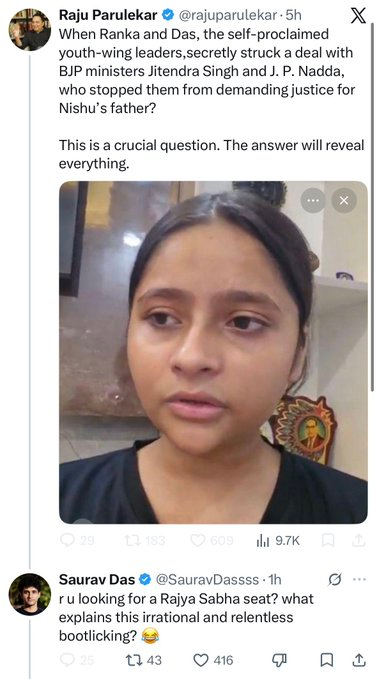
Instead of directly addressing the allegation or the question about Nishu Azad, Das responded with a very different question: “Are you looking for a Rajya Sabha seat?”
AAP also enters the Congress-CJP fight
The dispute then pulled in the Aam Aadmi Party as well. Another Congress supporter shared a post after AAP Delhi president Saurabh Bharadwaj backed Ratna Singh in the same row over credit. Bharadwaj wrote, “Ignore, you have a long way to go.”
Baat Congress and CJP ke beech mei horahi hai!
— gulvinder (@rebelliousdogra) September 5, 2026
To yeh AAP wale apni marvane har jagah kyun ajate hain?
Either openly admit that CJP is backed by AAP, or stay the fcuk away….. https://t.co/xmYYsAcbYK
The Congress supporter responded sharply, “The fight is between Congress and CJP! So why do these AAP people come into every issue just to get themselves involved? Either openly admit that CJP is backed by AAP, or stay the f*** away. ”
What is the Supreme Court case about?
The political and social-media fight comes after the Supreme Court’s 1st September order on FIRs linked to the July protests. The court invoked Article 142 and ordered that the FIRs against protesters connected with those demonstrations be quashed, while allowing an important exception for 2,873 people identified as having serious criminal antecedents.
The exception does not mean all 2,873 people have been declared guilty. The Delhi Police can proceed against them if the investigation establishes their involvement in serious offences such as bodily harm or property damage. The court also barred fresh FIRs over the same protest-related incidents for the other protesters.
