


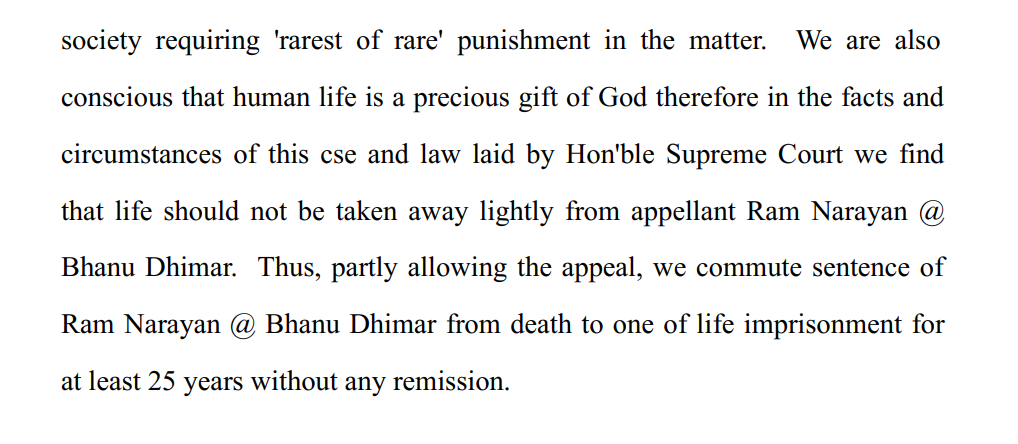
The Madhya Pradesh High Court recently commuted the death sentence of a man convicted of raping and killing a 2.5-year-old in the Shahdol district of Madhya Pradesh. A bench of Justice Vivek Agarwal and Avanindra Kumar Singh reduced the death sentence of the convict to life imprisonment for at least 25 years without remission.
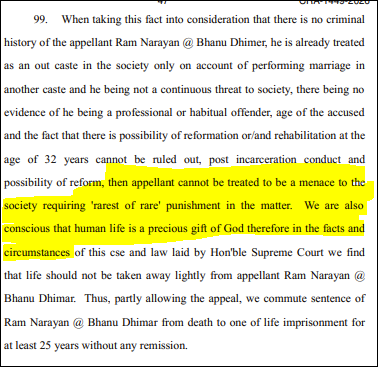
The judges reduced the convict’s punishment, observing that human life is precious and therefore, the convict’s life should not be taken away so lightly. “We are also conscious that human life is a precious gift of God; therefore, in the facts and circumstances of this case, and the law laid down by the Hon’ble Supreme Court, we find that life should not be taken away lightly from the appellant (convict),” the bench noted.
The decision was passed by the High Court during the hearing of a criminal reference for confirmation of the death sentence granted to the convict Ram Narayan Dhimar, along with three connected appeals against a judgment dated January 13, 2026. The judgment was passed by the Special Judge, POCSO Act, Budhar, in Shahdol, convicting and granting a death sentence to Ram Narayan alias Bhanu Dhimar under Sections 302, 201, and 506 Part-II of the IPC read with Section 5(m)/6 of the POCSO Act.
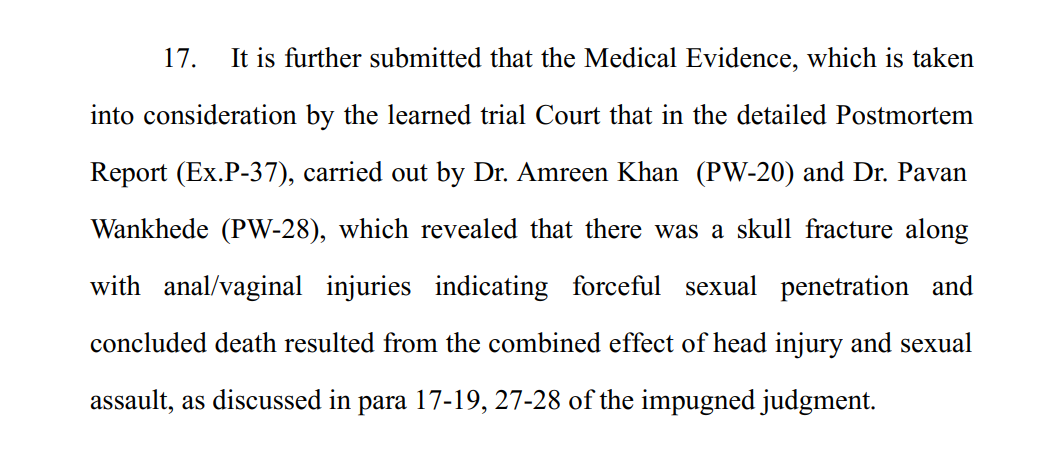
The culprit was convicted by the trial court for the rape and murder of the victim, who was left in his custody by her mother. As per the prosecution’s case, the mother of the victim has been residing at the house of the convict, who was a close friend of her jailed husband. On March 1, 2023, at night, she left her daughter asleep at the convict’s house and went to collect coal at a colliery along with the convict’s wife and two others. When the mother returned, she found her daughter lying in a pool of blood with injury marks on her face. The infant was taken for medical treatment, but she died three days later, on March 6, 2023.
The postmortem of the victim, conducted by Dr Amreen Khan and Dr Pawan A Wankhede at Medical College, Shahdol, revealed vaginal and anal injuries and a skull fracture.
While deciding on the death sentence of the convict, the High Court compared the “aggravating” and “mitigating” circumstances of the case. According to the High Court, the aggravating circumstances included the fact that the victim was two years and five months old and was left in the custody of the convict by her mother. The convict inflicted brutality upon the infant, who was incapable of resistance or articulation.
The High Court treated the lack of previous criminal antecedents of the convict, his age (32 years) at the time of commission of the offence, his rural and economically weaker background, no abnormal conduct during his custody, and the responsibility of his wife and two minor children on him, as the mitigating circumstances in the case.
In the High Court’s opinion, the mitigating circumstances in the case outweighed the aggravating circumstances. The court held that the case did not fall in the category of the ‘rarest of rare’ cases, overturning the trial court’s decision, and the convict posed no threat to society. “…then appellant cannot be treated as a menace to society requiring ‘rarest of rare’ punishment in the matter,” the High Court held.
For commuting the sentence of the convict, the High Court referred to a chart of similar cases, where the Supreme Court commuted the sentences of convicts.
This is the only time when Indian courts seem to have shown leniency in punishing the convicts in rape and murder cases involving extreme brutality. Earlier this year, in March, the Supreme Court stayed the death penalty of a man accused of ripping apart the vagina of a 5-year-old girl with a culinary knife, raping and then killing her in the Shahjahanabad area of Bhopal in Madhya Pradesh.
