

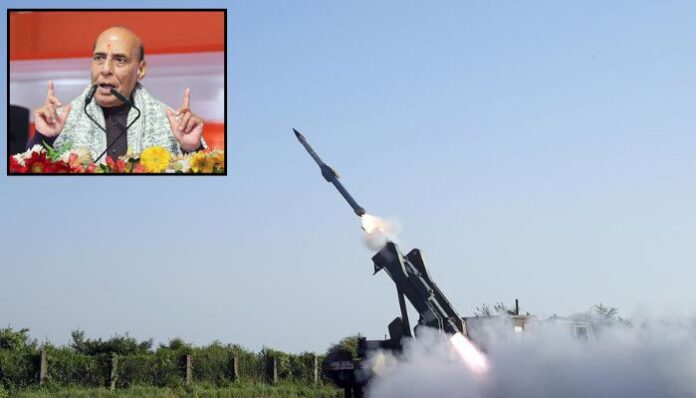
On Monday, 7th September, the Defence Acquisition Council (DAC), headed by Defence Minister Rajnath Singh, approved capital acquisition proposals worth around ₹1.1 lakh crore to strengthen the capabilities of India’s armed forces. The approvals cover a wide range of equipment for the Army, Navy and Air Force, including advanced helicopters, radars, electronic warfare systems, CBRN reconnaissance vehicles and mobility equipment.
The Indian Air Force will also explore a pilot project to integrate Russian-origin RVV-BD long-range air-to-air missiles with Sukhoi-30 fighter jets. The DAC also gave its Acceptance of Necessity (AoN) for a Ground-Based Multi-Purpose Jammer (GBMPJ) for the IAF. The system is designed to jam the radars of enemy forces and strengthen electronic warfare capabilities.
For the Indian Army, the approvals include Advanced Light Helicopters, CBRN reconnaissance vehicles, high-mobility vehicles, self-propelled mechanical mine layers, trawl tanks and the Sarvatra Bridge System. The CBRN vehicles will be used to detect, identify and monitor areas contaminated by chemical, biological, radiological or nuclear agents.
New systems for Army and Navy
The Navy will get Arudhra radars, which are planned to replace older air-route surveillance radars at various naval air stations. The DAC has also cleared the design, development and later procurement of marine gas turbines, an important step towards reducing the Navy’s dependence on foreign suppliers for warship propulsion.
The Army’s high-mobility vehicles are expected to improve logistics and troop movement, particularly in difficult terrain. The self-propelled mechanical mine layers will allow faster deployment of mines, while the trawl tanks and Sarvatra Bridge System will help fighting formations cross difficult terrain during military operations.
The government has also approved the Defence Forces Secure Access Card (DEFSAC) system. It will replace paper-based identity cards, passes and permits with an interoperable smart-card system based on radio-frequency identification technology.
98% procurement to come from Indian industry
A major feature of Monday’s approvals is the focus on domestic defence manufacturing. The Defence Ministry said around 98% of the procurements covered by the AoNs will be made from Indian industry. An AoN is the first in-principle administrative approval in the defence procurement process and does not itself mean that a final purchase contract has been signed.
The latest move fits into the government’s wider Make in India and Aatmanirbhar Bharat push in defence. India has been trying to reduce its dependence on imported military equipment by encouraging local manufacturing, restricting imports of selected defence items, supporting domestic companies and giving greater opportunities to private firms, MSMEs and startups.
Make in India gets boost through global partnerships
The push is not limited to developing completely indigenous systems. India is also increasingly entering joint ventures and technology-transfer arrangements with major foreign defence companies so that sophisticated equipment can be manufactured in the country.
One example is the BEL-Safran partnership for the HAMMER precision-guided air-to-ground weapon. The proposed joint venture will manufacture, supply and maintain HAMMER systems in India, with localisation expected to rise to 60% through domestic production of key sub-assemblies, electronics and mechanical components.
Another major development is Safran’s commitment to 100% technology transfer for a new fighter-jet engine being developed with India for the future AMCA programme. Safran CEO Olivier Andries described it as “a complete transfer of technologies”, saying the company and DRDO would develop the engine together in India.
India is also expanding domestic production of major aircraft components. In June 2025, Dassault Aviation and Tata Advanced Systems signed four production-transfer agreements for manufacturing Rafale fighter fuselages in Hyderabad. It will be the first time Rafale fuselages are produced in India.
Similarly, partnerships around advanced artillery ammunition such as KNDS’s KATANA 155mm precision-guided munition show how India is seeking to bring modern defence technologies and manufacturing capabilities into its domestic ecosystem. KATANA uses combined satellite-navigation and inertial guidance and is designed for precision strikes at ranges beyond 40 km.
The government is also pushing the Make in India agenda to boost India’s domestic defence industry through programmes such as Tejas, AMCA, Project Kusha and the indigenous ballistic missile defence system. These initiatives reflect New Delhi’s long-term effort to build critical military capabilities domestically.
The government has set a target of taking annual defence production to ₹3 lakh crore by 2029.
The latest DAC approvals therefore serve two purposes at the same time: giving the armed forces newer and more capable equipment while creating demand for Indian manufacturers. The larger objective is to move India from being heavily dependent on foreign suppliers towards becoming a country that can design, develop, manufacture and eventually export advanced defence systems.
