

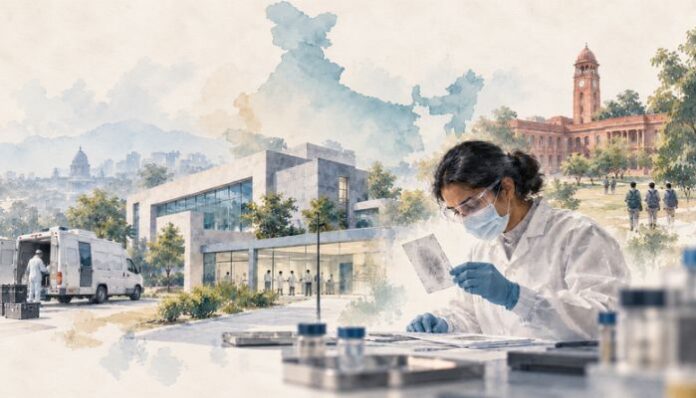
A bloodstain recovered from a murder scene, fingerprints found on a weapon, a mobile phone seized during an investigation or CCTV footage capturing a suspect’s movements can become crucial evidence in a criminal case. However, collecting evidence is only the beginning. Before it can help establish what happened, it must be properly preserved, scientifically examined and presented before a court.
India’s forensic investigation system involves police personnel, forensic scientists, specialised laboratories and judicial authorities. The journey of evidence from a crime scene to the courtroom involves several procedures, including collection, documentation, sealing, transportation, laboratory examination and maintaining the chain of custody. Any lapse in these processes can affect the evidentiary value of scientific findings.
Identifying people is another important function of forensic science. DNA profiling and fingerprint examination help investigators connect suspects with crime scenes, establish identities and identify unidentified bodies. Systems such as the National Automated Fingerprint Identification System (NAFIS) and DNA-based identification initiatives have expanded the tools available to Indian investigators, including in cases involving missing persons.
Criminal investigations have also changed with the widespread use of smartphones, messaging applications, digital payments and surveillance cameras. Digital forensic examination enables investigators to recover deleted information, examine call records, analyse CCTV footage and study electronic communications. Establishing the authenticity of digital evidence and linking it to an individual remain essential parts of the process.
To support these growing requirements, the government has undertaken measures to expand India’s forensic science infrastructure. The Rs 2,254.43 crore National Forensic Infrastructure Enhancement Scheme provides for nine National Forensic Sciences University campuses and seven Central Forensic Science Laboratories. Mobile forensic units, specialised training and provisions under the new criminal laws are also changing how scientific evidence is incorporated into investigations.
Together, these developments demonstrate how forensic science contributes to identifying victims, tracing suspects, examining physical and digital evidence and strengthening criminal investigations across India.
Read the complete series
Read the first article Crime scene to courtroom: How does India’s forensic science work? on Chapter One Magazine.
Read the second aticle How DNA and fingerprints help identify people in India on Chapter One Magazine.
Read the third article How investigators turn phones, chats and CCTV into evidence on Chapter One Magazine.
Read the fourth Building India’s forensic future: How new laboratories and universities are changing criminal investigations on Chapter One Magazine.


