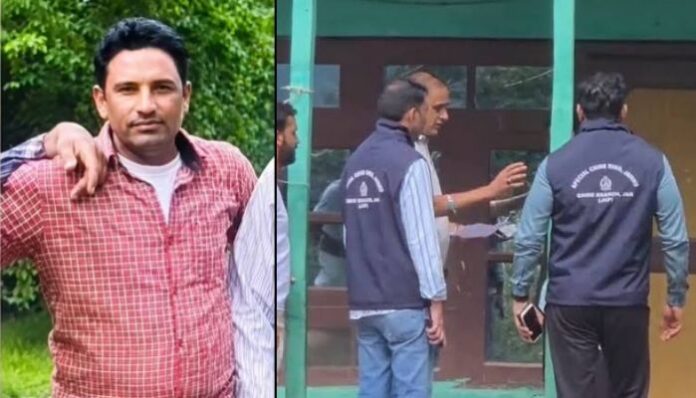
A society is inarguably in a deplorable state when outrage against a heinous crime is contingent on the identity of the victim and the perpetrator rather than the severity of the crime itself. The conspicuous silence of Kashmir and negligible outrage across India on the rape and murder of a 15-year-old tribal girl in the Chatroo area of Kishtwar by her government school’s teacher, Khalid Hussain, exemplifies this hypocrisy. The same Kashmir that burnt for over 45 days due to the fake 2009 Asiya-Neelofar ‘rape-murder’ case is demonstrating a profound moral decay and hypocrisy in the Kishtwar minor rape and murder case.
Kishtwar rape and murder case: The cover-up, social boycott threat against the victim’s family and complicit silence
In August 2026, a 15-year-old Muslim Gujjar schoolgirl in the Chatroo area of Kishtwar was allegedly raped repeatedly for over months by her teacher and in-charge headmaster at the Government Middle School, Khalid Hussain, resulting in pregnancy.
When the pregnancy was detected around 10th August at a local Public Health Centre, instead of mandatory reporting under the Protection of Children from Sexual Offences (POCSO) Act, 2012, it is alleged that the accused teacher, his brother Tariq, doctors, hospital staff, a brother-in-law, a pharmacy owner, and two local community figures hatched a conspiracy to cover up the matter and arrange an illegal abortion.
A junior staff member and two sanitary workers at the District Hospital Kishtwar were given money to aid the termination of the victim’s pregnancy.
On the 19th and 20th of August 2026, the 15-year-old victim’s age was falsely recorded as an adult on hospital registration slips, and illegal and unsafe methods were used inside and outside the hospital to terminate the minor’s advanced pregnancy.
However, as the victim’s health deteriorated, she was rushed in accused Khalid Hussain’s private vehicle to the Doda Government Medical College.
The minor girl died on 20th August during the botched procedure. Reports say that the victim was referred to GMC Jammu in view of her critical condition. However, the 15-year-old died on the way at Udhampur.
The police investigation revealed that Khalid Hussain’s vehicle, in which the victim was transported, was later washed to destroy evidence.
As the matter came to light, Khalid Hussain was removed from service, and the contracts of two accused sanitation workers at the Kishtwar district hospital were also terminated after their arrests.
Initially, a case was registered at the Chatroo Police Station.
What followed as a local protest and shutdown in the Chenab Valley. The case was transferred to the Special Crime Wing in Jammu.
Meanwhile, the police arrested over nine people, including Khalid Hussain and his brother.
Thereafter, Inspector General of Police, Crime, Sarah Rizvi, formed a special investigation team (SIT) led by Senior Superintendent of Police, Special Crime Wing, Jammu, Sanjay Kumar Parihar, immediately after the Crime Branch took over the probe.
During the initial probe by the Kishtwar Police SIT, DNA samples of the minor victim and the newborn, collected at District Hospital Kishtwar, were sent to Central Forensic Science Laboratory (CFSL) in Chandigarh for comparison with samples from the main accused and his co-accused brother.
In October 2026, the police filed a 1000+ page chargesheet against 15 accused persons, with teacher Khalid Hussain as the prime accused, relatives, doctors, hospital staff, community leader, etc.
All the accused have been booked under BNS, POCSO, SC/ST (Prevention of Atrocities) Act, and MTP Act, citing 143 witnesses.
“Two doctors and another accused have been booked under Section 21 read with Section 19 of the POCSO Act for failing to report the matter to the police despite having knowledge of the minor victim’s pregnancy,” the police said.
Meanwhile, the main accused remains in police custody.
The local police have stated that the deceased victim’s father was prevented from approaching the police. Not only this, but he was also subjected to immense pressure and intimidation.
Devastated by the death of his daughter, the victim’s father was also threatened with social boycott.
“A settlement deed or Razinama was prepared in a local meeting at the residence of one of the accused. The SIT has seized this document, and the expert opinion of Forensic Science Laboratory (FSL) Jammu has confirmed the authorship of the writing and the signatures on it,” a police spokesperson said.
While the mainstream political leaders across all parties have demanded a fair and speedy investigation into the matter, this disturbing case has somehow failed to shake the conscience of society at large.
However, nearly two decades ago, Jammu and Kashmir witnessed violent protests, intense political theatre, sustained agitation, and international media attention over the Asiya-Neelofar rape and murder case, which actually was not a rape and murder case at all.
The 2009 Asiya-Neelofar rape and murder hoax was concocted to exploit the accidental death of two women to target the Indian Army
On 30th May 2009, bodies of a 22-year-old Neelofar Jan and her 17-year-old sister-in-law, Asiya Jan, were found in the Rambi Ara stream near Shopian. Even before a proper investigation, allegations spread that both women were raped and murdered by Indian Army officers. The two women had, in reality, died after accidental drowning on 29th May 2009.
What triggered weeks-to-months-long intense protests and strikes across the Kashmir Valley, which attracted foreign media’s attention, was the postmortem reports. The postmortem reports by local doctors claimed that the deceased duo were raped and murdered.
At that time, the Hurriyat or the separatist groups, played the central role in protest mobilisation and intensified their ‘demands’ for breaking Kashmir away from India.
The death of Asiya and Neelofar back in 2009 had triggered violent protests led by Majlis-e-Mashwarrat. The situation could return to normal only after a Central Bureau of Investigation (CBI) probe found that the two sisters, Asiya and Neelofar, were neither raped nor murdered.
CBI, back in 2009, had filed a chargesheet against six doctors, two civilians, five lawyers and the brother of the victim for fabricating evidence. It was alleged that the lawyers had coerced two civilians to turn witnesses. The CBI has also rejected the Majlis’s claim of rape and murder, saying that the two women decided to cross the Rambi Ara river in Shopian as they were getting late. However, the two drowned in the river and died.
CBI produced statistics from the state irrigation department indicating that the Rambi Ara river recorded increased water discharge in that specific month in 2009.
In June 2023, the Jammu and Kashmir government terminated the services of two doctors Bilal Ahmad Dalal and Nighat Shaheen Chilloo who collaborated with Pakistan to falsify the postmortem reports of Asiya and Neelofar Jan.
The doctor duo intended to falsely implicate the Indian Army officials in murdering and raping the two girls. Dr Bilal Ahmad Dalal and Dr Nighat Shaheen Chilloo wanted to spread disaffection against the Indian armed forces.
It later emerged that the two teams of doctors who conducted the postmortem of the deceased girls had blatantly lied in their reports. The first team had claimed that Asiya died of cardiovascular arrest and Neelofar of neurogenic shock. The second team of doctors from Pulwama claimed sexual assault on both the girls.
The CBI investigation questioned the entire operation, claiming that doctors had assembled a piece of the heart and labelled it as lung components. Furthermore, the second team of doctors tampered with the vaginal swab samples. It didn’t belong to one of the women. Dr Nighat Shaheen failed to inform the CBI of where she obtained the samples.
In addition, the DNA tests on 47 officials whose samples were gathered came back negative.
In 2010, India Today had published a report wherein they claimed to have accessed the call recordings of the doctors involved in the postmortem of Asiya and her sister-in-law Neelofar. According to the report, Dr Nighat Shaheen, who was a part of the second team of doctors, “had concluded that the girls were raped without even examining their vaginas.”
Dr Nighat Shaheen and the other doctors had falsely stated in the report that Asiya’s hymen was ruptured.
However, the whole rape and murder hoax fell apart when the doctors of AIIMS conducted the autopsy and concluded that Asiya’s hymen was intact.
For nearly 45 days, Islamists and Kashmiri separatists led by the Hurriyat pushed the narrative that the Indian Army, the CRPF, the police, and “Delhi” had committed a horrific crime and thus were not worthy of their sympathy, let alone trust.
The Indian and foreign Islamo-leftist media presented the Asiya and Neelofar death case as a quintessential example of how Indian security forces ‘torment’ Kashmiris.
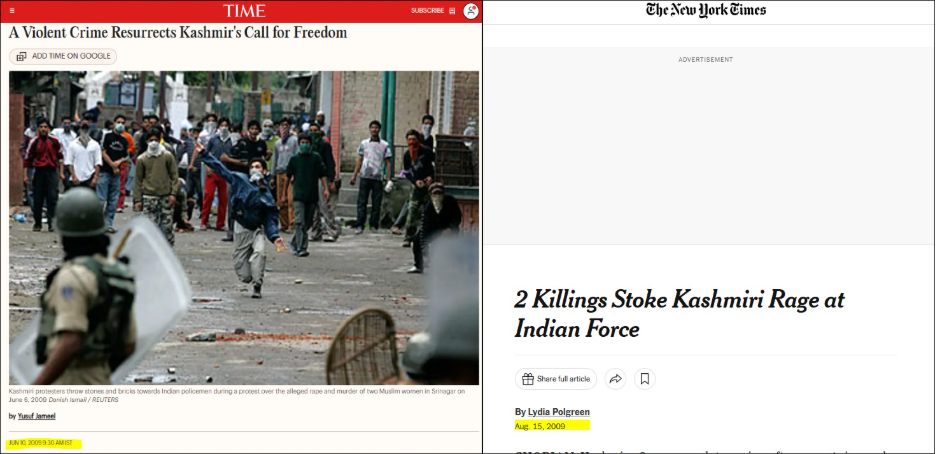
While the Kishtwar rape and murder triggered localised protests, political statements and standard media reporting, nothing on the scale of mobilisation and outrage, as well as national and international media coverage, was seen during the 2009 Asiya-Neelofar case.
What explains the selective silence of the same coterie on Kishtwar rape and murder, which agitated for weeks over a hoax
It is nothing but the narrative utility that explains the selective silence not only of the same groups that went berserk in 2009 over a fake rape and murder.
The 2009 Asiya-Neelofar case fit in the pre-existing ‘Indian armed forces rape and kill Kashmiri women’ apocrypha.
Blaming the accidental death of two young women on Indian forces, giving it a more provocative spin by alleging rape by fabricating medical evidence, weaponised the case for spreading anti-India hate, separatist mobilisation, and inviting external pressure on the Indian State.
Remember the nationwide outrage over the 2017 Kathua rape and murder case? From locals, human rights bodies, intellectuals, Bollywood celebrities to international media, all were collectively outraged; several protests happened and social was weaponised by Islamo-leftists to highlight the religious identity of the victim and the perpetrators. The whole placard gang had given a religious colour to the horrific crime.
However, the Kishtwar rape and murder case does not fit these templates. The accused perpetrator is a local Muslim; the victim is a tribal Muslim girl from the Jammu region, while the cover-up involved local doctors and hospital staff rather than security personnel.
In fact, various segments of that society, doctors, teachers, religious clerics, relatives, and even political leadership, all played a part in suppressing the matter.
Essentially, the society collectively attempted to bury a genuine case of rape, and in the process of this suppression, the 15-year-old victim lost her life.
However, beyond the performative outrage and a few social media posts, even a fatal cover-up involving teacher, medical, and community actors could not stir the collective conscience of those who claim to be the ‘true protectors’ and ‘champions’ of Kashmiris.
This deliberate silence, though disturbing, is not surprising. Back in May 2019, during the widespread protests in Jammu and Kashmir over the rape of a three-year-old girl by one Tahir Ahmad Mir, the Shia-Sunni Coordination Committee (SSCC) called for an immediate end to the protests to prevent Shia-Sunni tensions. They advocated an end to the protests, arguing that it may turn into communal tension as the victim and accused belong to two different sects of Islam.
In fact, for years, it remained an open secret that during the local Islamic terrorism in the region, women were frequently sexually abused by the Islamic terrorists in the valley.
There is a prevalent mindset, perhaps, that crimes not how horrific they are, deserve maximum outrage only when it is convenient to target the perpetrators. But when the perpetrator is one of their ‘own’, he should get punishment, but there is no need to make a big issue out of it.
Apparently, it is one of the reasons why the death and dignity of two Kashmiri women, Asiya and Neelofar, were turned into a tool for serving ideological-political means, but now the times have changed, and the degeneracy committed in 2009 can no longer be replicated; thus, silence is the only choice.
It is understandable that the groups that enjoyed local power and influence in 2009 are no longer influential to the same level; neither can separatist sentiments be reignited, as the days of Azadi slogans and stone-pelting are gone. There is undoubtedly a deliberate, hypocritical and calculated silence.
Apparently, the identity of the accused perpetrators and the victim(s) govern the extent and intensity of outrage, political-ideological utility, and not the severity of the crime itself.