

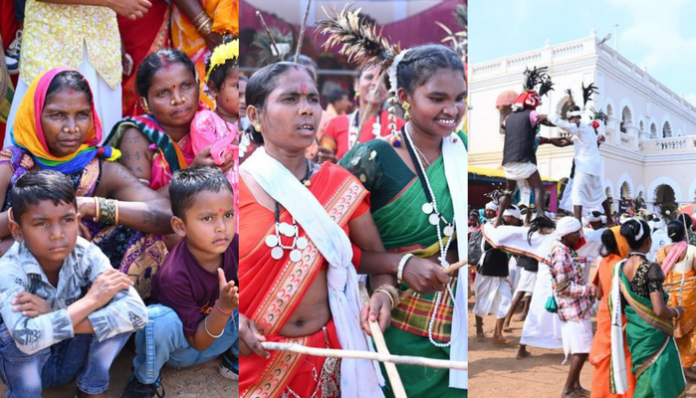
Chhattisgarh’s Bastar region is witnessing a grand 75-day-long Dussehra celebration. The festival commenced with Pat Jatra on August 12, 2026, and will formally conclude on October 27, 2026, with the farewell of Maa Danteshwari. President Droupadi Murmu is on a 2-day visit to the region to take part in the celebration.
#WATCH | Chhattisgarh | President Droupadi Murmu attends a public event and exhibition dedicated to Bastar Dussehra at Jagdalpur https://t.co/w7ALMgC4Bg
— ANI (@ANI) October 23, 2026
Even though the festival is called Dussehra, the celebration is not centred on the defeat of Ravana by Lord Ram, unlike popular Dussehra festivities in most of India. Bastar Dussehra is organised in reverence for Danteshwari Devi, the presiding deity of Bastar, and the Kuldevi of the Bastar royal family.
#WATCH | Jagdalpur, Chhattisgarh | Deities from around 50 villages, once heavily affected by Naxalism, participated in the world-famous Bastar Dussehra for the first time following the end of Naxalism in the region. (22.10) https://t.co/YseyxewSA1
— ANI (@ANI) October 22, 2026
Bastar Dussehra is one of the oldest festivals of the country with a history of over six centuries. It was started by the Kakatiya dynasty and has been preserved and promoted by the local tribal communities ever since. The festival is deeply linked to the spiritual beliefs of the tribes of Bastar.
A festival marked by diverse rituals
The festival is marked by a series of intricate rituals like Pat Jatra, Ratha Yatra, Kachan Gadi, and Muria (Muriya) Darbar, vibrant processions, and cultural performances. The core royal and tribal rituals of the festival take place every year in Jagdalpur, where tribals from nearby villages gather to attend the festivities.
Organised by the royal family of Bastar, the festival begins on Hariyali Amavasya in the month of Shravan, with Pat Jatra, which is a ceremonial worship of the first sacred timber. Villages across the region send their deities, priests, and craftsmen to take part in it. Over the days, the festival moves through a sequence of rituals, including the building of the great chariot, processions through Jagdalpur, the nighttime rites of the goddess, and the gathering of village deities.
In the closing days of the festival, a distinctive ceremony of Muria Darbar is organised, which marks the conclusion of the festival. The ceremony is held in Jagdalpur after the great chariot processions and the main Dussehra rituals have been completed.
Traditionally, the ceremony offered a platform for representatives of different communities, especially from the Muria tribe and Manjhi-Mukhiyas communities, to present their problems and community-related matters before the King. Even though the darbar system no longer exists in the modern democratic setup, the ceremony represents Bastar’s important traditional social system and highlights its social dialogue and community participation.
While the festival has been celebrated continuously for centuries, the festivities were dimmed by rampant Naxal activities in the region. Villages located in deeply affected areas such as Sukma, Bijapur, and Narayanpur were cut off from the celebrations due to Naxal violence. For decades, the villages that sustain this festival lay in the shadow of Maoist violence, but this year, the celebrations attracted a larger number of tourists and visitors to the region, which was long infested by red terror.
How the Bastar Dussehra festivities are different this year
Bastar Dussehra this year witnessed the participation of deities from around 50 villages in formerly Naxal-affected areas. This was unprecedented, as villages from the formerly Naxal-infested region participated for the first time in the historic festival since the region was declared to be free from Naxalism by the central government on March 31, 2026.
The tribals of the region, which was besieged by the Naxal menace for decades, are finally getting to lead normal lives, free from the shadows of red terror. This normalcy, which was once impossible to imagine in the region, has become a reality because of the Modi government’s declared mission for total extermination of Naxal terror in the country. The government and the security forces together undertook the arduous task of uprooting the Maoist ideology from the region in pursuance of the government’s zero-tolerance policy towards left-wing terrorism.
During last year’s Bastar Dussehra celebrations in Jagdalpur, Union Home Minister Amit Shah reiterated March 31, 2026, as the firm deadline to eradicate Naxalism from the region and the country. He urged local tribals associated with the Maoist ideology to give up arms and surrender to join the mainstream. To encourage tribals to renounce insurgency, the state government promised ₹1 crore in aid to each village declared Naxal-free. The government also formulated a policy for the rehabilitation of surrendered Maoists.
The end of Naxalism
For the complete eradication of left-wing terror from the region, the government adopted a multi-pronged strategy combining aggressive military operations, enhanced coordination between Central and State forces, and development efforts to address the root causes of Naxalism. While on one hand the government offered Maoist cadres an opportunity to bury their past and lead normal lives, on the other hand the security forces launched an offensive in the deepest Maoist strongholds.
In January 2024, the government launched Operation Kagar as part of its intensified efforts to deal a death blow to the Naxal menace. Under this operation, around 1 lakh paramilitary troops, including the Central Reserve Police Force (CRPF), its elite CoBRA units, District Reserve Guards DRG), and state police, were deployed in the left-wing terrorism affected areas. The security personnel were equipped with modern technology like drones for information gathering, AI for intelligence gathering, and satellite imagery, among others.
Under the operation, the security forces neutralised Maoist cadres along with the entire remaining Maoist leadership. Top Maoist leaders like the General Secretary of the CPI (Maoist) and head of the Central Military Commission, Nambala Keshava Rao alias Basavaraju, and Central Committee member, commander of the People’s Guerrilla Liberation Army (PGLA) Battalion 1, and secretary of the Dandakaranya Special Zonal Committee, Madvi Hidma, along with several others, were eliminated during the operation, crippling the Maoist organisations. During the operation, security forces carried out massive, intelligence-driven operations in Chhattisgarh, Jharkhand, Madhya Pradesh, Maharashtra, Andhra Pradesh, and Telangana, encompassing the entire Naxal-infected Dandakaranya region.
To further sniff life out of the Maoist cadres, the government launched a crackdown on all Maoist financial routes, which sustained their terror activities, starving them of funds as well as motivation. Raids and probes by government agencies led to the seizure of assets worth crores possessed by Maoist cadres. Over the last few years, strong political will combined with the on-the-ground efforts of the security forces has yielded the desired results. Hundreds of Maoist cadres laid down arms while several hundred were killed during the security forces’ operations.
Insurgency to normalcy
As a result of the sustained efforts of the government and the security forces, the tribals of the Naxal-affected areas are now able to breathe free air. In August this year, a group of women formerly associated with the Maoist ideology walked the ramp at a tribal fashion show in Raipur, Chhattisgarh.
The women walked the runway in traditional handloom outfits at the event, organised to mark National Handloom Day. The event marked a major leap for these women who once walked in the Naxal-affected forests, carrying weapons. The eradication of the Maoist ideology gave them an opportunity to join mainstream society and lead a life they could not have even imagined under the shadows of Naxalism.
The shift is visible in various aspects of the lives of people living in formerly Naxal-affected regions. In April this year, a remote village in the Narayanpur district received tap water connections for the first time. The region was previously designated as a “highly sensitive” zone because of persistent Naxal threats. The Maoist ideology prevented any form of development from reaching tribal villages, fueling resentment against the government. However, after the end of red terror, development projects of both the centre and the state are being implemented across the region.


