

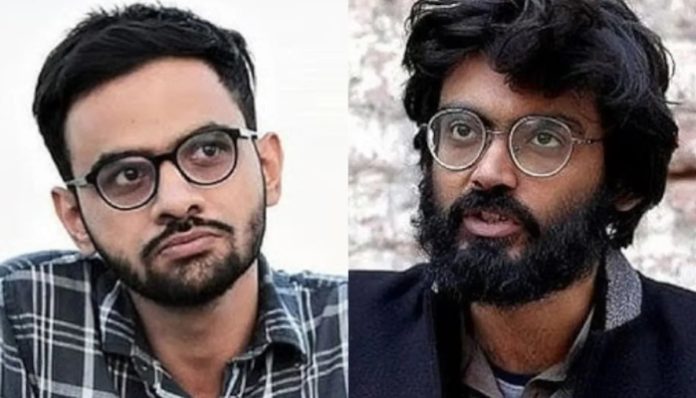
On 30th September (Wednesday), Umar Khalid and Sharjeel Imam were denied bail by the Delhi High Court in the anti-Hindu Delhi riots conspiracy case. The verdict was delivered by a Division Bench consisting of Justices Dinesh Bhatt and Prathiba M. Singh. The High Court has rejected the bail plea of the Unlawful Activities Prevention Act (UAPA) accused Umar for the third time and Sharjeel for the second time.
The court highlighted that it could not change the Supreme Court’s ruling in the Gulfisha Fatima case, which stipulated that Umar and Sharjeel could request bail only after the examination of the protected witness was completed and after a year had passed following the order. The bench noted, “This court is bound by judicial discipline,” remarking that the restrictions placed on them cannot be altered.
The court outlined that “they were given liberty to renew their prayer for grant of bail before the jurisdictional court, upon either of the following circumstances taking place: A) Completion of examination of the protected witnesses relied upon by the prosecution; or B) Expiry of a period of one year from the date of this order, i.e., till 5th January 2026, whichever is earlier. Despite this specific observation, the present two appellants have moved applications for grant of bail.”
It was further stated that the duo had different roles than Tasleem Ahmed and Khalid Saifi. As a result, they cannot seek parity by relying on the interim bail order for the latter. The bench pronounced, “The role of Tasleem Ahmed and Khalid Saifi is different from that of Umar Khalid and Sharjeel Imam, and therefore parity cannot be sought.”
It mentioned that the court in another case arising out of the same FIR (First Information Report) had reviewed the involvement of Athar Khan and had rejected his bail. It firmly conveyed, “In view of the above discussion and the overall facts of the case, specifically the conditions imposed qua the appellants in the Gulfisha case, this court cannot find fault with the decision of the trial court. Accordingly, the appeals are dismissed.”
It was also observed that neither temporary nor final bail was granted, citing the Supreme Court’s judgement in the Athar Khan case. The bench pointed out that his role was previously analysed and contrasted with co-accused Umar Khalid and Sharjeel Imam while rejecting bail. It also asked how the prosecution could be held exclusively responsible for the delay in trial processes when the accused filed several applications.
Umar and Sharjeel had challenged the rejection of their petition for release on bail. The trial court’s 4th July verdict refusing them bail was appealed under Section 21 of the National Investigation Agency Act. The trial court mentioned that it had to abide by the Supreme Court’s decision not to grant bail to either of them.
The Supreme Court had granted bail to Gulfisha Fatima, Meera Haider, Shifa Ur Rehman, Mohd. Saleem Khan and Shadab Ahmed on 5th January but denied bail to Umar and Sharjeel. It stated that the prosecution material discloses a prima facie case against Umar and Sharjeel. Thus, the statutory threshold under Section 43D(5) of the UAPA was attracted. The bench held that the stage of proceedings did not justify granting bail to them.
The larger conspiracy case arises from the anti-Hindu Delhi Riots of 2020, in which 53 people died, and hundreds were injured. An FIR was registered by the Special Cell of the Delhi Police, pointing to a larger conspiracy that was hatched to engineer large-scale riots in the name of the anti-Citizenship Amendment Act (CAA) protests
Umar Khalid was arrested in September 2020 and has been in custody since then. Sharjeel Imam was booked in several FIRs across states on sedition and UAPA charges. He secured bail in other cases but remained in jail in the larger conspiracy matter.
