

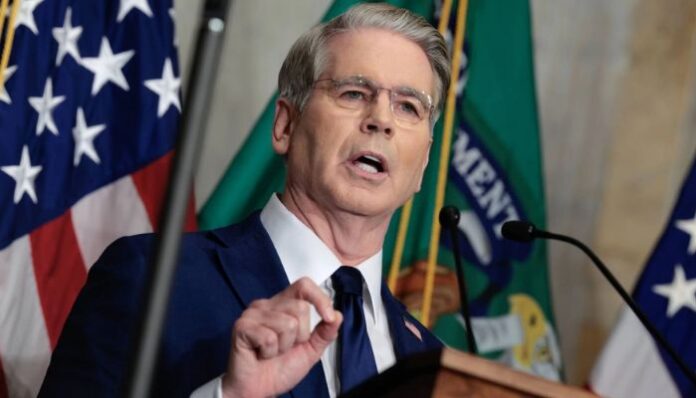
US Treasury Secretary Scott Bessent has criticised European countries for refusing to join the United States in imposing tariffs on India and China over their purchases of Russian oil. He questioned why Washington should bear the economic cost of pressuring Moscow when its European allies were unwilling to take similar steps.
US Treasury Secretary Bessent says Europe "refused" to put secondary tariffs on India, China for buying Russian oil at Washington’s request Vdo csty: NBC News https://t.co/7ZLdq1e7zX
— Sidhant Sibal (@sidhant) October 18, 2026
In an interview with NBC News Meet the Press on Sunday, Bessent said the Trump administration had approached European allies in the spring to seek joint action against countries buying Russian energy. However, he said European nations turned down the proposal.
“We have asked, in the spring, I asked our European allies to join us in putting secondary tariffs on China, on India. They refused. So why should the US bear the burden?” Bessent said.
Trump wants Russia-Ukraine war to end, says Bessent
Bessent said US President Donald Trump wanted to stop the fighting in Ukraine. He added that the proposed sanctions legislation would give the administration time to study the situation before deciding on further action against Russia and countries buying its energy.
“President Trump has made it clear he wants the killing to stop,” Bessent said, referring to the Graham bill, which gives the president 60 days to assess the situation.
Trump had temporarily waived certain sanctions and tariff provisions under the Lindsey O. Graham Sanctioning Russia and Iran Act of 2026. The move allows the administration to examine the possible economic impact before deciding whether to implement the proposed measures.
The legislation would allow the US to impose tariffs of up to 100% on goods imported from the five largest buyers of Russian-origin crude oil or natural gas, including India and China.
Bessent questions Europe’s Russian energy purchases
Bessent also criticised European countries for continuing to buy Russian energy while supporting Ukraine in its war against Russia.
He pointed to shipments from Russia’s Yamal facility, saying that 140 cargoes left the facility during the first six months of the year, with 136 going to European countries, including Belgium, Spain, France and the Netherlands. According to Bessent, these shipments were worth more than $8 billion.
He argued that such purchases continued to provide Russia with significant revenue. His comments highlight Washington’s demand for a coordinated effort among its allies to increase economic pressure on Moscow.
Bessent also indicated that the US could approach European partners again to seek their support for tariffs and other economic measures against countries importing Russian energy.
Rubio calls India an important ally
Meanwhile, US Secretary of State Marco Rubio described India as an important ally and said its energy needs must be considered before Washington takes further action.
Speaking on Saturday, Rubio explained that the proposed measures against Russia also included tariffs on countries such as India. He said the administration wanted to understand how these steps could affect both the US economy and the global economy.
Rubio also pointed out that India had diversified its energy sources but could not immediately stop buying Russian energy. His remarks suggest that Washington is weighing its efforts to pressure Russia against the economic impact on its partners.
The issue comes amid continued pressure on global energy supplies due to the Russia-Ukraine war and rising tensions in the Middle East.
Trump’s 50% tariffs on Indian goods over Russian oil
In August 2025, the Trump administration imposed a 25% reciprocal tariff on Indian goods and later added another 25% duty as a penalty for India’s continued purchases of Russian oil. This took the total tariffs on some Indian products to 50%, putting significant strain on trade relations between India and the US. Washington said the additional duty was intended to pressure India over its Russian energy imports following the start of the Russia-Ukraine war.
Separately, the Office of the United States Trade Representative (USTR) proposed additional Section 301 tariffs, including a rate of 12.5%, over India’s import restrictions on goods made using forced labour. The US also raised wider concerns about generic pharmaceutical imports from India.
It must be recalled that after imposing 50 per cent tariffs on India, the Trump administration had unleashed its attack dogs, Peter Navarro, Howard Lutnick and Scott Bessent, to vilify New Delhi for buying Russian oil, even as China remained the top buyer of Russian oil.
