

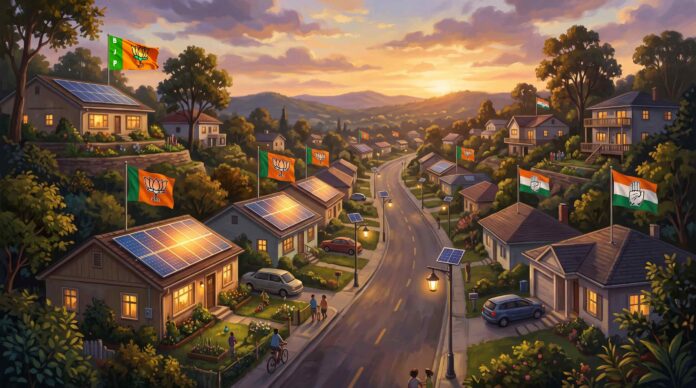
India’s renewable energy progress has been remarkable, yet the adoption of small-scale rooftop solar faces significant hurdles despite the launch of the PM Surya Ghar: Muft Bijli Yojana in February 2024. The central scheme aims to solarise one crore households by March 2027 and add 30 Gigawatts (GW) to the national grid. However, achieving this target appears increasingly difficult due to a sharp political and administrative divide.
The initiative is designed to transform households into independent power producers, offering up to ₹78,000 in central subsidies for a 3 kW solar system. The scheme relies on bidirectional net metering, which tracks surplus power sent to the grid and adjusts consumer billing accordingly, effectively turning the massive state grid into a free battery.
A look at the data highlights an undeniable administrative divergence between ruling dispensations in various states. In NDA-ruled states, administrative alignment with the central mandate is unequivocal. Gujarat remains the undisputed national leader by enabling rapid DISCOM approvals and dense vendor networks, while Uttar Pradesh has recorded over 8.58 lakh installations yielding 2.88 GW of capacity. Even geographically complex states like Assam have aggressively outpaced larger states through proactive DISCOM integration. Crucially, NDA states provide generous top-up subsidies stacked onto central funds—such as up to ₹30,000 in Uttar Pradesh, ₹45,000 in Assam, and additional support in Gujarat, Rajasthan, and Uttarakhand. These incentives effectively bridge upfront capital costs to build permanent, 25-year power-generating household assets without burdening future state budgets.
Conversely, non-NDA-ruled states have actively or passively derailed adoption through chronic administrative bottlenecks and bureaucratic apathy. In West Bengal, the previous administration stalled the central scheme in favour of its own parallel Aloshree initiative, creating confusing procedural layers. In Tamil Nadu, thousands of consumer applications languish amid severe net-metering delays, portal glitches, and systemic staffing gaps at the state DISCOM.
Compounding these administrative roadblocks is the aggressive rollout of state-sponsored electoral freebies in states like Karnataka, Punjab, and Telangana. Under Karnataka’s Gruha Jyoti scheme, which provides up to 200 units of free grid electricity monthly, consumers have zero economic rationale to invest ₹50,000 to ₹80,000 out-of-pocket for solar panels. State leaders have openly acknowledged that free grid power disincentivises solar uptake. Subsidising recurring consumption directly drains state exchequers and deepens DISCOM insolvency without fixing core grid weaknesses. For India to achieve 500 GW of non-fossil capacity by 2030, the policy priority must shift from populist consumption subsidies to durable, decentralised power generation.
Read the full article on Chapter 1 Magazine.


