

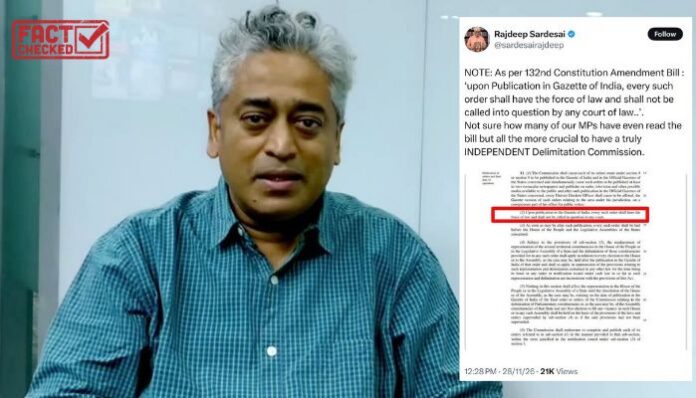
A recent social media post by pseudo-secular journalist Rajdeep Sardesai regarding the Delimitation Commission has sparked a debate online. Critics argue that it demonstrates a misunderstanding of the Indian Constitution. The post in question highlights a specific rule about the finality of delimitation orders. However, a fact check reveals that the provision Sardesai highlighted is not a novel or questionable inclusion, but rather a long-standing constitutional mandate enshrined in Article 329(a) of the Constitution of India.
The post and the provision
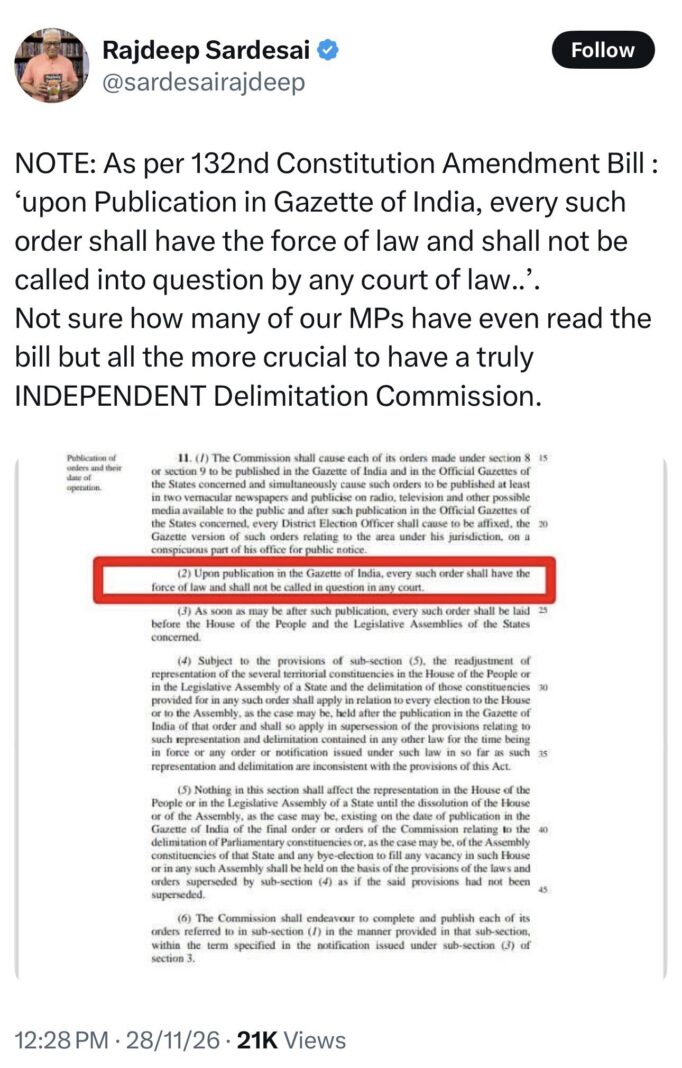
In his post, Sardesai shared a note stating that, as per the Delimitation Commission rules. He wrote that once an order is published in the Gazette of India, it “shall have the force of law and shall not be called into question by any court of law.” He went on to comment on the “trust deficit in institutions” and the need for a “truly INDEPENDENT Delimitation Commission”.
Sardesai presented this as a questionable or novel legal shield for the government’s delimitation exercise. This is where the factual check becomes crucial.
Fact Check: Article 329(a) of the Constitution
The rule Sardesai quoted is a direct reflection of Article 329(a) of the Constitution of India. This article explicitly bars the judiciary from interfering in electoral matters related to delimitation.
The text of Article 329(a) reads: “the validity of any law relating to the delimitation of constituencies or the allotment of seats to such constituencies, made or purporting to be made under article 327 or article 328, shall not be called in question in any court”.
This means that any law made by Parliament (under Article 327) or a State Legislature (under Article 328) concerning the delimitation of constituencies is protected from judicial review. This is not a new rule or a specific clause of the current Delimitation Bill; it is a foundational constitutional provision. Its purpose is to ensure that electoral boundaries, once set, are not subject to endless litigation, which could disrupt the democratic process.
The Supreme Court of India has consistently upheld this bar. Legal analyses note that Article 329(a), read with the Delimitation Act, imposes an “almost absolute bar on judicial scrutiny,” a position firmly established in cases like Meghraj Kothari v. Delimitation Commission.
Context of the current Delimitation Bill
The controversy unfolds against the backdrop of the government’s renewed push for delimitation. A revised Delimitation Bill was introduced in the Lok Sabha in late November 2026, aiming to increase the number of Lok Sabha seats by 50 per cent while freezing the share of states until 2051. An earlier version of the bill, the Constitution (131st Amendment) Bill, had failed to secure the required two-thirds majority in April 2026.
The government has argued that an independent delimitation commission will oversee the process. However, opposition parties have expressed concerns, which is a separate political debate from the constitutional facts.
The factual position is clear: the provision Rajdeep Sardesai highlighted that delimitation orders cannot be questioned in any court. It is not a new or suspect clause. It is the direct result of Article 329(a) of the Constitution of India, a provision that has been part of India’s constitutional framework since 1950.
The factual check confirms that the constitutional bar on judicial review of delimitation laws is a mandated feature of India’s electoral architecture, not an anomaly. Therefore, the criticism that the post ignores the Constitution’s own provisions appears to be legally sound.
