

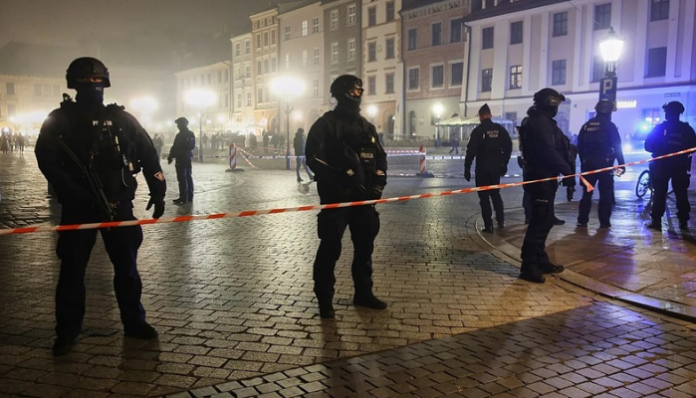
On Saturday, 7 November, a gunman killed six people in a rampage through Krakow’s historic main square. Police shot and wounded the attacker, authorities said. Hours later, the discovery of three more bodies at the suspect’s home brought the total death toll to nine, deepening a tragedy that has stunned Poland and prompted its prime minister to label the Krakow shooting an act of terrorism.
The violence erupted shortly before 15:00 local time (14:00 GMT) in Main Market Square, a UNESCO-listed tourist hub in Poland’s second-largest city. Police said the attacker drove a vehicle into the crowded square and fired randomly at pedestrians, shopfronts, and a tram with a military-grade weapon.
Footage showed people fleeing in panic as gunfire echoed through the square, leaving behind overturned tables and scattered belongings. The attack lasted approximately three minutes. Armed police pursued the suspect’s car until it crashed, then engaged him in a firefight. The gunman, dressed in military-style fatigues and a bulletproof vest, was shot and subdued. Two police officers were wounded, one critically. Prime Minister Donald Tusk later identified them as Senior Constable Jakub Kulik and Senior Constable Artur Morański, calling them “true heroes” who “saved many lives”.
Four women and two men were killed in the square. Officials confirmed that three of the victims were Polish, one was British, and two have not yet been publicly identified. Five out of 16 people injured were foreign nationals from Austria, Germany, Portugal, Russia, and Britain. The three additional bodies found at the suspect’s home in Ostrowiec Świętokrzyski, a city roughly 150 kilometres (93 miles) northeast of Krakow, are believed to be the suspect’s immediate family members. Tusk said there were “strong indications” that the victims, two women and one man, were his close relatives, describing the discovery as “the next acts of this tragedy”.
Polish Prime Minister described the deadly shooting in Kraków, which killed six people and wounded 15, as an act of “terrorism.” Authorities later discovered three additional bodies at the suspect’s residence, thought to be members of his family. https://t.co/iwdT8eTLLQ
— GeoTechWar (@geotechwar) November 8, 2026
The attacker has been identified as a 25-year-old Polish man. Authorities have not officially released his name. The suspect was equipped with military-style weapons and attire, but the government said he was not a member of the Polish armed forces. Additional weapons and ammunition were found in his vehicle. He remains in hospital in serious condition after undergoing surgery. Police have confirmed he acted alone and that there is no continuing threat to the public. Tusk vowed that any “possible supporters of the perpetrator” would be detained and appealed to the public for information.
Tusk described the attack as “terrorism,” saying: “Until now in Poland we haven’t had such drastic cases of terrorism… that’s what we have to call this cruel attack on people’s lives here in Krakow”. Poland’s defence minister, Władysław Kosiniak-Kamysz, also described the shooting as an “act of terror” against the people of Krakow.
A massive armed police presence was deployed across Krakow on Saturday evening, and security measures were ramped up in the capital, Warsaw, and elsewhere. A period of mourning has been declared in Krakow until Wednesday, 11 November. Mayor Łukasz Gibała, announcing the mourning period, said: “The square will belong to us again,” while insisting the city would remain open to visitors.
World leaders sent messages of solidarity to Poland. European Commission President Ursula von der Leyen expressed her condolences to the victims’ families, writing that “Europe stands with Poland and expresses its solidarity”. Italian Prime Minister Giorgia Meloni condemned a “cowardly and unacceptable act of violence,” while French President Emmanuel Macron said his thoughts were with Poland, the victims, and their families.
German Chancellor Friedrich Merz said Germany stood by Poland’s side as a friend and partner in these difficult times, and Ukrainian President Volodymyr Zelensky described the attack as a shocking crime. The US ambassador to Poland, Tom Rose, characterised the shooting as a “savage and murderous attack”.
Mass shootings are rare in Poland. The attack has shocked the nation and raised urgent questions about extremism and the availability of military-grade weaponry, as investigators continue to search the suspect’s home and examine his background and digital footprint.
