

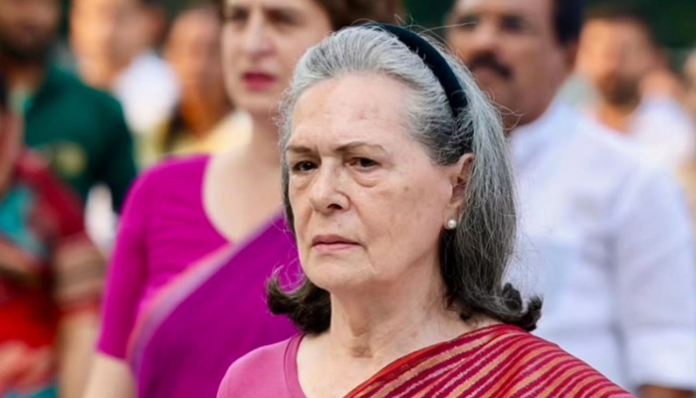
Congress Parliamentary Party chairperson Sonia Gandhi said that she broke down in tears while watching the demolition of the Babri Masjid on television in 1992, prompting a sharp backlash from the Bharatiya Janata Party (BJP), which alleged that the statement proves “Babur remains in the Congress’s heart”.
In an interview with The Guardian ahead of the launch of her memoir, Belonging: A Journey of Love, Gandhi recalled the events of 6 December, 1992, stating she cried as she witnessed the mosque being razed. She said the incident made her realise that India faced a “long battle” to preserve its secular character, and acknowledged that the Congress had, in some ways, contributed to the rise of the BJP and its “hardline Hindutva politics”.
“I think we have been too complacent in many ways. There was a laissez-faire kind of an attitude,” Gandhi was quoted as saying in the interview.
Reacting sharply to her remarks, BJP spokesperson Sudhanshu Trivedi told reporters in Delhi that the statement exposed the Congress’s true allegiance. “This shows that Babar was in the heart of the Congress party back then, and he remains in its heart even today,” Trivedi said.
Trivedi said that the Congress has now narrowed its scope to “Babar Raj,” moving away from Mahatma Gandhi’s concept of “Ram Rajya”. He further claimed that the remarks demonstrate that the Congress is a party with “two faces” that “aligns itself with radicalised elements among Muslims”.
The BJP leader also questioned the factual basis of Gandhi’s claim that she watched the demolition on television. He pointed out that Doordarshan did not broadcast continuous live coverage of the event in 1992, and asked when and where Gandhi had watched the footage, noting that the BBC World Service had aired only limited video and photographs in the days that followed. Trivedi also cited historical visits by three generations of the Gandhi family to Babur’s tomb—Jawaharlal Nehru in 1959, Indira Gandhi in 1968, and Rahul Gandhi along with Manmohan Singh in 2005—to allege that the party’s affinity for the Mughal ruler was long-standing.
The Batla House Encounter: ‘Cried for Terrorists’
The BJP’s attack also revived a long-standing political controversy surrounding Gandhi’s alleged reaction to the 2008 Batla House encounter. Trivedi, while reacting to the Babri remarks, accused Gandhi of “shedding tears for those accused in the Batla House encounter,” linking it to what he described as the Congress’s “true underlying mindset”.
The Batla House encounter took place on 19 September 2008. It saw the Delhi Police raid a flat in South Delhi to arrest Indian Mujahideen terrorists involved in the 13 September serial blasts. Two suspected terrorists and Delhi Police Inspector Mohan Chand Sharma were killed in the operation.
In 2019, then-BJP president Amit Shah said, “Sonia Gandhi had shed tears for the terrorists killed there. However, she did not cry for the police officer who lost his life in the incident. The Congress must answer this”. In 2024, BJP president J.P. Nadda repeated the charge, stating, “During the Batla encounter, terrorists were killed, and their (Congress) leaders said that Sonia Gandhi cried. She cried for terrorists”.
According to the statements of Congress leader Salman Khurshid, who in 2012 said that when Gandhi was shown images of the encounter, she “wept bitterly”. The BJP has repeatedly said the Congress is pursuing “vote bank politics” and is soft on terrorism.
With Gandhi’s latest memoir bringing the Babri chapter back into public discourse, the BJP has seized the opportunity to consolidate its narrative, conflating her expression of grief over the mosque’s demolition with her alleged grief over the killing of terrorists to portray the Congress as a party that has consistently sympathised with forces opposed to the nation’s cultural and security interests.
