

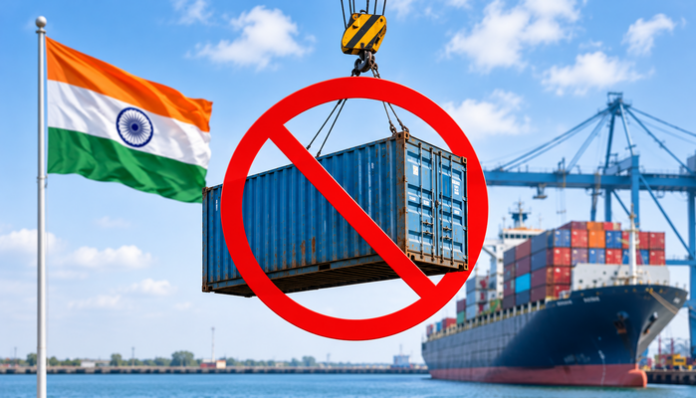
The Centre has modified the policy on exporting a specified category of battery waste, including lithium-ion battery black mass. The Directorate General of Foreign Trade (DGFT) issued a notification dated November 10, 2026, announcing the amendment to the “Export Policy of Waste and Scrap of Primary Cells, Primary Batteries and Electric Accumulators (Lithium-Ion Battery Black Mass)”.
Under the notification, the export policy for “waste and scrap of primary cells, primary batteries and electric accumulators; spent primary cells, spent primary batteries and spent electric accumulators – unsorted and not containing lead, cadmium or mercury” (Lithium-Ion Battery Black Mass) is changed from “free” to “prohibited”.
#JustIn | #Govt Bans Export Of Battery Waste, Scrap & #Lithium-Ion Battery Black Mass With Immediate Effect https://t.co/TC8UApjUFo
— CNBC-TV18 (@CNBCTV18Live) November 11, 2026
The amendment is applicable with immediate effect and is applicable only to the specified category of battery waste. This does not impose an all-out ban on the export of all kinds of battery waste. Under the unamended policy, the export of the specified category of battery waste and scrap was allowed under the ‘free’ category.
The change aligns with the government’s aim to boost the country’s battery recycling capacity and secure supplies of critical minerals. Earlier in October, the government reportedly highlighted India’s limited capacity to process black mass and extract these minerals. The government said that some of the battery waste was being exported without its valuable minerals being recovered.
To address this problem, the government is making efforts to expand domestic capacity to recover such materials from spent batteries and electronic waste through its ₹1,500-crore National Critical Mineral Mission for critical mineral recycling, which was launched in September this year.
What is Lithium-Ion Battery Black Mass?
Black mass is a dark, powdery substance inside a lithium-ion battery, which is a type of rechargeable battery that is now widely used in everyday devices like mobile phones and electric vehicles. Black mass contains a valuable mix of materials, including materials such as lithium, cobalt and nickel, that can be recovered, refined, and reused for the production of new batteries.
It is recovered during the shredding of used lithium-ion batteries, and its useful components are then utilised for making new batteries. Black mass has become valuable owing to the scarcity and increasing demand of metals found in it. Besides, mining these scarce minerals is a costly, slow, and environmentally intensive process compared to extracting them from Black mass and reusing them, which is a faster, cleaner, and more cost-effective process.
