

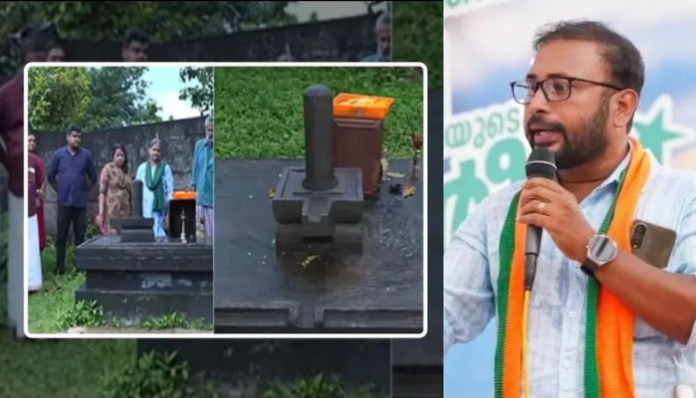
The desecration of an ancient Hindu temple in Kerala’s Thiruvananthapuram district with the words ‘ISIS’ and ‘786’ has triggered a major political row after the state police registered a non-bailable criminal case not against the muslim vandals, but against Yuvraj Gokul, a BJP leader who publicly questioned the incident. The development has raised serious concerns over selective policing, freedom of expression, and the protection of places of worship under the Congress-ruled UDF government.
The temple desecration
The incident took place at the Mohanapuram Mahadeva Venugopala Swami Temple in Pothencode, Thiruvananthapuram district. According to reports, acts of desecration were carried out on the nights of 23 and 24 October, 2026. Some muslims entered the temple premises and scribbled ‘ISIS’, the name of the world’s most extremist Muslim terrorist organisation, along with ‘786’ on sacred structures, including a Shivling and its pedestal.
The repeated nature of the incidents caused alarm among devotees and Hindu organisations, who demanded a thorough investigation and action against those responsible. Writing ‘ISIS’ inside a Hindu place of worship is not an ordinary act of vandalism; it invokes a terrorist outfit and carries the potential to intimidate devotees and disturb public harmony.
The case against Yuvraj Gokul
Instead of focusing on identifying the perpetrators of the temple desecration, the police did the unthinkable. They registered an FIR against Yuvraj Gokul, a BJP leader and former Nedumangad Assembly candidate. Police registered the case under Section 196 of the Bharatiya Nyaya Sanhita (BNS), which deals with promoting enmity between groups and acts prejudicial to the maintenance of harmony. The provision is cognizable and non-bailable, with imprisonment of up to three years.
The case stems from a Facebook post by Gokul on 27 October, in which he raised the temple desecration issue, questioned the encroachment of temple land, and criticised the Travancore Devaswom Board’s failure to protect temple property.
In the post, he described the destruction of temples and the encroachment of temple lands as reflecting a “Pakistan-like mindset.” Apart from that, he questions the temple land encroachment. The temple once owned more than 100 acres of land, but due to widespread encroachments, its holdings have now been reduced to less than one acre. The temple is under the administration of the Devaswom Board, which is run by the Kerala government. However, the Board appears to show little interest in addressing such issues.
The complaint against Gokul was filed by the Social Democratic Party of India (SDPI) and its youth wing, Young Democrats, on 30 October, alleging that his remarks could create communal tension and disturb public harmony. Gokul has maintained that his post did not name any religious community or call for hostility against any group, and questioned why the SDPI had taken offence to a post that was fundamentally about the desecration of a temple.
BJP National Secretary K. Surendran came out in support of Gokul, questioning the registration of an FIR under a non-bailable provision over what he described as a baseless complaint. He argued that writing ‘ISIS’ inside a temple was inconsistent with Indian cultural values and warned the government against arresting young BJP leaders to appease what he described as religious extremists.
The SDPI-PFI Context
The SDPI’s intervention has drawn scrutiny due to its organisational background. The Popular Front of India (PFI), an anti-national, anti-Hindu terror organisation, was declared an unlawful association by the Union Ministry of Home Affairs on 28 September, 2022, under the Unlawful Activities (Prevention) Act, with the Ministry citing serious offences including terrorism and its financing, targeted killings, and activities prejudicial to India’s sovereignty and security.
While SDPI was not individually named in the September 2022 notification, it has frequently been described in political discourse as PFI’s political arm or political successor. The authorities must examine complaints from such an organisation objectively rather than allow political pressure to determine the direction of an investigation.
Questions Kerala Police & UDF Govt must answer
The handling of this case raises several uncomfortable but necessary questions that the Kerala Police and the UDF government must address.
Who entered the temple premises and defaced sacred structures with references to ISIS and 786? Were there attempts to desecrate the temple on consecutive nights? What security arrangements existed, and have the police identified suspects, examined CCTV footage, and investigated the circumstances?
Police should explain: Does Yuvraj Gokul’s Facebook post actually satisfy the legal ingredients of Section 196 BNS? Did it promote hatred between identifiable communities, or was it a politically charged response to an incident involving a place of worship? These questions must be answered by examining the complete post and its context, not by accepting the interpretation of the complainant.
Why has a non-bailable provision been invoked against a political leader for a social media post while the perpetrators of the temple desecration remain unidentified? Does criticism of an alleged act of desecration become a criminal offence merely because a political organisation finds the criticism objectionable?
The encroachment of temple land requires independent verification through Devaswom Board records, revenue documents, and land surveys. If temple property has been encroached upon, the authorities must identify the encroachers and take action, irrespective of their political or religious affiliations
The Travancore Devaswom Board, which manages the temple, has failed to protect temple property. What steps has the Board taken to secure the premises and prevent further desecration?
The FIR has intensified questions over the government’s political accommodation of SDPI and the implications for freedom of expression, and has raised concerns over temple protection. Both matters- the desecration of a sacred site and the criminal case against a Golkul for speaking about it, deserve serious and independent investigation. Neither should be used to distract from the other.
