

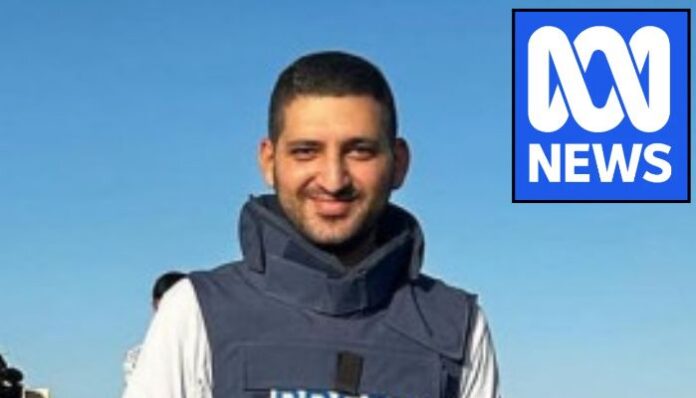
Australian public broadcaster ABC has come under scrutiny for employing Hamas terrorist Roshdi Al Sarraj as a freelance journalist and presenting him as a Palestinian media worker. Al Sarraj, who was killed in 2023, had been a member of Hamas for 12 years and risen through its ranks to become a deputy squad commander.
According to The Australian, the ABC employed Al Sarraj in 2023, during the early stages of the Israel-Hamas war, to provide video footage for its current affairs programme, 7.30. His name has now appeared in a Hamas document recovered by Israeli forces in Gaza, identifying him as a terrorist linked with Hamas.
The document lists Al Sarraj as a “deputy squad commander” and records his identification number as 852492. It states that he joined Hamas as a foot soldier in 2011, when he was 19, and was promoted in 2018, at the age of 26.
An IDF spokesperson told The Australian, “We can now reveal a document located by IDF troops in the Gaza Strip containing information on Hamas military wing operatives, in which Sarraj is listed.”
The spokesperson further stated, “His military ID number is 852492; his role in Hamas’s military wing was as an observer and deputy squad commander.”
The IDF added that the document demonstrated that Al Sarraj’s links to Hamas were not merely allegations and that he was an active terrorist who had risen to the position of deputy squad commander.
ABC demands evidence from IDF instead of examining the wider evidence
The revelations have raised questions about how a Hamas terrorist came to work as a freelance journalist for the ABC. On 3rd October, The Weekend Australian reported that Al Sarraj appeared on an IDF list of 170 terrorists.
Following the report, the ABC focused much of its public response on the evidence specifically relating to Al Sarraj. During Senate Estimates last month, ABC Editorial Director Gavin Fang said the broadcaster had requested supporting evidence from the IDF but had not received any.
The wider issue has also raised questions about the ABC’s own reporting and its willingness to examine whether individuals identified as media workers had links to terrorist organisations. Earlier this year, ABC Global Affairs Editor Laura Tingle declared that Israel “absolutely dominates the record books for its murder of journalists”. However, her sweeping remark overlooks a crucial aspect of the fact that several individuals identified as journalists by media organisations have also been linked to terrorist organisations such as Hamas and Palestinian Islamic Jihad (PIJ).
By overlooking these affiliations, Tingle’s statement presents the deaths as a straightforward case of Israel killing journalists, without addressing evidence that most of the individuals counted in these figures have had direct links to terrorist organisations.
BBC also portrayed 53 Palestinian terrorists as journalists
The controversy surrounding the ABC comes amid similar criticism of the BBC over its coverage of Palestinian journalists killed during the Israel-Hamas war.
An investigation published by The Telegraph on 26th September reported that the BBC had identified 53 individuals as journalists who were linked to terrorist organisations, including Hamas. Most of these reports appeared on BBC Arabic. Of the 53 individuals, 10 were also identified as journalists on the BBC’s English-language website, while the remaining 43 were described as journalists exclusively by BBC Arabic.
Evidence examined in the investigation included photographs and social media posts showing several individuals wearing combat fatigues, carrying weapons and displaying headbands associated with terrorist organisations. Some were also described as martyrs by Hamas and other terrorist groups, while others have participated in the 7th October 2023 terrorist attack on Israel.
Following the controversy, the BBC said it was reviewing the information concerning the individuals identified in its coverage as journalists. Meanwhile, 12 of the 53 names were removed from the Committee to Protect Journalists’ (CPJ) list of killed journalists after the organisation determined that they either did not qualify as journalists or media workers or had directly participated in combat.
The controversies involving the ABC and BBC have raised serious questions about how international broadcasters verify the identities and backgrounds of people they present as journalists in conflict zones, particularly when evidence points to direct links with terrorist organisations.
