

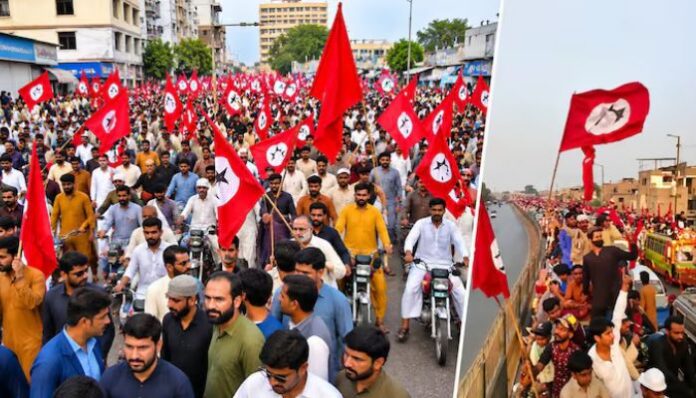
Thousands of Sindhi nationalists took to the streets of Karachi. They marched against a military-backed proposal to redraw Pakistan’s provincial map. They demanded an independent “Sindhudesh,” in a display of public anger that threatens to escalate into a fresh political storm for the country’s embattled military establishment.
The march was organised by the Jeay Sindh Rahbar Committee (JSRC). It is a coalition of four Sindhi nationalist parties. The demonstrators were carrying red flags and wearing traditional Sindhi ajrak scarves and caps. The protesters said Army Chief Field Marshal Asim Munir and the Punjab-dominated power structure are attempting to fragment Sindh. They want to weaken Sindh’s political influence and seize control of its resources.
The controversy was triggered by Interior Minister Mohsin Naqvi, a close aide of Munir. He floated the proposal to create new provinces through a possible referendum. Planning Minister Ahsan Iqbal has since spoken of increasing the number of provinces from four to between 12 and 15. Defence Minister Khawaja Asif said on 22 November that discussions on a referendum could take concrete shape by the end of 2026.
The protesters rejected the proposed referendum outright. They argued that it could be used to legitimise a predetermined decision on Sindh’s division already taken by the authorities. Shafi Muhammad Burfat, chairman of the Jeay Sindh Muttahida Mahaz (JSMM) declared: “Sindh is not Pakistan. The Sindhi nation rejects Pakistan as an unnatural state, a Punjabi colonial occupation, and every conspiracy by the deceptive Punjabi military to divide Sindh”. The JSMM has threatened an economic blockade of Punjab. They vowed to expand their campaign into a full-fledged movement for an independent Sindhudesh.
The mobilisation was not confined to Karachi. Similar protests were reported across Hyderabad, Nawabshah, Larkana, and Dadu. Jamiat Ulema-e-Islam-Fazl (JUI-F) was also organising demonstrations. Sindhi nationalist leaders have suggested that PPP chairman Bilawal Bhutto-Zardari, JUI-F chief Maulana Fazlur Rehman and nationalist parties could join forces against the proposed division.
Background: Bilawal’s warning of bloodshed
The protests have intensified against the backdrop of a stark warning from Bilawal Bhutto-Zardari. Speaking at the Karachi Press Club on 17 17 November, the PPP chief opposed the division plan. Bilawal warned that any attempt to forcibly divide Sindh could trigger widespread violence and bloodshed.
“If Sindh is divided by force, questions will be asked about the blood that flows on the streets of Karachi,” Bilawal said. He added, “I do not want to see that bloodshed”. He warned that the streets would see “blood, not garbage,” and named Hyderabad and other parts of Sindh as potential flashpoints. He framed his warning as a “sober reading” of Sindh’s political history. He invoked the ethnic violence of the 1980s and 1990s that scarred Karachi and left thousands dead. Bilawal also cautioned that forcibly dividing the province could push ordinary people to take up arms.
PoK unrest: A parallel crisis
The turmoil in Sindh is unfolding alongside a severe and prolonged crisis in Pakistan-occupied Kashmir (PoK). The military’s heavy-handed response to protests has drawn international condemnation. In Rawalakot, Pakistani Rangers and Frontier Corps personnel launched a major attack against demonstrators, employing drone strikes and heavy gunfire in civilian areas.
According to reports, at least seven civilians were killed, and 23 others were injured in the initial hours of the attack. The total death toll since June has reached 153. Protesters recovered and displayed fragments of drone-dropped bombs and the tail fin of an RPG-7 rocket. It is evident that Pakistani forces were using military-grade combat weapons against unarmed civilians. Sardar Omar Nazir, a key organiser of the five-month-long demonstrations, publicly displayed the bomb fragments. He appealed to international human rights organisations to take urgent notice.
