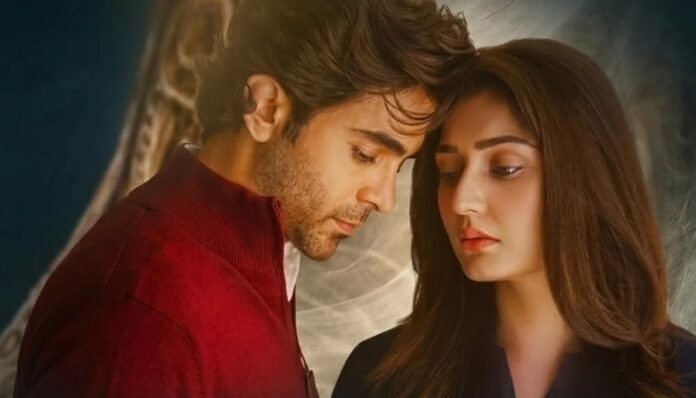
Abu Bakr, a fictional character in the Pakistani television drama Dar-e-Nijaat, has become a new obsession among a section of Indian people. Sheheryar Munawar Siddiqui carries a superficial charm. Declared already as a ‘green flag’ and even ‘green forest’, Abu Bakr, however, is neither a green flag nor a quintessential ‘dream husband’.
What began as an appreciation for a well-written romantic character has now snowballed into watch parties, special screenings, fan gatherings, and women, not only in Pakistan, but in India, declaring that they want an Abu Bakr in their lives.
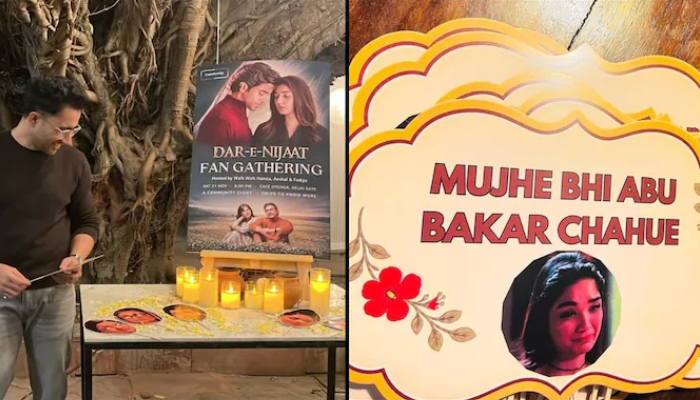
The Pakistani drama’s popularity has travelled beyond Instagram reels. The show’s fans have organised screenings in Delhi and Hyderabad, and the director, Saqib Khan, even joined a Delhi gathering via a video call.
Are you watching Dar-e-Nijaat? Falling for Abu Bakar? Believing “art has no borders”? What if the Pakistani drama you’ve been romanticising is part of a much bigger threat to our National Security? I started investigating its Indian screenings. The trail led to Pakistani media families, military officers, ISPR and questions about ISI influence. Here’s what I uncovered 🧵
— Ojas Bhandari (@ojasbhandarii) November 23, 2026
A former Pakistan Army officer associated with the military wing, ISPR, also reportedly joined the interaction.
This is alarming and needs to be probed.
However, I want to first talk about Abu Bakr, the supposedly ultimate ‘green flag ‘.
Before that, let me apprise our readers of the broad storyline of the drama on-air since 1 August 2026.
Dar-e-Nijaat is a Pakistani drama centred on the lives of Zaryab (played by Durefishan Saleem), her practising Muslim husband Abu Bakr (Shehryar Munawar) and her ex-boyfriend Zamil (Nameer Khan).
Zaryab was a college-going modern girl who was not particularly religious. Zaryab and Zamil had been so deeply in love that they cared about no perceived boundaries and established sexual intimacy outside marriage.
She was so obsessively in love with Zamil that even her dream to go to Harvard went to the back seat.
However, Zamil, who had lived a carefree life so far, begins to reset his priorities amid academic failures.
Zamil ends his relationship with Zaryab without telling her first and marries a Madarsa woman named Hamna, claiming Zaryab is not pious or pure enough to be a good Muslim man’s wife.
He describes his relationship with Zaryab as an “era of ignorance” and leaves Zaryab to deal with her emotional fallout alone.
And that is when Abu Bakr enters Zaryab’s life. Struggling with her emotional turmoil and regrets over past choices, Zaryab, who has hardly known Abu Bakr, asks her mother to send a marriage proposal to Abu Bakr’s mother, KhushBakht.
Abu Bakr meets and asks Zaryab why she wants to marry him. To this, Zaryab’s response was that she thinks it would be appropriate to marry Abu Bakr since he is pious, well-settled and a good human being.
Amid Zaryab’s emotional dilly-dallying, Abu Bakr and Zaryab get married. Initially, Abu Bakr’s calm and near-perfect persona irritates an imperfect Zaryab, who finds his calm and tolerance a mockery of her emotional despair.
Abu Bakr regularly sends Tilawats of the Quran to Zaryab over WhatsApp, and in one scene, he is shown reading the Quran loudly. Zaryab believes that Abu Bakr is as perfect as a fictional character, and too good for her.
However, things begin to change gradually; Zaryab grows to like Abu Bakr’s spiritual side and even gets inspired to perform Namaz. Her idea of modesty also begins to shift as she continues treading on the supposed path to redemption or Dar-e-Nijaat.
The patience and tolerance of Abu Bakr, who himself recovered from an emotional rough patch in the past with help of the Quran, in helping Zaryab through her panic attacks and outbursts of anger, have been particularly admired by female viewers of the show.
But does that mean Abu Bakr is a universal green flag? No!
Abu Bakr is a Maulana without a beard and skullcap
Abu Bakr is not a universal green flag. Instagram creators on both sides of the border have exalted him. How the predominantly Muslim audience in Pakistan receives the character is, honestly, not my concern.
What concerns me is how the Indian audience, particularly women and young girls across different social and religious backgrounds, perceives Abu Bakr.
Indian audiences of Dar-e-Nijaat, particularly women who have turned Abu Bakr, the show’s male protagonist, into a romantic ideal, the quintessential husband material and whatnot, are missing an important part of this character.
Abu Bakr is not merely a gentle, emotionally available, saviour complex-driven man who happens to be a Muslim.
The character has been woven by writer Umera Ahmed, who has a reputation for writing stories and characters deeply rooted in Islamic ‘spirituality’.
Abu Bakr’s Islamic faith is central to his personality, his understanding of the world, and the kind of life partner he would choose.
This distinction has gone unaddressed so far. But not anymore.
There should be no objection to a man being religious or offering namaz. A Pakistani Muslim character consulting the Quran before making important decisions or allowing his faith to guide his conduct is also not a problem.
In fact, what makes Abu Bakr interesting is the fact that his religiosity is not expressed via the typical visual markers of a conservative Muslim Maulana.
Abu Bakr does not need a beard, skullcap or traditional religious appearance to communicate his religiosity and devotion.
He is a Maulana without the conventional appearance and regressive ‘Bayaans’ of a Maulana.
Abu Bakr’s moral universe is essentially structured around the Quran.
He is an ardent follower of the Islamic text and traditions.
Dear South Delhi Shanayas and Lavanyas, Abu Bakr may not be your dream man
The media hype and craze for making reels and engagement farming magnify the whole idea of ‘obsessing’ over a fictional character, Abu Bakr. However, Indian girls, especially non-Muslim ones, supposedly ‘falling’ for Abu Bakr is quite problematic.
What makes some Indian female viewers admire and romanticise Abu Bakr is his tenderness, the patience, the emotional maturity and the religious discipline.
Abu Bakr is a ‘Paanch waqt ka Namazi’ and most, if not all, his life decisions are governed by his understanding of the Quran.
Now if a Shanaya from South Delhi is obsessing over Abu Bakar and wants his real-life replica, she needs to know that for an ardent Quran-following Abu Bakar, she is just a Kafir girl, whom he cannot marry until she denounces her religion and converts to Islam.
And no, Shanaya, you are no Zaryab.
Abu Bakar won’t be telling Shanaya that “your character and faith are none of my business; it’s between you and your God”.
That supposed demonstration of tolerance is relevant only in the set-up where the girl is already a Muslim.
No such courtesy is extended to non-Muslim women.
Under the dominant interpretation of Islamic jurisprudence, a Muslim man may marry a Muslim woman and, subject to conditions, a chaste Jewish or Christian woman belonging to the People of the Book.
A practising Muslim, even an Abu Bakr, whose personality is framed such a way that, despite being orthodox, he comes across as a liberal man, would never marry a Hindu or Sikh woman until she converts to Islam.
For non-Muslim women, the Quran accords no better status than a Kafir, a Mushrik or worse, Maal-e-Ghanimat.
It may happen that an Abu Bakr would conduct himself nicely around you, not necessarily judge you or your faith, but if the question of marriage arises, the religious text he follows would require him to tell you, Shanaya, that there’s no way he is abandoning his faith, so either you abandon your faith or feel free to leave.
The only thing Abu Bakr would do differently is put all this to Shanaya in a soft and sophisticated manner.
So, watching a show for entertainment and moving on is fine, although watching Pakistani dramas of actors who badmouth India, and while Indian films remain banned in Pakistan, may not be absolutely fine, but obsessing over Abu Bakr or dreaming of finding his replica in real life is delusional and absurd.
Abu Bakr may not exist in real life for Muslim women. He definitely doesn’t exist for non-Muslim women.
This is not a lamentation but a mere statement of facts.
Zaryab’s sleeveless dress: Umera Ahmed’s Dar-e-Nijaat shows modesty as a visual measure of spiritual progress
In Episode 29 of Dar-e-Nijaat, Zaryab skips a sleeveless dress for her sister’s baby shower because she finds it ‘revealing’. Previously comfortable and confident in Western outfits, Zaryab no longer feels comfortable in a ‘revealing’ outfit.
There is a scene where Zaryab looks at herself in the mirror while wearing a white western sleeveless outfit. She eventually decides that she is not comfortable wearing it and changes into a salwar kameez with a dupatta.
On the surface, this can be seen as a shift in personal choice. A woman is totally entitled to change her preferences. There is nothing inherently wrong with choosing traditional clothing.
But like many people who watch the drama or often come across its clips on Instagram, I could not help but notice the larger symbolism.
Zaryab’s visible discomfort looking at herself in the mirror wearing a sleeveless dress and subsequent decision to go traditional is essentially the writer’s way of using Zaryab’s wardrobe to communicate her journey towards Islam and spiritual redemption.
While the same Shanayas and Lavanyas who describe mere expectation that they would avoid shorts or supposedly revealing outfits inside Hindu temples or any religious function as an encroachment on their personal liberty and agency, do not find it problematic that Zaryab’s more covered outfit became the visual shorthand for her growing modesty and deepening understanding of Islam.
How is it that the same women who associate Western clothing, sleeveless and backless dresses and revealing outfits with modernity, confidence, power dressing and female independence seem perfectly fine celebrating a fictional setting in which a woman’s spiritual evolution is showcased through increasingly conservative clothing?
Does greater bodily coverage guarantee or define greater religious consciousness?
What next for Zaryab? Will she go full Hijab or Burqa-clad by the end of the show?
Is this Dar-e-Nijaat? Or is it Dar-e-Propaganda, a fictional, aesthetic retelling of the speeches of Mullah-Maulvis who offer disgusting analogies such as ‘unwrapped lollipops get covered in flies and dirt, while the one wrapped remains protected’?
At a time when women in Islamic countries like Iran are being lashed and even killed by Islamists for not wearing Hijab, Muslim women are being denied the right to education and subjected to confinement in Burqas in Afghanistan; a mainstream Pakistani drama shows that a woman’s ‘Nijaat’ is contingent on the length of her clothes, though no such compulsion exists for a man.
Remember? Abu Bakr does not keep a beard without a moustache. He does not always wear an Islamic skullcap. His spiritual growth reflects in his composure, but Zaryab’s spiritual progress is validated by the ‘modesty’.
But Shanayas and Lavanyas live in their own delulu world. For them, religion is a social construct: covering the head during Aarti is regressive and patriarchal, but Namazi Abu Bakr is the ideal man, Zaryab’s Pakistani suit collection is their dream wardrobe, and learning to wear Hijab is catching the vibe of the show.
What is behind South Delhi’s Sanaya’s obsession with the Pakistani drama Dar-e-Nijaat? Why is a watch party being organised in Delhi, and why is Sanaya so drawn to Abu Bakr? After calling head-covering regressive, why has Sanaya suddenly fallen in love with the hijab? @pujaranaa explains.
— OpIndia.com (@OpIndia_com) November 24, 2026
Zaryab needed her Harvard dream after heartbreak, not a marriage
Zaryab was good in academics and wanted to study at Harvard University. When Zamil left Zaryab heartbroken, she did not think of pursuing her academic or career goals. She chose to get married to a man due to his piety.
Isn’t this how society has been? If something goes wrong in a woman’s life, the first thing parents think of is getting her married, saying: ‘Bahut ho gayi padhai, Shadi karwa do, sab theek ho jayega’.
But in the world of Dar-e-Nijaat, the girl herself prioritises hushed marriage over her career.
Zaryab’s recovery from heartbreak and betrayal in a relationship must be accompanied by a visible shift towards Islamic respectability.
Just imagine an Indian television drama or a Bollywood movie making a Dar-e-Nijaat with Hindu characters and Hindu religiosity at centre.
The same audiences going gaga over Abu Bakr and Zaryab would have dismissed the film as regressive, patriarchal, and even label it as ‘How to be Sanskari 101’.
Should Indians watch Dar-e-Nijaat?
Would I recommend our readers watch Dar-e-Nijaat? This is now an irrelevant question.
People no longer significantly rely on media reviews while deciding whether to watch a show or not.
Now online virality governs such decisions.
One scene of a show goes viral, and the content consumer immediately finds the YouTube channel or OTT platform to binge on the whole show.
And no, no amount of lecturing on Shatrubodh is going to dissuade Indian audiences hooked on Pakistani dramas from abandoning them at once.
Those who watched Pakistani dramas earlier must have watched their favourite show even on the evening of 22nd April 2025, when Pakistani Islamic terrorists singled out Hindu men and shot them dead in Pahalgam for failing to recite the Kalma, essentially for being Hindus.
They continued watching Pakistani shows even during the May conflict, and Instagram was replete with sobbing posts with the ‘Ye Ishq Tum Na Karna, Ye Rog Hi Lagaye’ song to lament the ban on accounts of several Pakistani actors last year.
Not to forget, Durefishan Saleem, who has played Zaryab in Dar-e-Nijaat, had endorsed the equation of Hindutva with Zionism by a rabid Islamist last year, just days after the Pahalgam attack.
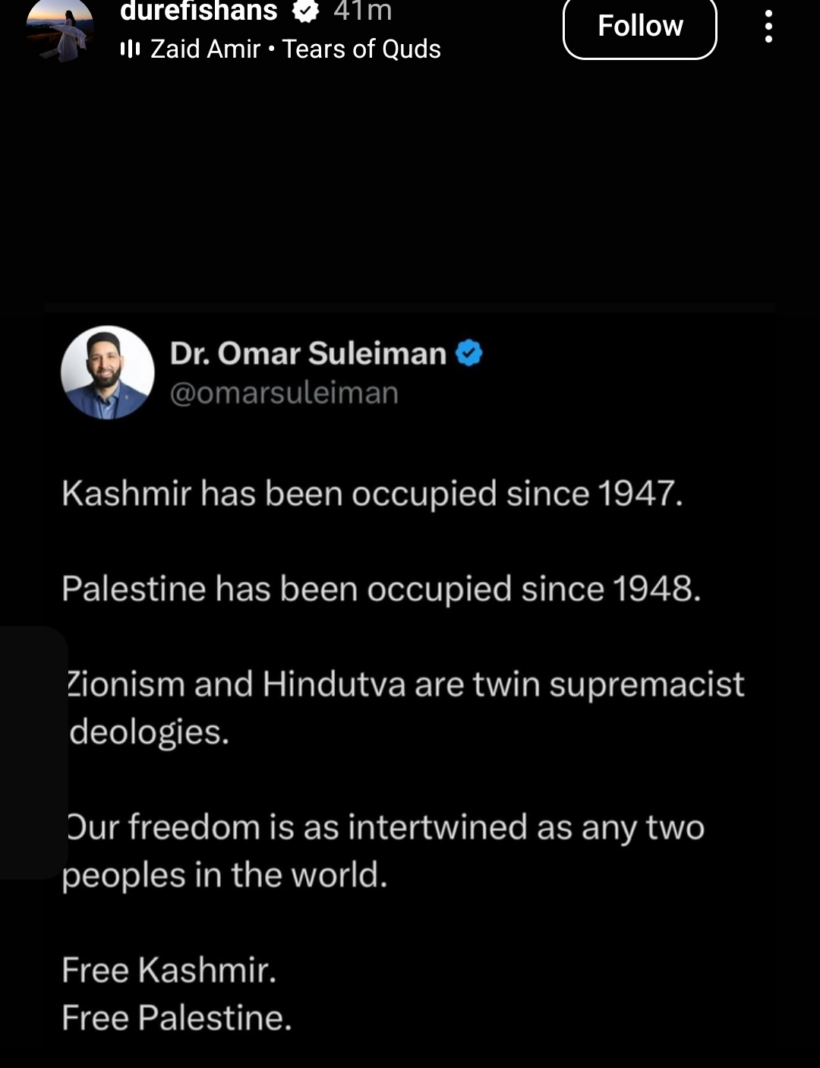
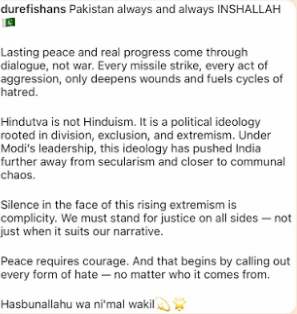
In an Instagram post, Durefishan had claimed that Hindutva is a political ideology rooted in division and extremism. This came even as it is Islamic terrorism rooted in the idea of establishing Islamic supremacy, which continues to harm innocent people across the world to varying extents.
“Hindutva is not Hinduism. It’s a political ideology rooted in division, exclusion and extremism… Silence in the face of this rising extremism is complicity,” she wrote.
There was, is and will always be a convenient excuse: ‘actors are not terrorists’, ‘art has no boundaries’, ‘spread love, not hate’, and so on.
This deliberate amnesia is not confined to just the Indian audience of Pakistani dramas; now even the mainstream media has joined.
It began with an India Today article swooning over Abu Bakr, and now Filmfare has started promoting upcoming Netflix MENA series starring Pakistani actors.
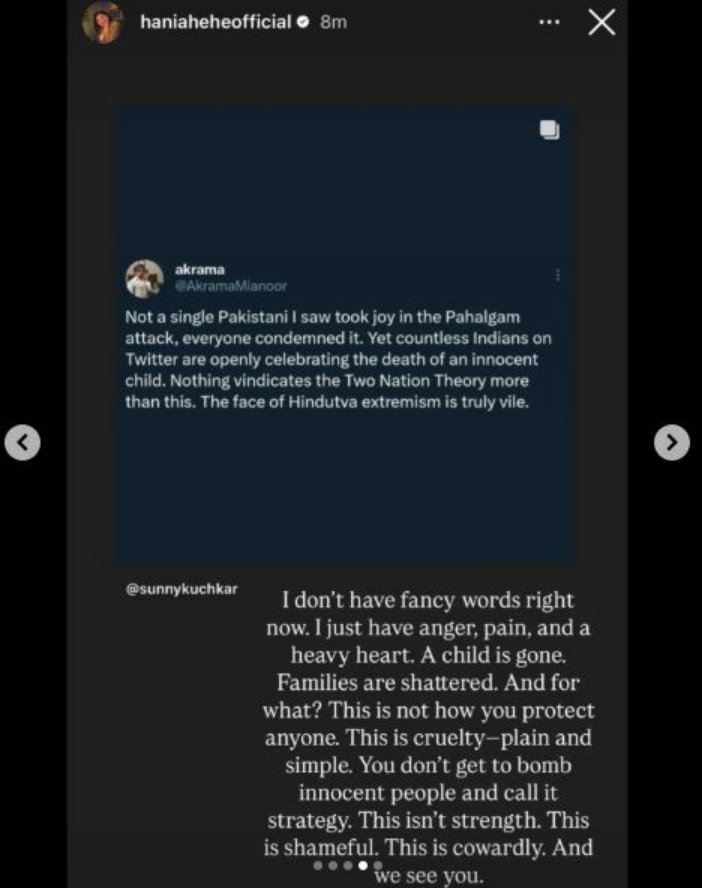
Filmfare conveniently forgot that it is the same Pakistani actors who spewed venom against India during “Operation Sindoor,” on Pakistani terror camps to avenge the terror attack.
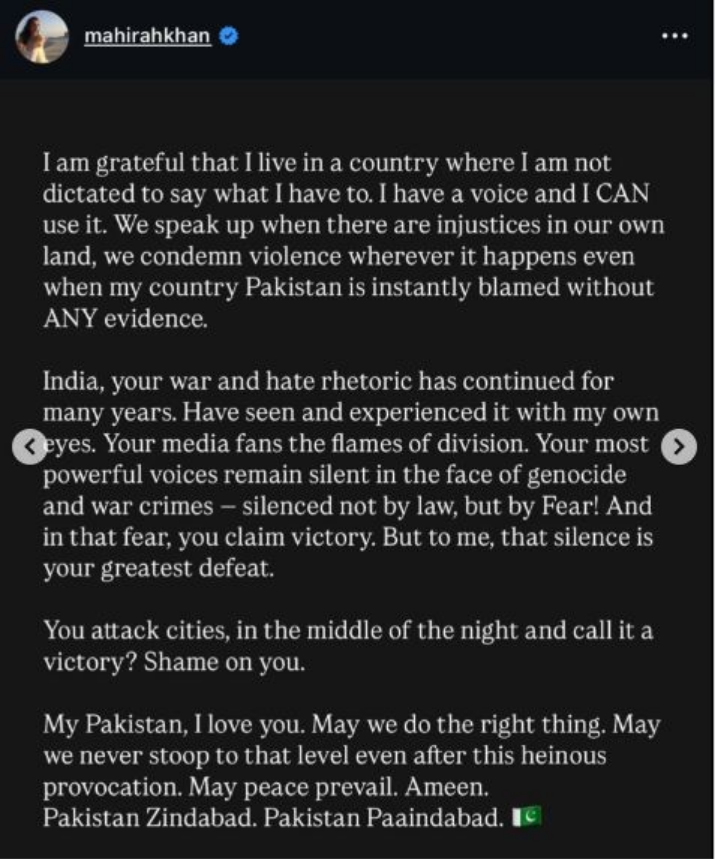
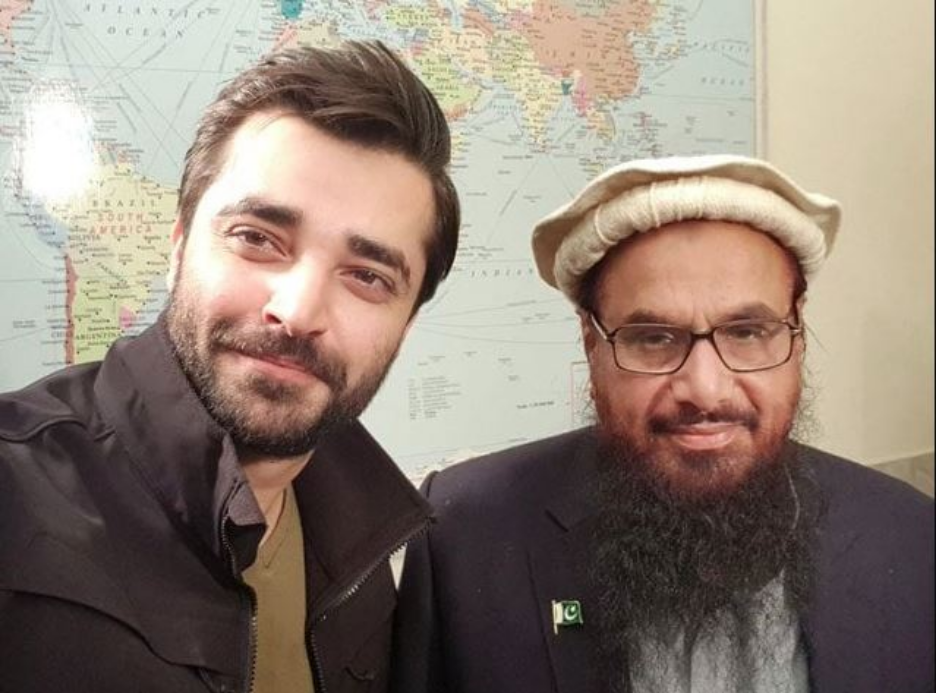
Filmfare also ignored the fact that one of the actors on the show, Hamza Ali Abbasi, is a fanboy of Islamic Jihadi and the mastermind of the 26/11 Mumbai terror attacks, Hafiz Saeed.
Had Indian media outlets promoting the Pakistani Netflix series, with or without paid partnerships, done some research, they would have known that this series is produced by the same Momina Duraid, who produced the drama Ehd-e-Wafa, which recreated Indian Wing Commander Abhinandan Varthaman’s captivity and interrogation with cheap mockery.
A massive section of the Pakistani populace holds a hostile view of India, and yet their weddings are incomplete without Bollywood songs.
They have grown to hate Bollywood for its slight deviation from one-sided and utterly delusional Aman ki Asha propaganda.
Despite this, the Dhurandhar duology Pakistanis declared ‘anti-Pakistan’ and somehow even ‘Islamophobic ‘ trended on Netflix in Pakistan and its pirated copies were widely sold in the country.
Just months after the May conflict, Dhurandhar songs were played in Pakistani weddings.
Pakistani celebrities continue to use Bollywood songs in their Instagram posts and reels.
This is how it is. Call it cultural exchange or whatever, but this is not going anywhere.
Indian government banned YouTube channels and Instagram handles of Pakistani actors; their Indian fans began using VPN.
Pakistani entertainment channels created even separate channels for their popular shows to circumvent the ban in India.
When the Pakistani government banned Bollywood movies, people there got pirated copies or watched them on OTT platforms like Netflix.
The government can take stricter measures, though it evidently lacks intent. Rather, it may no longer even find this problematic.
Am I suggesting that Indian television should step up, stop making nonsensical, ridiculous daily soaps and make meaningful, realistic and relatable shows that can strike a chord with Indian audiences just as many Pakistani shows did?
No. Honestly, that’s a hopeless pursuit. Indian television chases numbers, TRPs, and embarrassing ‘milestones’ like 3000 episodes.
ITV has produced memorable shows like Beyhadh, Kuch Rang Pyar Ke Aise Bhi, Iss Pyar Ko Kya Naam Doon, Ye Unn Dinon Ki Baat Hai or Saraswatichandra (only till the episodes directed by Sanjay Leela Bhansali)
However, Indian television drama producers, directors, and even audience to a great extent, have become accustomed to celebrating mediocrity, visual extravagance, forced ‘Naari Sashaktikaran’ narratives, and Dupatta-getting-stuck-in-the-watch kind of romance.
Biggest contribution to this conditioning has been made by none other than Ekta Kapoor.
Indian television wasn’t always non-serious. In the pre-Ekta Kapoor era, writing and storytelling was relatively very real, compelling, serious and most importantly, relatable.
Those who have watched TV adaptations of Munshi Premchand’s novels like Godaan, Nirmala, or have watched shows like Buniyad, know that ITV too had a phase of demonstrating great writing prowess.
The downfall began when the ITV ushered into the infamous ‘Dhoom tana” era.
At present, relatable storytelling has arguably shifted to OTT and to medium or low-budget films.
Ironically, what is preventing Pakistani cinema to compete at the same level, in terms of budget and scale, is the very religious and conservative mindset Abu Bakar of Dar-e-Nijaat represents in a sophisticated and sanitised fashion.
Moving on, the Indian right wing, though outrage is justified to a great extent, needs to come out of the delusion that stricter bans and criticising fellow citizens can stop people from watching Pakistani dramas.
Not to forget, while the Indian government banned Pakistani YouTube entertainment and YouTube channels, shows like Dar-e-Nijaat can be easily accessed through the website of the channel it is airing on, without even requiring a VPN.
At best, constant monitoring and banning of Pakistani YouTube channels being created to circumvent ban in India, the monetisation of Indian views can be prevented to some extent. But will the government take any such measure? Highly unlikely.
Indian government’s narrative game is deplorably weak.
Is Dar-e-Nijaat an ISPR propaganda piece created to influence Indian audience?
One of Umera Ahmed’s June 2021 dramas, Dhoop Ki Deewar, was sent for ISPR approval, given it was centred on cross-border tensions and a love story between an Indian Hindu boy and the son of a martyred Army officer, Vishal (Ahad Raza Mir) and a Pakistani Muslim girl, Sara (Sajal Aly), daughter of a Pakistani Army officer killed by Vishal’s father during a conflict.
In fact, Pakistani people had demanded a ban on the show for presenting a love story between a Hindu Indian boy and Muslim Pakistani girl. They even suggested that the show defies the Two-Nation Theory, the hateful and divisive ideology which forms the foundation of the Islamic State of Pakistan.
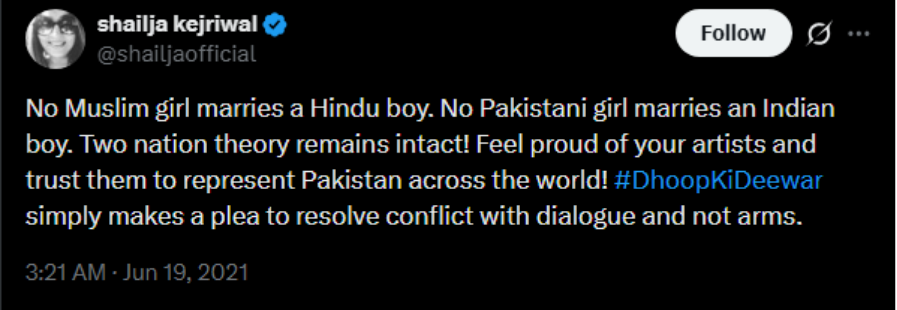
Shailja Kejriwal, the executive producer of the cross-border drama, had even published a tweet in which she had boasted that no Muslim girl married a Hindu boy, and that the Two-Nation Theory also remained intact. Basically, she boasted about having upheld the bigoted and hateful Islamist mindset.
“No Muslim girl marries a Hindu boy. No Pakistani girl marries an Indian boy. Two nation theory remains intact! Feel proud of your artists and trust them to represent Pakistan across the world! #DhoopKiDeewar simply makes a plea to resolve conflict with dialogue and not arms,” Kejriwal wrote.
While Umera Ahmed’s Dhoop Ki Deewar was an ISPR-approved propaganda piece, which did carry some thought-provoking elements given it was meant for both Indian and Pakistani audiences, Dar-e-Nijaat, released in 2026, is not a drama created to specifically serve an Indian audience or to manipulate them.
Its Indian reception is organic, though the paid watch parties and specific ‘Pakistani ensemble’ dress codes do indicate that the influence of the show has gone beyond social media.
Dar-e-Nijaat may not be a outright propaganda piece created to push a pro-Pakistan or pro-Islam narrative among Indian viewers; it has now opened a door for the ISPR to use this soft power avenue for its agenda.