In politics and in life, significant events rarely occur in a vacuum. They either mark the end of a chain of events or the dawn of a new one after one chain of events has drawn to a close. Significant events cannot ever be seen in isolation. They are a product of the circumstances that immediately preceded them and often occur to influence the cycle of events in the near future. It is in this light that we ought to see the outbreak of violence at the Jawaharlal Nehru University (JNU) on Sunday.
When the protests began against the Citizenship Amendment Bill, most of us would have assumed these were routine protests by compulsive contrarians and there was nothing much to worry about regarding them. However, after the Bill was passed by the Rajya Sabha and it became an Act, the intensity of these protests increased manifold.
The Beginning of the Battle
Most of us did not take these protests very seriously because we could not even decipher what was so wrong with the Act that demanded such resistance. The Act only fulfilled a natural obligation India had towards Hindus, Jains, Buddhists and Sikhs from the Islamic States in the neighbourhood and even added Christians to the mix for good measure. The exclusion of Muslims from the provisions of the Act was only natural as it is ridiculous to claim that they should be treated equally as a non-Muslim from Islamic countries.
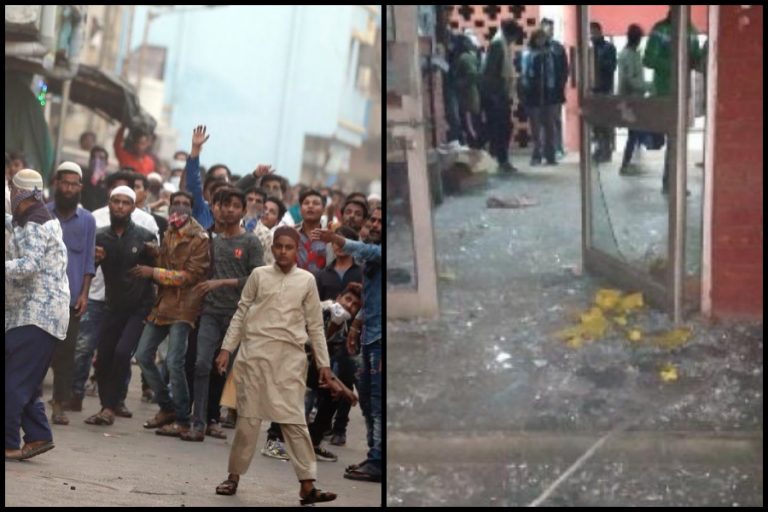
But soon, it became evident that the ‘protests’ were going to get very ugly. In Mamata Banerjee’s West Bengal, Muslim mobs ran riot and damaged public property with impunity. Soon enough, on the 15th of December, Muslim mobs rampaged through the streets of Delhi setting fire to public property in their wake. The manner in which the Police responded in the two places speaks volumes for the reasons behind the protests.
Read: Anti-CAA riot in Bengal, an eyewitness account: An announcement, stone pelting, arson and scared passengers trapped in a tin box
In Mamata Land, the Police did not make any effort to control the rampaging mobs and thus, they ran riot. Eventually, violence declined after the Kolkata Mayor Firhad Hakim practically begged the vote bank of his party to not indulge in vandalism as it would only benefit the BJP politically. In Delhi, the Police responded by enforcing a strict crackdown on the ‘protesters’ of Jamia Milia Islamia University. It is important to note here that violence declined in Delhi following the Police action at Jamia after just one more massive outbreak of violence at Seelampur.
Read: Khilafat 2.0: How Useful Idiots in the media and political parties were fooled by Jamia students associated with the ‘blood brother’ of a banned Radical Islamic outfit
The same night, there was another crackdown elsewhere in another prominent institution. The Uttar Pradesh Police entered the campus of the Aligarh Muslim University and brought the rioters present to kneel. In Yogi’s state, violence escalated following the crackdown at AMU but the Chief Minister responded by heightening the stakes many times further. Ultimately, the rioters relented because too heavy a cost was inflicted upon them. A similar chain of events was observed in Karnataka.
The Liberal Establishment Enters The Fray
It would be inaccurate to claim that it was only after the 15th of December that the Liberal Establishment entered the fray because they had been involved in the spreading of misinformation from the very beginning. But it was only after the events of the night of the 15th that the full gambit of the Liberal Establishment became obvious. Soon, it turned into protests not only against the CAA but the crackdown on the rioters of AMU and Jamia as well.
Intellectuals, Bollywood actors and actresses, and liberal enclaves in prominent universities participated in demonstrations protesting against the alleged ‘fascism’ in the country. The media contributed by propagandizing on behalf of the rioters and the mobsters and inventing a host of fake news narratives. However, as the saying goes, you cannot thrash a donkey into a horse. Once a donkey, always a donkey.
And thus, it happened that the Jamia ‘sheroes’ were revealed to be Islamic Extremists who had in the past called India fascist for executing the Mumbai Blast terrorist Yakub Memon and gave calls for Jihad.
Read: Jamia ‘shero’ hailed by Barkha Dutt celebrates Moplah massacre, when Muslims massacred thousands of Hindus in 1921 in the name of Islam
The fake news that was spread of ‘innocent students’ of Jamia and AMU bit the dust when footage from these Universities was released by authorities in the public domain. It also became evident that the Bollywood actors and actresses who attended these protests did not have much clue about the matter at all and were only in it for cheap publicity.
Nevertheless, the Public Relations Team of the Liberal Establishment did not stop propagandizing and the mainstream media continued in its merry way. We shall see later on in the report how the Liberal Establishment played a significant part in shaping the events that occurred on the 5th of January at the JNU.
The Political Hand behind the Protests
From the very beginning, the political nature of these protests was evident. In Mamata’s West Bengal, it became evident when the violent protests ceased to occur following an appeal by the Kolkata Mayor. In Delhi, AAP leader Amanatullah Khan was spotted leading one of the protests that eventually turned violent and caused immense damage to public property.
Read: AAP MLA Amanatullah Khan spotted leading the protests which turned violent in Delhi: Reports
In the Jamia protests, the involvement of leaders associated with the students’ wing of prominent political parties was uncovered. Most significantly, however, OpIndia exposed the manner in which the Congress party was instigating protests across Universities while maintaining the carefully constructed garb of ‘spontaneous protests’. We revealed the manner in which the students’ wing of the Congress party, NSUI, was working towards creating the facade of a massive students’ movement across the country, aided ably by their minstrels in the media.
Read: Who is instigating violence in colleges: Congress, NSUI, a sinister WhatsApp group and anti-CAA protests
It is pertinent to note that several Congress leaders have been booked for the anti-CAA riots by Muslim mobs that have gripped the nation.
While investigating the incidents of statewide violence which occurred on December 21, the Patna Police recently got their hands on Congress leader Ashutosh Sharma who has been accused of attacking media people during the Bihar bandh and has been on the run since then. Congress leader Ashutosh Sharma was caught on camera assaulting journalists at the Dak Bungalow Chowk in Patna. The Congress leader was reportedly on the run after the case was registered against him.
Read: Take revenge, don’t spare any cop: Congress Corporator Shehzad Khan Pathan instigated anti-CAA riots in Ahmedabad
The crime branch of Ahmedabad police had nabbed a Congress leader for posting a fake and misleading video on social media which incited a Muslim mob during a protest march at Shah-e-Alam, Gujarat, where several police officials were brutally attacked by Muslim mobs.
Congress party’s minority cell member Umar Khan Pathan had shared a video on social media in which a police action against rioters from Lucknow was passed on as an incident in Ahmedabad stoking violence in the Shah-e-Alam. The fake news had unleashed a violent Muslim mob, who attacked and injured more than 25 policemen on duty.
The Ahmedabad Police had arrested Congress Corporator Shehzad Khan Pathan along with 32 others for carrying out the deadly attack during anti-CAA riots on police personnel. They have been booked for attempt to murder, rioting and assaulting police.
Additionally, Six people including four local politicians and the former Congress MLA were named as suspects in the Delhi Police FIR related to Jamia violence. The Delhi Police had named former Congress MLA Asif Khan as one of the accused in its FIR.
The Collapse of the Conspiracy
The extensive effort that was put into these protests by the Liberal Established collapsed under its own weight when the Radical Islamic nature of these protests became evident. Prime Minister Modi remarked that the rioters could be identified from their clothes which sent the establishment into a frenzy. But they knew it was true and they were fully aware that their lamentation will fall on deaf ears.
Simultaneously, the morbid anti-Hindu bigotry that was intrinsic to these protests prompted even the political parties to engage in some degree of course correction and the media realized that a shade of red or a shade of pink, a pig is still swine. Thus, when the law enforcement authorities crushed the conspiracy to spread anarchy across the country, it received widespread applause from the masses.
By the end of it all, Islamic Extremists and Political Parties were bickering with each other on social media. The former accused the latter of hijacking a Muslim uprising against the CAA for their own ends while the latter claimed that a nationwide protest was being coloured with communal colours and it was only benefitting the BJP. Nothing defeats like defeat and alliance of opportunism between the Islamic Extremists and the Political Parties was collapsing with every group looking to preserve its own interests.
The Calm Before the Storm
As the festive mood set in during the Christmas and New Year, the frenzy that had been the hallmark of these protests evaporated into thin air. Anti-CAA crusaders had moved on to ‘Thirst Traps’ and even the ‘protesters’ were too busy in merry-making. Thus, the country came to the conclusion that the worst of it had passed and things would soon return to normalcy. However, as it has turned out, the ‘protesters’ were only biding their time and recovering from the massive set back they hd suffered in the last month of 2019.
An agenda remained unsuccessful, objectives had not been met, and a desire to spread anarchy across the nation still festered in the hearts of people who were involved in these protests from the very beginning. The differences between the political parties and the Islamic Extremists were also resolved during this temporary lull and the festivities came as a respite for the vanquished and they took the time to recuperate and rejuvenate themselves.
Thus, by the 5th of January, the perennial protesters were again ready and roaring to go. The defeats were forgotten, differences were mutually resolved and the fragile edifice of the Liberal Establishment was again reconstructed, on similar fragile grounds, and as soon as they festivities were over, they were about to relaunch their efforts again. And on the second of January, The Wire columnist Sharjeel Imam announced that ‘Hong Long style protests’ were going to be launched in phase 2 of the exercise.
The Chain of Events: 5th of January, 2020
It is still unclear as to what exactly happened on Sunday and the events that transpired. Unlike liberals, the Gods haven’t granted us the boon of premonitions and divine revelations. Therefore, we can only piece out what happened from the account narrated by stakeholders on social media and establish the chain of events in chronological order.
First things first, chaos did not erupt for the first time at JNU on Sunday, it has occurred earlier as well. Only on Friday, the 3rd of January, the students of the University disrupted the registration process for the winter semester by barging into the Centre for Information System office and cut off the power supply to protest against the fee hike. The protests over fee hike, as we all know, had been going on for quite some time.
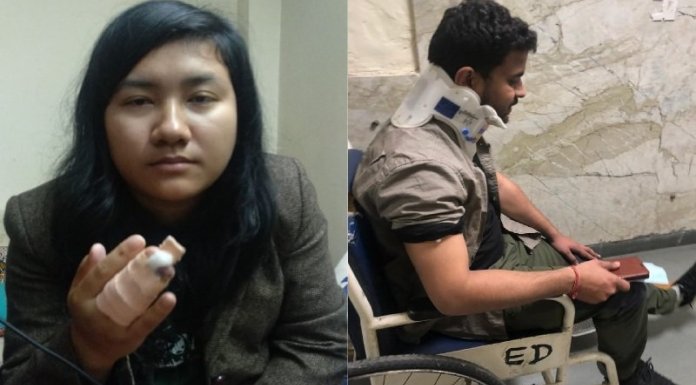
The JNU administration issued a statement over the matter in the aftermath of the violence. The statement said that at 4.30 pm on Sunday, the agitating students had moved from the admin block to hostel rooms attacking students who had supported the registration process. Even though police were informed, by the time police reached, several students and security staff at the hostels were reportedly badly injured in the assault by the violent protestors.
The statement added that masked miscreants had entered the Periyar hostel and had attacked students and security staff with sticks and rods. Some groups of students had also vandalised the admin block and ransacked the VC’s office in the past few weeks. The university has filed police complaints after the incidents. All of this is consistent with other reports that have been coming in and consistent with the version of events as described by the ABVP.
The President of the ABVP’s JNU Unit, Durgesh Kumar, accused the Left of unleashing violence at the University. His statement was consistent with the official statement of the JNU administration. According to him as well, violence erupted over the matter of registrations. He said that the Leftists had attacked the ABVP students and had even chased them into the hostels where they had taken refuge and assaulted them.
Abhinav Prakash, assistant professor at the Delhi University, narrated a similar chain of events. He, too, confirmed that leftist goons at the University had attacked the ABVP students and even professors and ordinary students at the University. As per Mr. Prakash, it was a planned attack carried out by the Leftists and according to him, at least one video being circulated which claimed to show an attack by ‘ABVP goons’ actually depicted students trying to defend themselves against the mob.
Senior BJP leader Meenakshi Lekhi narrated a horrible tale of unspeakable horrors after meeting some of the victims of the assault and asserted that Jamia students had been called by leftists in JNU to assault students on the campus. She further said that students were beaten brutally and had suffered terrible injuries including memory loss due to head trauma. She also said that there were girls who were hit on their private parts and some girls were so embarrassed that they had left for their homes with their families.
An officer of the Bihar Public Service Commission, who is currently studying at the university, also spoke out on the horrors he suffered on Sunday. He, too, blames the Leftists for the violence. He made two startling revelations. He said that he saw JNUSU President Aishe Ghosh with his own eyes entering the Periyar hostel and when she entered the hostel, she was well and not hurt. He says he doesn’t know when Ghosh got hurt thereafter. He also claims that for about an hour, the stone pelting at the gate of Periyar hostel continued by the Leftists.
The Onslaught of Leftist Propaganda
Amidst the ensuing chaos, JNUSU President Aishe Ghosh was beaten by someone. She could be seen with injury to her head and she claimed that she was thrashed by masked men.
Soon enough, prominent members of the Liberal Establishment discharged a barrage of propaganda on social media accusing the ABVP of unleashing violence in the campus. Chief among them was Swara Bhaskar who released a video on Twitter where she appealed for people to reach the main gates of the JNU to stop the ‘alleged ABVP goons’.
Merely an hour later or so, maybe one and a half, protests started erupting across the liberal enclaves in prominent universities. Even considering their remarkable expertise and experience in organizing protests, one and a half hours seems too short of a notice to organize a full-blown protest with placards, banners and all. It could also be that they always have banners ready protests and they bring them out after making minor adjustments given immediate requirements. On a serious note, the quickness with which leftist camps erupted in protest over the JNU incident does raise a lot of suspicion.
Apart from Jadavpur University, protests broke out in Aligarh University as well.
It is pertinent to note here that there was no evidence whatsoever to suggest that ABVP was involved in the violence at the University. However, there was sufficient evidence to indicate that Leftists goons were again up to their usual antics. They have been engaing in deplorable attacks against the administration for quite some time now. Not so long ago, they even stopped a professor who had fallen sick from being taken to the hospital for treatment. Only on Friday, they had attacked the technical infrastructure at the campus. Thus, the first suspects in the incidence of violence would naturally be the Leftists. But facts do not matter in the world of liberalism.
Regardless of the utter lack of evidence, the Liberal Establishment embarked upon a quest to pin the entire blame on the ABVP and by extension, the BJP. By their own admission, the perpetrators were masked men. Therefore, it begs the question, how does one know the political affiliations of masked individuals? Even Priyanka Vadra Gandhi reached AIIMS where those injured were being treated.
The Congress party would come out of this looking extremely embarrassed and suffer an even greater lack of credibility but we would get to that later.
The Propaganda Collapses: The Curse of Barkha
Barkha Dutt has this weird knack of appearing in support of people who inevitably suffer catastrophic defeats in the near future. It has happened numerous times in the past and even during the course of the CAA Saga. For instance, moments after Barkha hailed Ladeeda Sakhaloon and Aysha Renna as ‘Sheroes’ of Jamia, they were revealed to be Islamic Extremists. Barkha Dutt’s contribution on Sunday followed a similar trajectory.
Barkha Dutt on Sunday shared a part of a conversation from a group called ‘Unity Against Left’, the implication being that the individual concerned was a member of the ABVP and was out to get Leftists in JNU. The impression that was sought to be conveyed was that it was a WhatsApp group where ABVP workers were organizing in order to attack the JNU. However, as it turned out, the individual in the screenshotted text is linked to the Congress party and then on, the entire edifice of the propaganda began crumbling down like a pack of cards. The Congress party even had to issue an official denial of their links to the entire fracas.
Soon after, numerous screeshots that were shared by Leftists themselves as evidence of ABVP’s involvement in the protest showed that the numbers belonged to Leftists and the group name itself had been recently changed from anti-ABVP to anti-Left.
Another bit of propaganda that was peddled after the JNU violence revolved around an ABVP functionary, Shambhavi. It was alleged by the Leftist crowd that one of the masked woman indulging in violence at JNU was her. However, as became evident afterwards, the masked woman was definitely not Shambhavi and she was herself injured and taken to the hospital for treatment.
In another twist in the tale, Aishe Ghosh, the Leftist who was injured earlier could be seen in a video leading masked men into the hostel. It was also pointed out by others that given the presence of sunlight in the video, Ghosh could not be leading those men as an act of defense and was most likely meant to be an attack. With that, claims of a lack of involvement of Leftist goons in the JNU violence on Sunday appear to rest on wafer-thin ice.
Ex-JNUSU President and AISA activist Geeta Kumari was caught sharing fake news and misinformation to incriminate the ABVP. In the process, she gave away the entire propaganda tactic of the Leftist goons who were trying to pin the blame on the saffron organization. The screenshots proved quite conclusive that the ones celebrating violence on students were actually the ones from the left and the party Geeta Kumari belongs to.
Endgame: Oppa Hong Kong Style
The entire series of events begs the question, what’s the endgame here? What is it that the perennial protesters of JNU are trying to achieve? And the answer lies in the statement made by The Wire columnist who said that time had come for them to initiate Phase 2 of the anti-CAA protests which would be symbolized by Hong Kong style protests. People would be aware that Hong Kong was recently witnessing to protests where the protesters had resorted to using unconventional tactics to resist the Chinese regime. But India isn’t China. Therefore, what is justifiable in the context of Hong Kong isn’t justifiable here.
Read: Shaheen Bagh protests: The Wire columnist Sharjeel Imam pulls out to prepare for ‘Hong Kong style’ round 2, women say ‘chakkajam’ still on
Furthermore, it appears that in India, it’s not pro-Democracy protesters that are planning to use unconventional tactics. The protesters here are Leftist goons and Islamic Extremists. And they have been planning to do it for quite some time. As far back as the 29th of December, handles on Twitter were offering advice on how to avoid facial recognition tools of the Delhi Police.
The Quint had also offered edicts on how to avoid being recognized by facial recognition tools. And on Sunday, we witnessed precisely these tactics being used by the goons who had attacked students on the campus of JNU. It appears that the whole thing was a false flag created to stir a fresh round of protests after the Liberal Establishment suffered a catastrophic defeat once the Radical Islamic characteristic of the anti-CAA protests became evident.
Possible Foreign Interference
We have been reporting on the foreign interference in the anti-CAA and anti-NRC campaign from the very beginning. On the 17th of December, we had reported how Islamic fundamentalist organizations had started working with foreign-funded NGOs and those linked extensively with ‘Urban Naxals’ in their bid to undermine the CAA which was passed by the Indian Parliament.
Then, on the 2nd of January, we had reported on how the US Department of State was funding “Advocacy and Outreach Programme for Detainees in the North Eastern States of India”. In the same report, we had also mentioned how huge amounts was being funneled into India from shady globalist NGOs for the purpose of “Reducing Arbitrary Detention in India”. All of this does amount to foreign interference in Indian internal affairs.
One conspicuous name that ought to be mentioned here is The Quint. As we had mentioned earlier, The Quint had offered elaborate tutorials on how to conceal the facial identity. As we know, the media outlet’s parent company partnered with Bloomberg News to found the BloombergQuint. Bloomberg News was founded by Michael Bloomberg, one of the Democrat Presidential aspirants for the 2020 US Presidential Elections.
We are aware that the ownership of Bloomberg News does affect their editorial policies. They had announced after Michael Bloomberg entered the presidential race that they will not perform investigative journalism on any of the Democrat aspirants. Following this, the Trump Campaign had announced that they will not credentialize Bloomberg News going forward. For the first time, even the Leftists did not complain nor did anyone in the media and they believed Donald Trump was completely justified in his actions.
Given what we know now about the manner in which ownership affects editorial policies, did the association between The Quint’s parent company and Bloomberg News affect the former’s coverage and led them to offer tutorials to conceal one’s face during protests? We can only speculate. As for the possible motivations behind Michael Bloomberg to interfere in Indian internal affairs, one can safely that there has been a concerted attempt by the Democrat establishment to undermine Narendra Modi’s leadership in recent times. We had also elaborated the manner in which The New Yorker report that slandered Narendra Modi was a carefully constructed bit of propaganda.
Khilafat 2.0 meets Petty Domestic Politics meets Communist Revolution Fantasies
Quite early on, we had published a report that elaborated on how the first wave of anti-CAA protests was a bid to recreate the Khilafat Movement. The involvement of Radical Islamic organizations has been suspected in the violence that erupted across the country and we had shown how the Jamia protests could not be disassociated with the violence that erupted across the national capital.
Furthermore, the Congress party and other political parties are clearly involved in instigating protests against the government so that they could reap political mileage from it. However, when the visuals capturing anti-Hindu bigotry in the protests went viral, that phase had to be abandoned. An attempt has been made, however, to recreate the same anti-government fervour that dominated the initial round of protests.
In this face, the mask of a Communist Revolution has been put over the face of Khilafat 2.0. The violence at JNU on Sunday is meant to stir a fresh round of anti-government protests under the cloak of ‘Secularism’. A barrage of propaganda was unleashed to portray the Leftists at JNU as victims when, in reality, they were most likely the instigators of it. An attempt is also being made by Communists to initiate a Hong Kong style protest in collaboration with Islamic Extremists.
The government showed remarkable clarity in crushing the first round of protests. It remains to be seen how the government deals with Phase 2. It’s quite clear, however, that the government does have the overwhelming support of people of the country and they are well poised to crush the rebellion. Another goal of the protests might be to induce Narendra Modi to act in a manner contrary to his nature.
As we have reported before, Narendra Modi may be a democratically elected Prime Minister but he has governed like a King. He does not wish to act in a manner that would earn him political mileage but at the cost of the nation’s stability. Contrary to the demands of democratic politics, Narendra Modi has put the nation’s stability before the political interests of his own party. However, the protesters appear to be in a mood to force his hand and make him act in a way that undermines his own style of governance. Again, it is extremely unlikely that the protesters would succeed in this venture of theirs as well.