Home Blog Page 6199

Pakistan PM Imran Khan warns India of another Pulwama like attack due to effective abrogation of Article 370

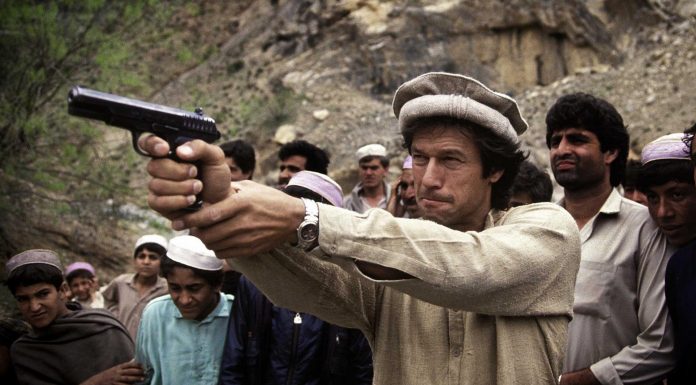
Reacting to India’s internal matter regarding effective abrogation of Article 370 and bifurcation of Jammu and Kashmir, Pakistan Prime Minister Imran Khan today threatened India saying that “incidents like Pulwama are bound to happen again”, after Indian government decided to revoke Article 370 and strip Jammu and Kashmir of the special status. Foretelling a terror attack, Khan said, “I can already foretell this will happen. They will attempt to pin the blame on us again. They may strike us again, and we will strike back.”

Khan was addressing a joint session of the National Assembly on Tuesday to deliberate about the country’s response to India’s decision of scrapping Article 370 from its constitution and thereby revoking the special status granted to the state of Jammu and Kashmir. Khan declaimed that when he came to power, his government’s priority was to improve relations with the neighbouring country including India.

“On my first communication with India, they had raised concerns about militant outfits operating from Pakistan. I assured Modi that after the tragic incident of Army School massacre, all the political parties in Pakistan pledged to not let their land be used for terror activities. However, I felt that the Indian side was interested in talks. My doubts were confirmed on my trip to Bikshek, where the Indian side showed no willingness to talk about the strained relations between the two countries,” Khan said.

Khan further said that the Indian regime believes in Hindu supremacy and their aim to bifurcate Jammu and Kashmir and scrap Article 370 is a manifestation of their entrenched ideology that puts Hindus above other religions and aims to subjugate minorities by the use of sheer brute and force. “What happened in Kashmir reconciles with their ideology. They are racists,” Khan said.

In what appeared as another desperate attempt to draw the world’s attention towards Kashmir after failing innumerable times, Khan said, “India will intensify their clampdown on Kashmiris now. This will result in incidents like Pulwama attack. They will place the blame on us and attack us. We will respond and both the countries will go to war which will have grave consequences for the rest of the world. This is not nuclear blackmail. We want world leaders to take note of this matter. I will inform the Western world about the systematic repression of Muslims done by the Indian government.”

With this threat, all the pretence of Pakistan being serious and committed against clamping down the terror organisations operating from its land stands exposed as PM Khan hails and attempts to glorify terror attacks such as Pulwama attack that killed 40 Indian soldiers.

Pulwama attack was schemed by Pakistan based Jaish-e-Muhammad terror organisation. In a dastardly attack, a Kashmiri youth indoctrinated by religious bigotry was brainwashed to attack a convoy of CRPF convoy, killing 40 soldiers. After the attack, JeM released a video in which the attacker was seen spewing hatred for Hindus. After Pulwama attack, Indian Air Force avenged the deaths of the Indian Bravehearts by conducting airstrikes deep inside Pakistan, in Balakot, killing about 200-300 JeM terrorists.

Ayodhya hearing day 1: “keep the dignity of the court” CJI tells advocate of Muslim party as hearing witnesses heated exchanges

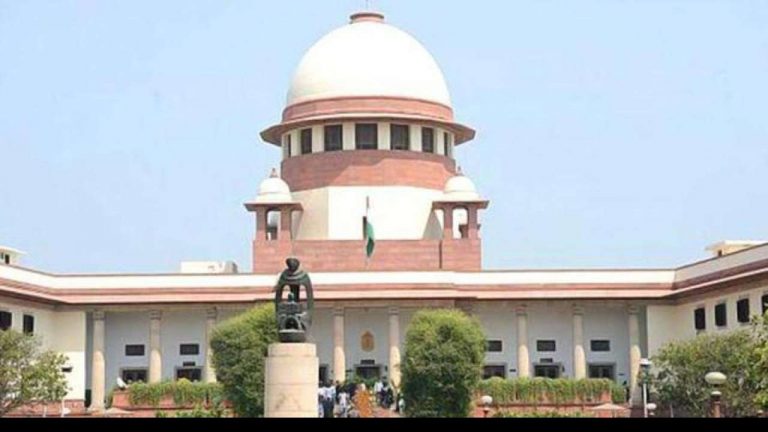
The day to day hearing in the Ram Mandir-Babri Masjid land dispute case commenced in the Supreme Court today. The case was heard by a Constitution Bench of Chief Justice of India Ranjan Gogoi and Justices SA Bobde, DY Chandrachud, Ashok Bhushan and Abdul Nazeer.

The Ayodhya case has been taken up for a day to day hearing after the efforts to arrive at an amicable settlement through mediation failed.

Today was the first day of the hearing in the case and CJI Gogoi has turned down the plea for live-streaming, audio-video recording of the hearing.

Allahabad high court in its September 30, 2010 verdict had divided the 2.77 acres of main disputed Ayodhya land into three equal parts. It had allotted one part each to Ram Lalla (idol), Nirmohi Akhara and Sunni Wakf Board. All three parties had appealed the High Court judgement in the Supreme Court.

Senior Advocate Sushil Kumar Jain began making submissions on behalf of Nirmohi Akhara, which is claiming ownership of the entire disputed plot.

  • He began by saying, “We have been fighting for this for so long because it is an issue of emotions for us.”
  • Senior advocate Sushil Kumar Jain, appearing for the Nirmohi Akhara, said that the “Ram Janmasthan” belonged to, had been the possession of, and was managed by the organisation. “I am a registered body. My suit is basically for belongings, possession and management rights”, said Jain.
  • “Outer courtyard has always been in possession of Nirmohi Akhara, therefore suit of Nirmohi Akhara is limited to the inner courtyard, including Sita Rasoi, bhandar grih.” Attachment order of 1951 is confined to the inner portion, Jain argued in front of the bench.
  • Staking a claim over the disputed 2.77 acres of land, Jain argued, “The place known as Ram Janmasthan or the ‘Janam Asthan’ was also in possession of Nirmohi Akhara and Hindu’s were allowed to worship there”.
  • “The plaintiffs have been wrongfully deprived of the charge and management of the temple”, Sushil Kumar Jain.
  • “I am making a prayer for the removal of the Receiver and giving the custody and management to the plaintiff”, Jain furthered on behalf of Nirmohi Akhara.

While the five-judge bench asked questions to understand the “structure and locations” of the disputed site, the Nirmohi Akhara council argued that its temples had been “demolished by some miscreants with no caste, or creed, or religion” on 6 December 1992.

Explaining the legal status and functions of Nirmohi Akhara, Jain added that Nirmohi Akhara manages several temples.

Asserting that the Jhansi ki Rani was also “protected” by the Akhara after the battle of Jhansi when she “took refuge” at the temple in Ayodhya, Jain on behalf of the Nirmohi Akhara claimed that no Muslims were allowed to enter the structure since 1934 and it has been in exclusive possession of Nirmohi Akhara.

Jain cited Allahabad High Court judgements to back his claims that ‘no Muslims were allowed to enter the structure since 1934″:

  • “A place cannot be considered a mosque if no prayers or namaz are offered there,” the senior advocate said.
  •  The absence of provision for ‘wuzu‘, by which Muslims wash hands and feet before namaz, at the disputed site, was interpreted by the Allahabad high court, to arrive at the conclusion that prayers were not being offered there since 1885 hence it ceased to be a mosque long back, argued Jain.

However, in response to his argument the Supreme Court cited the Allahabad’s high court’s order saying that before 1934, Muslims were offering regular prayers at the site.

Meanwhile, the ongoing argument witnessed a heated exchange of words between the CJI and senior advocate Rajeev Dhavan, who is appearing for the Muslim party.

While the bench was asking the counsell for the Nirmohi Akhara to confine his arguments to the civil dispute and skip reading some written statements, Dhavan interfered and said perhaps there should not be any curtailment of arguments.

The CJI said the hearing of the arguments would not be curtailed in any manner and there should be no doubt in anybody’s mind about it. In response, Dhavan got up and clarified that he meant when CJI stopped him and told him to speak when it is his turn.”Mr Dhavan please maintain the dignity of the court”, said CJI Gogoi to which Dhavan replied, “Your Lordships asked a question, I answered”. However, CJI Gogoi reprimanded the advocate by saying, “there is a way to answer it, you are an officer of the Court”.

Justice Chandrachud, one of the members of the Constitution Bench, questioned Jain whether the basis of the claim of the Nirmohi Akhara to the Ram Janmabhoomi-Babri Masjid land was possession or ownership, to which the counsel said, “Ownership because of possession.”

The Supreme Court, in its reply, said, “In any case, you have been given one-third of the disputed area in a preliminary decree by the Allahabad High Court.”

CJI Gogoi, reading from the Allahabad High Court judgment just before the bench took a break for lunch, quoted the statement and said, “There is no evidence to show that there existed any temple and that there were idols in it”. Jain responded to this by saying, “My lords, the structure was demolished in 1992.”

Gogoi countered the claim by demanding evidence from the advocate, citing the Allahabad judge’s statement about there being “no evidence”.

After this, the bench rose for lunch at 2 pm. Post lunch, Jain assured the judges that he will show “only the findings”. Continuing with his argument, Jain emphasised on the “importance of worshipping the deity” at the “Ram Janmabhoomi site”.

Reading relevant portions from the Allahabad High Court’s judgment in 2010, Jain said that the Nirmohi Akhara’s suit in the dispute was filed in 1959, “four years after the attachment orders were issued in relation to properties in their possession.”

The Counsel and Bench continued to read various parts of Allahabad High Court judgment, with which Day 1 of the hearing in the Ayodhya case came to an end, which will resume tomorrow (Wednesday).

The daily hearings were prescribed by the Constitutional bench on August 2 after taking note of the failed mediation by a three-member panel led by former Supreme Court judge FMI Kalifulla, also comprising of spiritual guru Sri Sri Ravishankar and senior advocate and renowned mediator Sriram Panchu.

The panel had said in its report that the Hindu and the Muslim parties had not been able to find a solution to the vexatious dispute.


A star is born: Meet the 33-year-old Ladakh MP Jamyang Tsering Namgyal who floored the Parliament today with his speech

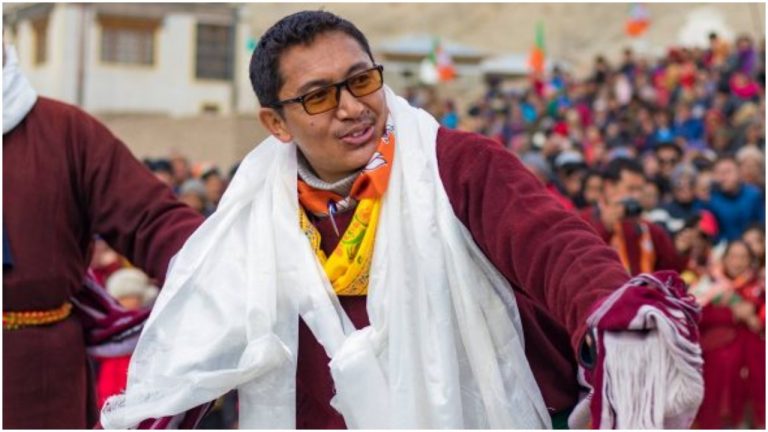
A star has been born today in the form of Jamyang Tsering Namgyal, Member of Parliament from Ladakh, popularly known to people as JTN as he gave a rousing speech in the favour of the state’s bifurcation for which the NDA government has moved the Jammu and Kashmir (J&K) Reorganisation Bill, 2019 in the Parliament.

The 33-year-old Jamyang Tsering Namgyal, one of the youngest MPs in the Lok Sabha from India’s largest parliamentary seat, geographically – Ladakh, pleasantly surprised spectators with his exemplary speech in the Lok Sabha on Tuesday supporting the effective abrogation of Article 370 and proposal to bifurcate Jammu and Kashmir into two Union territories.

Jamyang Namgyal was born in Matho village to Buddist parents. He completed his graduation from the Jammu University. He was also known in the political circles after he became a successful student leader in the Jammu University. Before plunging into politics, he had served in All Ladakh Student Association, Jammu, while becoming its President from 2011-12.

After joining politics as a member of BJP in Leh, he served as Private Secretary to the previous Member of Parliament from Ladakh Thupstan Chhewang. Later in 2015, Namgyal contested and won the election of Ladakh Autonomous Hill Development Council, Leh in 2015 from Martselang Constituency.

He was elected as Councillor in Ladakh Autonomous Hill Development Council in Leh. Jamyang Tsering Namgyal was elected as the Chief Executive Councillor to the Ladakh Autonomous Hill Development Council after the resignation of Dorjay Motup from the post of Chief Executive Councillor.

As 2019 Lok Sabha elections were announced, BJP was in search of a young candidate from the Ladakh region. JTN was decided as the candidate from Ladakh Parliamentary Constituency. He was elected at 17th Lok Sabha, representing Ladakh constituency, replacing his mentor Thupstan Chhewang.

With his speech, Jamyang Tsering Namgyal received rousing applause not only within the Lok Sabha but also from various quarters, with even the Lok Sabha speaker Om Birla noting how well the young MP spoke.

Lok Sabha passes resolution to abolish the provisions of Article 370, and the Jammu and Kashmir Reorganisation Bill

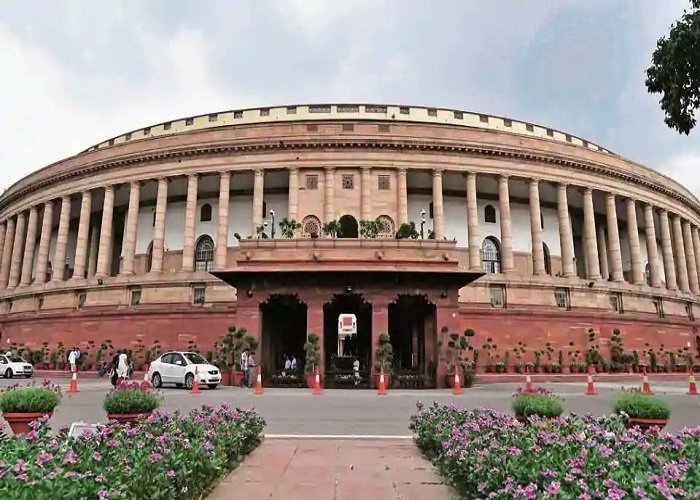
The presidential resolution abolishing article 370 of the constitution has been passed by the Lok Sabha today. The bill was voted by 351 members of Lok Sabha, 72 voted against it, while one MP abstained from voting.


The resolution tabled by Home Minister Amit Shah, which was passed by Lok Sabha reads:

“In exercise of the powers conferred by Clause (3) of article 370 read with clause (1) of article 370 of the Constitution of India, the President, on the recommendation of the Parliament, is pleased to declare that, as from the date on which the President of India signs the Declaration and it is published in the Official Gazette, all clauses of the said article 370 shall cease to be operative except clause (1) thereof which shall read as under, namely:- ”All provisions of this Constitution, as amended from time to time, without any modifications or exceptions, shall apply to the State of Jammu and Kashmir notwithstanding anything contrary contained in article 152 or article 308 or any other article of this Constitution or any other provision of the Constitution of Jammu and Kashmir or any law, document, judgement, ordinance, order, byelaw, rule, regulation, notification, custom or usage having the force of law in the territory of India, or any other instrument, treaty or agreement as envisaged under article 363 or otherwise.”

This means all the existing clause of the Article 370 has been abolished, and it has been amended to contain only one clause, which says that the entire Constitution of India will be applicable on Jammu and Kashmir. This was done using the provision of clause 3 of Article 370.

With this, both the articles giving special status to Jammu and Kashmir has been abolished. The Article 35A, which was inserted by presidential order in 1954, was revoked yesterday when a new presidential order was issued superseding the 1954 order.

The Jammu and Kashmir Reorganisation Bill also has been passed by the Lok Sabha today. After the bill gets presidential consent, Jammu and Kashmir state will be officially split into two separate Union Territories, Jammu & Kashmir and Ladakh.


The bill was voted by 370 members of Lok Sabha, 70 voted against it. The bill was passed by 125-61 votes in Rajya Sabha yesterday, with several opposition parties voting with the government. The bill was passed by Rajya Sabha yesterday, with several opposition parties voting with the government.

With this, Jammu and Kashmir ceases to be a full state of India, and two new Union Territories have been created. Jammu and Kashmir has been made a Union Territory with a legislative assembly, on the line of Puducherry model, while the other UT will be Ladakh, without any assembly. The Union Territory of Ladakh will comprise Kargil and Leh districts, and the Union Territory of Jammu and Kashmir will comprise the remaining territories of the existing state of Jammu and Kashmir.

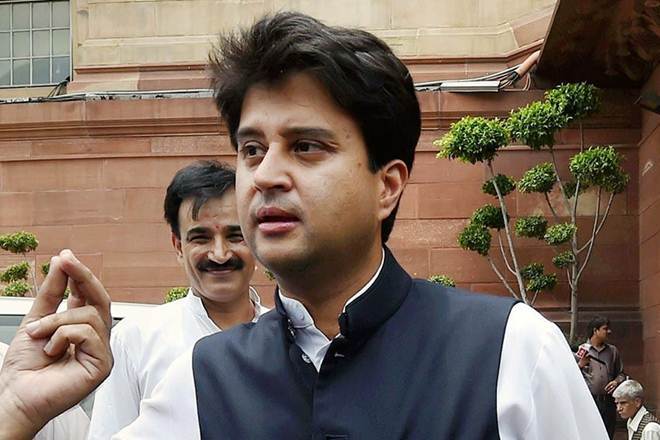
Jyotiraditya Scindia supports Modi govt’s move to dilute Article 370 and bifurcate JK even as Congress toes Pakistan’s line

While Modi Government’s bold move to effectively abolish Articles 370 and 35A and the bifurcation of Jammu and Kashmir are winning them accolades from neighbouring countries like Sri Lanka and UAE it has received mixed reactions from its political opponents.

While most members of the Congress including ex-president, Rahul Gandhi has been toeing the Pakistani line and speaking against the move there are few who have gone against their party’s stand to bat for this bold and pathbreaking decision taken by Modi led NDA government.

Amongst the most unexpected names, was that of Congress loyalist, Jyotiraditya Scindia who joined the list of those Congress leader’s who dared to go against their party’s regular habit of downplaying whatever BJP does and dared to voice their opinion in favour of the conscientious.

The former MP who was until now, being considered as the next face to represent the grand old party, took to Twitter to extend his support on the move of bifurcation of Jammu and Kashmir. Even though his support was also clubbed with a rider that it would have been better if the constitutional process had been followed, nevertheless, he extended his support saying that it was in the interest of the country.


Amongst other’s were, Senior Congress leader Deepender Hooda who extended his support to stripping down of Article 370 saying that Jammu and Kashmir is an integral part of India and such a move will be beneficial to Kashmiris. His support had also come with riders that such a move should have been made by taking other political parties into confidence.

Another senior Congress leader Janardan Dwivedi, a close aide of former Congress President and currently UPA chairperson Sonia Gandhi, too went against the party’s stand and welcomed the move. Congress’ Rae Bareli MLA Aditi Singh, too, welcomed the move.

Moreover, Congress’ chief whip Bhubaneswar Kalita resigned from Rajya Sabha yesterday because he was upset over Congress’ stand to oppose Centre’s move to dilute Article 370. He stated that Congress’ stand on this issue was “against the people’s feelings” and that the party seemed “ hell-bent on political suicide.”

LGBT Rights Advocacy Group trolled by people from the LGBT community for celebrating the complete integration of JK

The entire country is in a celebratory mood after Articles 370 and 35A were effectively abolished by the Indian government. Apart from vested interests and bleeding-heart liberals, everyone is overjoyed with the great step towards national integration.

The LGBT community has a special reason to celebrate the abolition of the provisions. Until yesterday, homosexuality was still a criminal offence in Jammu & Kashmir since the state had a separate constitution. Thus, an advocacy and support group, the Queer Hindu Alliance (QHA), posted a tweet celebrating the historic event.


In a surprising turn of events, the outlet was subject to a vicious attack by an online mob which comprised primarily of people from the LGBT community. QHA was disowned by them and it was claimed that they do not represent the LGBT community.


Indeed, it is quite perplexing that people from the LGBT community are disowning and attacking one of their own for its support toward a government decision which means homosexuals cannot be prosecuted anymore in Jammu & Kashmir. It does appear that people from the LGBT community care more for the prosperity of Radical Islam than their own rights.

The continued support of toxic elements of the Muslim community by the representatives of the LGBT community is rather bewildering. It is well known that when Radical Islam thrives, homosexuals usually end up being thrown off rooftops or stoned to death. In most Islamic countries, homosexuality is illegal and in certain countries, Homosexuality carries capital punishment. In some Islamic countries, there is legal provision for stoning homosexuals to death. Therefore, the unconditional and unreciprocated support by representatives of the LGBT community toward toxic elements who absolutely hate them is inexplicable.

QHA, meanwhile, is a quintessential LGBT advocate. It describes itself on its Facebook page as “an advocacy and support group that will promote a more inclusive Hinduism through creating safe spaces for LGBTQI+ Hindus and allies to engage, share, and support each other without fear or discrimination.” These are explicitly far-left terminology not endorsed by conservative sections of the Hindu community.

The advocacy group, quite clearly, is not a blind supporter of the NDA government. Earlier today, it tweeted its opposition to the Transgender Rights bill proposed by the government.


Thus, the fact that representatives of the LGBT community believe homosexuals shouldn’t celebrate the fact that they can now celebrate their love in the beautiful Kashmir Valley without risking punishment perfectly captures everything that is wrong with LGBT activism. The rights of LGBT people do matter to activists, however, the right of Radical Islam to torture them comes first.

UAE ambassador to India and Sri Lankan PM support Indian govt’s decision to bifurcate Jammu and Kashmir, say ‘internal matter’

The UAE ambassador to India, Dr Ahmad Al Banna has backed the Indian government’s move to effectively abolish Article 370 and move a bill to bifurcate the state of Jammu and Kashmir into two Union Territories-Jammu and Kashmir with legislature and Ladakh without legislature.


Banna said that UAE has taken note of the Indian government’s decision of non-operationalisation of some sections of Article 370 of the Indian Constitution.

Defending Indian government’s measures, Banna said that reorganisation of states is a regular feature in the history of independent India & that it was primarily targeted at reducing regional disparity & improving efficiency. Banna further added that it is India’s internal matter as specified by the Indian Constitution.

The Prime Minister of Sri Lanka, Ranil Wickremesinghe too has extended his support for the Indian government’s decision to convert Ladakh into a Union Territory. Stating that the reorganisation of Indian states is India’s internal matter, Ranil hailed Ladakh Union Territory as a first Indian state with Buddhist majority.


The government maintains that scrapping of archaic Article 370 will bring in peace, prosperity and hope to the region. Home Minister Amit Shah stated that Article 370 has withheld Jammu and Kashmir from enjoying the developments that a modern, inclusive and advanced India has achieved. He also claimed that the long age of violence and bloodshed in the valley will come to an end after the abrogation of Article 370.

Anti-India posters disguised as pro-India come up on streets of Islamabad, removed by police

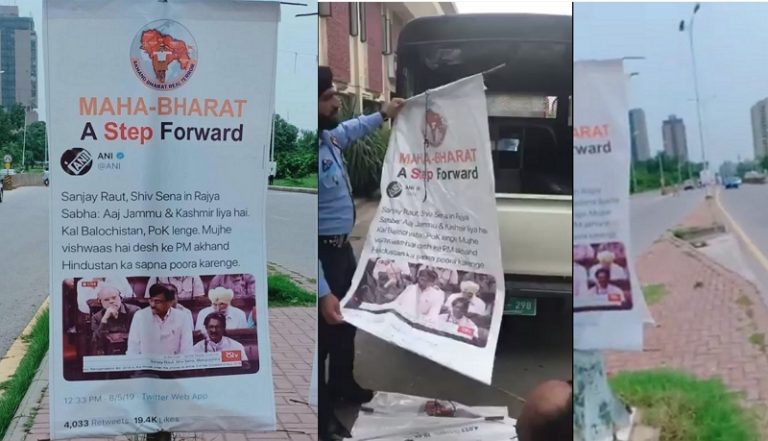
A day after Article 35A was abolished and Article 370 was made ineffective by presidential order, posters sprang up in Pakistan capital Islamabad which appeared to hail the move of Modi government. In videos that have been spreading on circulating on social media, such posters are seen hanging on the median of a road in the city.

The poster says “Maha-Bharat” in large fonts, below which it reads “A step forward”. Below this heading, a tweet from ANI has been printed on the poster, which contains a quote by Shiv Sena MP Sanajy Raut. The quote says, “Aaj Jammu & Kashmir liya hai. Kal Balochistan, PoK lenge. Mujhe vishwaas hai desh ke PM akhand Hindustan ka sapna poora karenge”. (Today we have taken Jammu and Kashmir, tomorrow we will take Balochistan, PoK. I believe the PM of the country will fulfil the dream of undivided India.)


The Pakistani citizen named Sajid, who shot the video, said, ‘I don’t understand, as a nation where are we heading. Indians are putting their posters in our country, in our city, in front of our eyes, and we are sleeping. I can see the posters as far as I can see. You can see that the posters have put up on the streets of Islamabad’.

[youtube https://www.youtube.com/watch?v=7xLTF17XoY8]
Another video shows a large number of same posters being unloaded from truck by a security guard. It seems that posters have been removed from the streets and were carried away in the vehicle.

[youtube https://www.youtube.com/watch?v=mPqgGzaM3qI]
Many Pakistani citizens questioned their authorities how the posters came up in the capital of the country, posting videos and photos of the posters.


Maria Memon, a journalist with Ary News asked who is responsible for the posters, and demanded that heads must role for this.


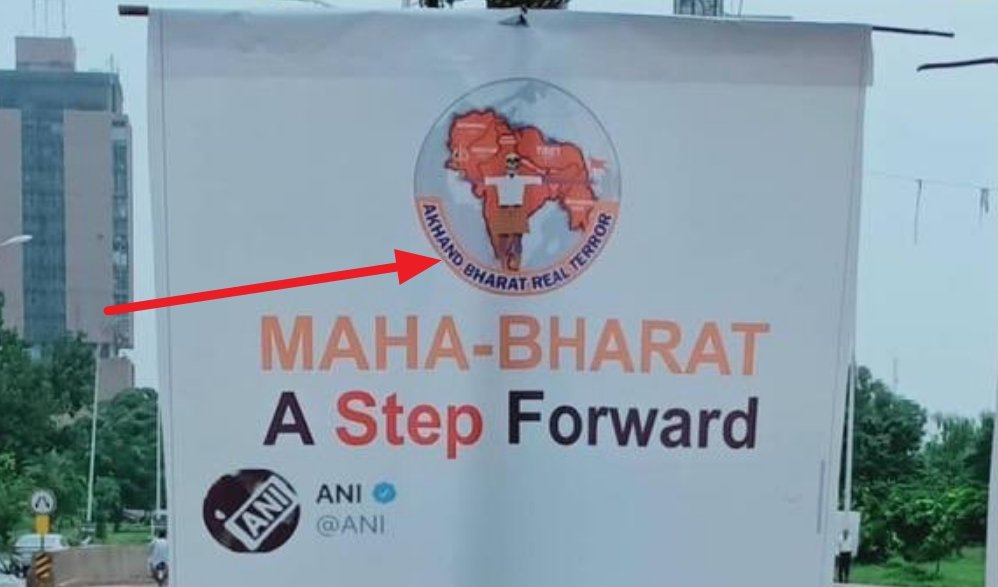
But if we see the posters closely, it is found that they are actually anti-India, not anti-Pakistan. If we see the map printed on the top of the map, a figure with RSS uniform can be seen superimposed on a map of greater India which includes entire South Asia. But the real give-way is the text below it, which says “Akhand Bharat Real Terror”.

The text below the map says “Akhand Bharat Real Terror”

Therefore, it is unlikely that Indians created and distributed the posters, it must be the work of some Pakistani citizen only. The poster has been created to imply that the act of fully integrating Jammu and Kashmir into India is a terror act by India.

It is not known who printed the posters and put it up on main roads of Islamabad.

This is our internal matter, don’t interfere: India reacts sharply to China’s ‘concerns’ over Modi govt’s decision to dilute Article 370

After the Modi government effectively abrogated Article 370 and accorded Union Territory status to J&K and Ladakh, Pakistan and China reacted sharply to India’s bold move.

China has said, “China is seriously concerned about the current situation in Kashmir,” Foreign Ministry spokesperson Hua Chunying said in a written response to media queries about the militaries of India and Pakistan exchanging fire along the Line of Control and the Indian government’s move to revoke Article 370 which gave special status to Jammu and Kashmir.

“China’s position on the Kashmir issue is clear and consistent. This issue is a legacy of history between India and Pakistan, which is also the consensus of the international community,” Hua said, without directly referring to revocation of Article 370 by India.

“The parties concerned should exercise restraint and act with caution, especially to avoid actions that unilaterally change the status quo and exacerbate the tension,” she said.

“We call on the two sides to peacefully resolve relevant disputes through dialogue and consultation and safeguard regional peace and stability”, she said.

Now, India has shot back and asked China not to interfere in the internal matters of India.


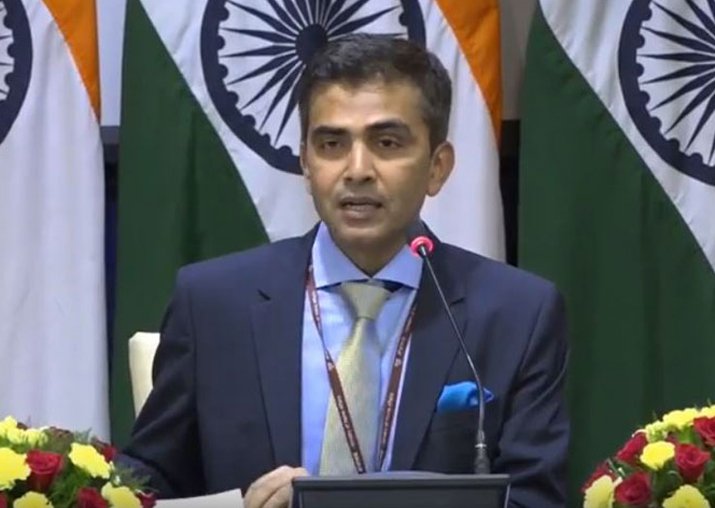
Indian MEA official spokesperson Raveesh Kumar said today:

“The Jammu and Kashmir Reorganisation Bill 2019 introduced by the Government in Parliament on 5th August, which proposes the formation of a new ‘Union Territory of Ladakh’ is an internal matter concerning the territory of India. India does not comment on the internal affairs of other countries and similarly expects other countries to do likewise. So far as the India-China Boundary Question is concerned, the two sides have agreed to a fair, reasonable and mutually acceptable settlement of the boundary question on the basis of the Political Parameters and Guiding Principles for the Settlement of India-China Boundary Question. Pending such a settlement, both sides have agreed to maintain peace and tranquillity in the border areas on the basis of relevant agreements”.

Pakistani media uses Congress MPs and other opposition leaders’ speech in Parliament to further their agenda on Kashmir

Since yesterday when Prime Minister Modi-led BJP government secured a Presidential order abolishing Article 370 and brought a bill to bifurcate Jammu and Kashmir, rattled Pakistanis have been endlessly ranting about India’s internal matter, claiming that India’s move to create two Union Territories is in contravention to the UN conventions agreed upon by Jawaharlal Nehru in 1948.

India’s position over the Kashmir issue has always been the same. India has always maintained that Jammu and Kashmir is an integral part of India and any discussions with Pakistan will only be bilateral. Regardless of the party ruling the centre, the national position has always been the same. India had even conveyed the same to US President Donald Trump recently when he had declared in media that he is willing to mediate.

However, in the blind race of political ambition and to vilify the ruling party, some Indian politicians have been displaying time and again that they are willing to put the interest of the nation in the backburner and try to vilify the ruling party at any cost. This tendency provides fodder to India’s enemies to further their agenda.

Regardless of the truth, Pakistanis anchors are using Indian politicians’ opposition to Jammu and Kashmir’s special status ensured by Article 370 and the bifurcation for governance efficiency in their shows to afford credibility to their bluster.


Twitter user Ankur Singh has shared a video clip of a news show aired by Pakistan’s Geo tv where Pakistani anchor Hamid Mir can be seen showing Indian politicians’ statements against the abrogation of Article 370 to drive home his point that Indian government’s move is illegal and repressive as the opposition leaders in their parliament have themselves pointed out.

Pakistani news channel Geo TV showed objections held by the Congress politicians and other opposition leaders repudiating the central government’s stand vis-a-vis Jammu and Kashmir. The Pakistani news channel showed Congress senior leader Ghulam Nabi Azad’s proclamations that BJP had murdered the constitution of India. P Chidambaram stating that it is the Black day in the country’s constitutional history was also broadcasted while slamming India. It also showed RJD leader Manoj Kumar Jha’s apprehensions that Kashmir will turn into Palestine within 5 years.

These statements made by Indian opposition leaders offer enough ammunition to the Pakistani media outlets who instantly lap up their remarks to advance their nefarious propaganda against India. The comments made by Congress politicians and other opposition leaders are co-opted by Pakistanis to project India as an occupying force, engaged in subjugating and repressing Kashmiris through illegal abolition of Article 370 and unwarranted bifurcation of the state.

The Indian government’s intent behind bifurcating Jammu and Kashmir have been directed towards increasing investment, annihilating terrorism and eliminating discrimination in the state. However, the opposition leaders’ unsubstantiated claims cast aspersions on the government’s aim and undermine their credibility which is then exploited by enemies of the state to further their propaganda.

This is not the first time that Congress ministers have echoed sentiments similar to that of Pakistanis. Following the Balakot airstrikes after the Pulwama terror attack, Pakistan’s FM used Congress’ rants to discredit the government of India and the Indian Army. Prior to that Pakistan had used Congress leader Digvijaya Singh’s tweets demanding proofs of airstrikes to target India.