On December 22, the Mumbai Police arrested one Insan Husain Shaik for sexually assaulting his minor daughter and impregnating her. The accused who has been arrested is 42 years old and the victim is 16 years old.
According to reports, the incident came to the fore when the victim was found pregnant. On asking, she revealed that she was raped by her father Insan Husain Shaik. The Police took cognizance of the incident and registered an FIR in the case. The accused has also been arrested by the Police under sections 376, 376 (N) of the IPC and under POCSO Act.
Maharashtra | A minor girl was raped by her 42-year-old father Insan Husain Shaik. Police have registered a case against the accused U/s 376,376(N) of IPC & under POCSO Act. The accused was arrested, matter came to light after the minor girl was found pregnant: Mumbai Police
The complaint was filed by the victim at Shivaji Nagar Police Station in Mumbai. Senior Officer Arjun Rajane stated that the father was a stepfather to the victim. He said that the mother of the victim had married three times and that the victim was her child from her first husband. However, the accused is the third husband of the girl’s mother.
Earlier, a similar incident was reported from Ahmednagar, Maharashtra where a minor girl was raped several times by the accused identified as Ajmoddin Mohammed Sheikh. The accused had trapped the girl into a love affair and had raped her brutally. The Police had then booked the accused under IPC sections 376 (2) (n), 506 and Protection of Children from Sexual Offences Act (POSCO) sections 5 (j) (2), 5 (l) and 6.
In the current case, the accused has been booked by the Mumbai Police under sections 376, 376 (N) of the IPC and under POCSO Act. The accused has also been arrested and is to be produced in Court soon.
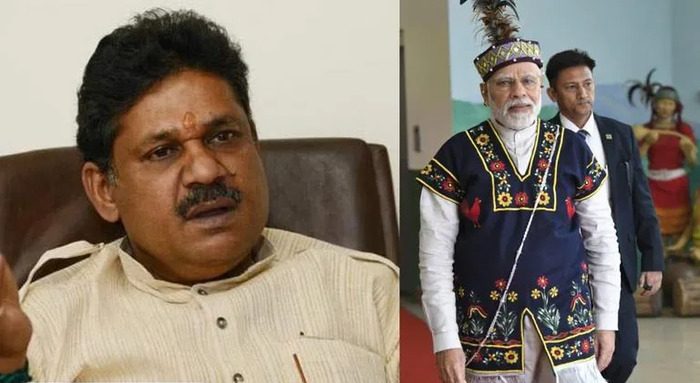
On Friday, December 24, Trinamool Congress (TMC) leader Kirti Azad issued an ‘apology’ over his tweet which made insulting remarks about Prime Minister Narendra Modi without really apologising for insulting the Prime Minister. This comes after the TMC distanced itself from Azad’s disparaging remarks about PM Modi’s traditional attire which he wore during his Meghalaya visit.
Taking to Twitter, Kirti Azad in a series of tweets said that his previous tweet was misconstrued and that he has immense respect and pride for India’s diverse culture.
“My recent tweet was misconstrued. It hurt sentiments of the people. To them I say sorry. have immense respect & pride for our diverse cultures. I regret the hurt caused by my unintentional remark. I reiterate my pledge to work to uphold our constitutional values always,” Azad tweeted.
My recent tweet was misconstrued. It hurt sentiments of the people. To them I say sorry. have immense respect & pride for our diverse cultures. I regret the hurt caused by my unintentional remark. I reiterate my pledge to work to uphold our constitutional values always
The “soldier of TMC,” however, did not apparently apologise for derogatory remarks he made about PM Modi.
“As a soldier of the party, I have always followed the path laid down by our Constitution which calls for respecting and honouring our diversity. Anything that appears like an inadvertent digression from that path is absolutely regrettable,” another tweet by the former cricketer read.
As a soldier of the party, I have always followed the path laid down by our Constitution which calls for respecting and honouring our diversity. Anything that appears like an inadvertent digression from that path is absolutely regrettable.
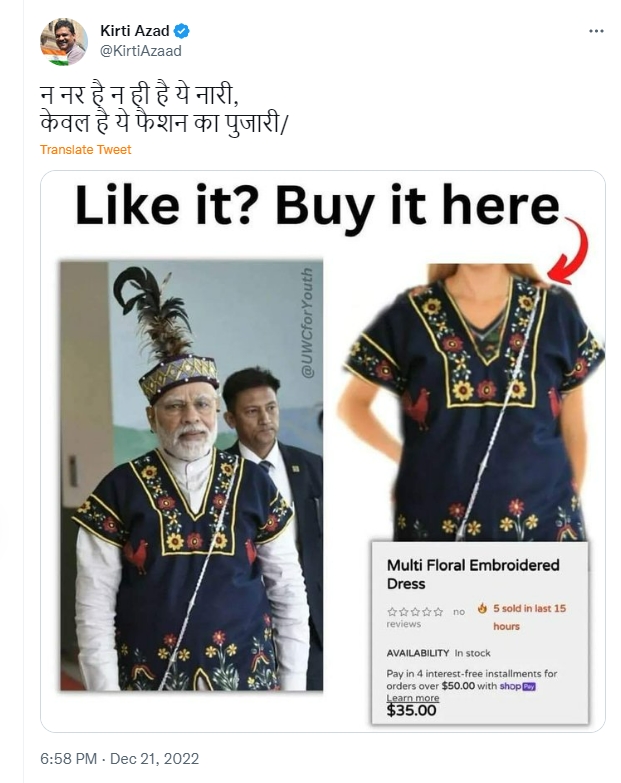
Notably, on Wednesday, Kirti Azad tweeted a photoshopped image of PM Modi wearing a traditional attire of Meghalaya during his visit to Shillong to insinuate that PM Modi was wearing a woman’s attire.
In his now deleted tweet, Azad also wrote a derogatory caption which read, “ “It’s neither male nor female. It’s just the priest of fashion.”
Apparently, the TMC leader called the Prime Minister to be a transgender person or a cross-dresser.
As we reported earlier, the image that Azad shared was photoshopped and that two images were combined to create the fake image.
The official Twitter handle of the Trinamool Congress, posted a tweet distancing itself from Azad’s tweet mocking PM Modi.
“We uphold India’s diversity & respect the vibrant culture of our nation. Proudly, we celebrate the ethnic traditions of diverse people and strive to empower them. We do not support @KirtiAzad’s comments & strongly condemn it. His remarks do not reflect the party’s views,” a tweet by the official Twitter handle of TMC read.
Azad’s tweet sparked outrage on Twitter with netizens slamming Azad for stooping to a new low just to express his hatred for PM Modi. Besides, the Chief Minister of Meghalaya also called out Azad’s derogatory tweet.
Meghalaya CM Pema Khandu quoted Kirti Azad’s tweet (now deleted) and called Azad’s “mockery of the rich tribal culture and heritage as contemptuous and abominable and also an affront on the dignity of womanhood.”
It is pertinent to mention that PM Modi’s image used in the doctored image is from his recent visit to Meghalaya on Sunday.
On Sunday, December 18, 2022, Prime Minister Narendra Modi addressed a North Eastern Council (NEC) meeting in Shillong. The meeting was held to mark the North Eastern Council’s formal inauguration in 1972 and its golden jubilee. During this program, PM Modi was dressed in Khasi attire.
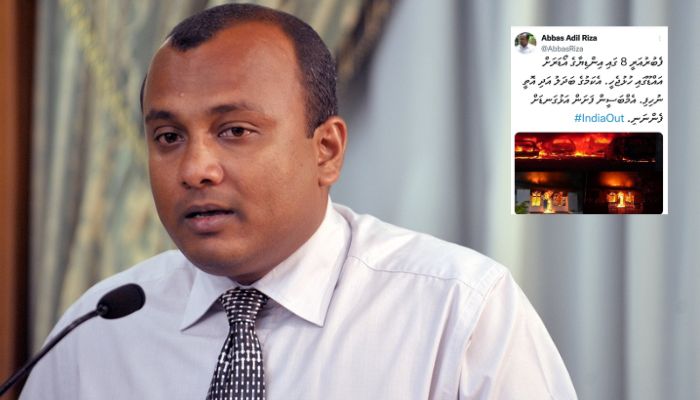
On Friday (December 23) morning, a Maldivian politician named Abbas Adil Riza courted controversy after he called for an arson attack on the Indian High Commission in the capital city of Malé.
Abbas is currently a member of an Islamist political party named Progressive Party of Maldives (PPM) and had earlier served as the Commissioner General of Customs during the rule of former President Abdulla Yameen Abdul Gayoom.
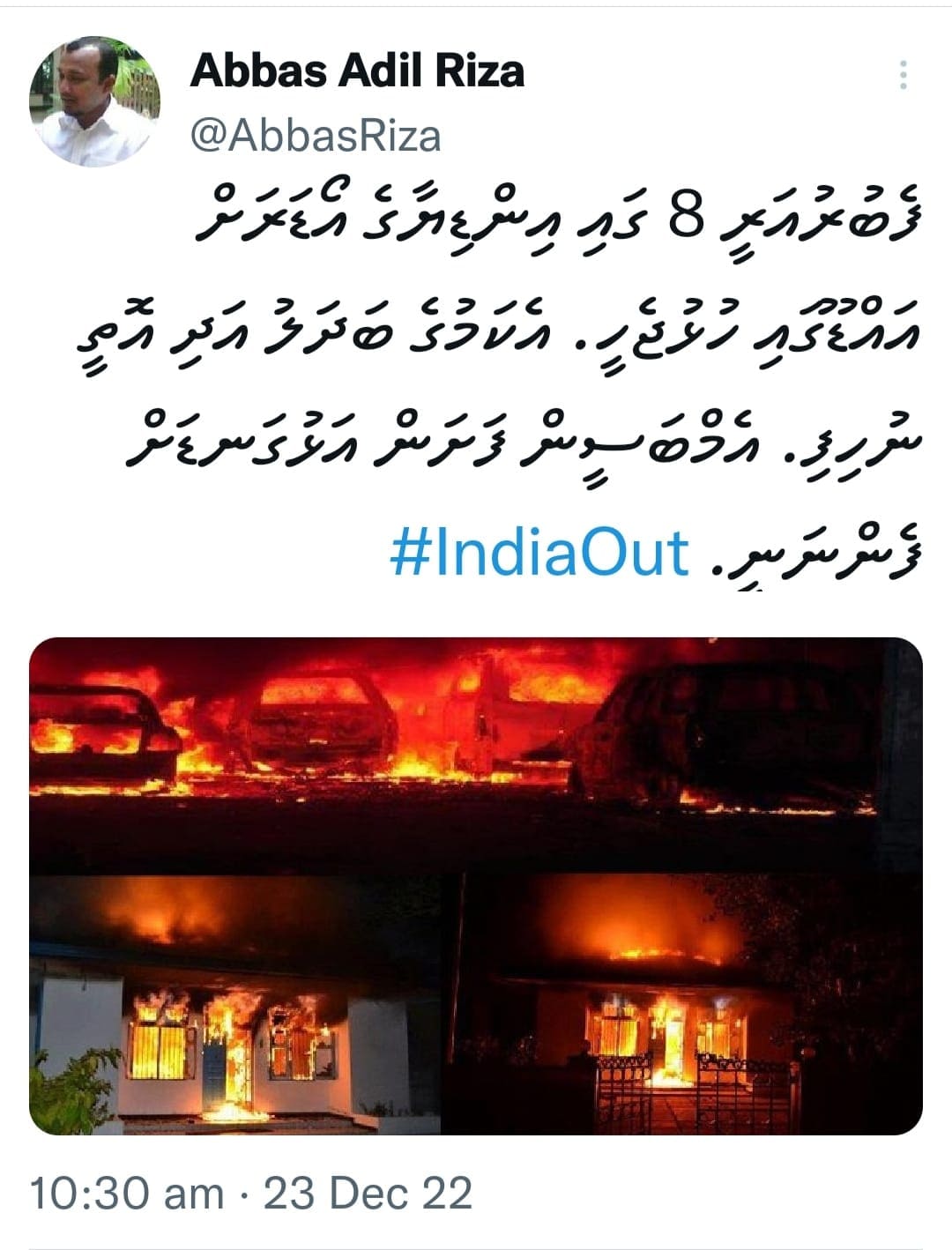
In a tweet, Abbas Adil Riza wrote, “The 8th February arson attacks in Addu were carried out on India’s order. We haven’t retaliated to that yet. I propose we start from the Indian High Commission. #IndiaOut”
Screengrab of the controversial tweet by Adil Abbas Raa
The controversial tweet by Abbas, wherein he threatened violence against the Indian High Commission, was retweeted 58 times and liked by 32 people at the time of writing.
The PPM politician was referring to the violent protests, which took place on February 8, 2012, following the ouster of President Mohamed Nasheed at ‘gunpoint.’ After Nasheed was ‘forced’ to resign, his supporters held demonstrations at Republic Square in Malé.
This led to a clash between the protestors and the police, with the latter responding with lathi charge and tear gas shells. Several supporters of President Nasheed were also arrested. Abbas Adil Riza has now claimed that the violence by Nasheed’s supporters was orchestrated at the behest of Indian authorities.
He has now vowed to take ‘revenge’, 10 years after the incident, and directed his followers to attack the Indian High Commission in Malé.
Political parties in Maldives condemn tweet by Abbas
After realising the long-lasting damage that the tweet by the PPM leader can cause to the bilateral ties with India, the ruling Maldivian Democratic Party (MDP) condemned the statement.
“The MDP condemns in the strongest terms the call for an arson attack on the Indian High Commission and calls on the authorities to investigate the matter. The MDP also condemns the opposition’s continuous effort to incite violence & hatred towards friendly nations,” it said in a tweet.
The MDP condemns in the strongest terms the call for an arson attack on the Indian High Commission, and calls on the authorities to investigate the matter. The MDP also condemns the opposition’s continuous effort to incite violence & hatred towards friendly nations.
Another political party nzmMaldives Third Way Democrats (MTD), which came into existence in 2018, also criticised the statement by Abbas Adil Riza.
“MTD condemns the call for arson attack & inciting terror against the Indian High Commission in Maldives by PPM member and former government official Abbas Riza. India is our closest neighbour & they are always there for Maldives in every time we needed,”
MTD condemns the call for arson attack & inciting terror against the Indian High Commission in Maldives @HCIMaldives by PPM member and former government official @AbbasRiza !
India ?? is our closest neighbor & they are always there for Maldives ?? in every time we needed. https://t.co/oV9dhkURdH
Maldives Reform Movement, a political party founded in 2019, stated, “MRM strongly condemns this cowardly incitement of arson and terrorism, targeted at High CommissionIMaldives. We call on authorities to investigate and take strong action against this, and such other acts of hate speech instigating violence.”
MRM strongly condemns this cowardly incitement of arson and terrorism, targeted at @HCIMaldives. We call on authorities to investigate and take strong action against this, and such other acts of hate speech instigating violence.@AmbMunu@PoliceMv@MNDF_Officialhttps://t.co/R9VhxJY2zg
The so-called ‘India Out’ campaign began in 2020 as on-ground protests, which later shifted to social media as a ‘hashtag campaign’. Besides the Progressive Party of Maldives (PPM), one of the frontrunners of this anti-India campaign has been a news outlet by the name of Dhiyares.
While speaking to The Indian Express, Dhiyares co-founder Shifxan Ahmed alleged, “We are just protesting military presence in the country. We are not calling for a violent clash against India or Indians in the Maldives.”
According to one research analyst, Dr Gulbin Sultana, the ‘India out’ campaign is led by former President Abdulla Yameen Abdul Gayoom. Sultana added that it is not a civil society movement anymore but rather a political movement.
It must be mentioned that former President Yameen, who is behind the campaign, had been pro-China during his tenure between 2013 and 2018 as Maldivian President.
Owing to the anti-India sentiments fuelled by the divisive campaign, Indian teachers had been at the receiving end of harassment from protestors. ‘India Out’ campaigners had targeted 2 Indian teachers on two different islands under the garb of protests. They were asked to leave the country.
The cases were confirmed by the Education Ministry of Maldives. “The ministry has also filed a case with the police since the Shaviyani Funadhoo School’s wall has been vandalized with spray paint, in a sign that reads India Out,” a report in The Edition stated.
The Maldives is of strategic importance for both India and China, with the Communist regime trying to exert its influence in the Indian Ocean. To counter this, India has invested large sums of money in the island nation and has now become of the largest investors in the island nation.
One of the primary arguments behind the ‘India out’ movement is the alleged presence of Indian military forces in the island nation. While speaking on this matter, Chief of Staff at President’s Office Ali Zahir said that the presence of foreign military did not automatically imply foreign control over the Maldives.
“Even our own military personnel are stationed in various countries abroad,” he added.
On Friday, December 23, Madhya Pradesh police booked a wrestling coach for abducting a minor Muslim girl from Bhopal. Naveen Nara, a wrestling coach from Rohtak district in Haryana converted to Islam to marry his 16-year-old girl who is a Muslim wrestler. MP police claimed that Naveen was already married.
Speaking on the case, Deputy Commissioner of Police (DCP) Riyaz Iqbal said that “The girl’s father told us that they met Naveen in Rohtak in July at a wrestling event. Naveen began attempting to persuade them to take their daughter to Rohtak for training. In August, Naveen travelled to Bhopal to visit the girl, but the family didn’t entertain him because they didn’t like his behaviour.”
The DCP further said that the family of the girl filed a complaint at Shyamla police station accusing Naveen of abducting their daughter in a car. Following the complaint, Naveen was booked for abducting a minor.
According to the DCP, while conducting an investigation, police located Naveen’s home in Charkhidadri in Jhajjar while tracking the stolen car.
“The girl was located in Rohtak, where he had married her by converting to Islam since he was already married and she was a minor,” DCP Iqbal added.
As per a Times of Indiareport, the couple got married as per the Islamic rituals in a Mosque at Nayagaon in Mohali.
Notably, the minor girl, citing a recent ruling of Punjab and Haryana High Court which held that a Muslim minor girl can marry a person of choice upon attaining puberty, filed a petition in Punjab and Haryana HC seeking protection for the couple from her family.
Umesh Yadav, Shyamla Hills police station in-charge said that the girl quoted the High Court’s October 28, 2022 ruling, which stated that a Muslim girl’s marriage after reaching puberty would not be invalid under section 12 of the Prohibition of Child Marriage Act 2006, to legalise their marriage. “We showed the court the CCTV evidence that proved he kidnapped the girl from Bhopal. On December 9, the girl was handed over to us by the court.
Despite everything, Nara was able to avoid arrest. According to a senior police official, they found the girl residing with him in Rohtak but chose not to arrest him due to the high court petition. “The girl appeared in court on the day of the hearing, and we brought her back,” the police officer added.
Notably, the girl was not willing to return to her parents and was repeatedly saying that she was not abducted. She said that she went along with Naveen and married at her own free will.
It is pertinent to mention that a woman named Jaya Phogat claiming to Naveen Nara’s first wife had filed a petition alleging that Naveen had not changed his religion while marrying the Muslim minor girl.
According to Shyamla police station inc-charge, the girl was handed over to her family members after counselling. On Friday, she recorded her statement in court that she was not abducted.
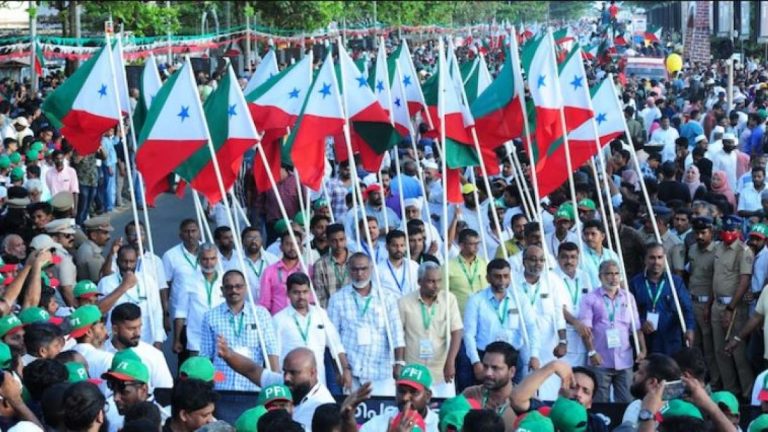
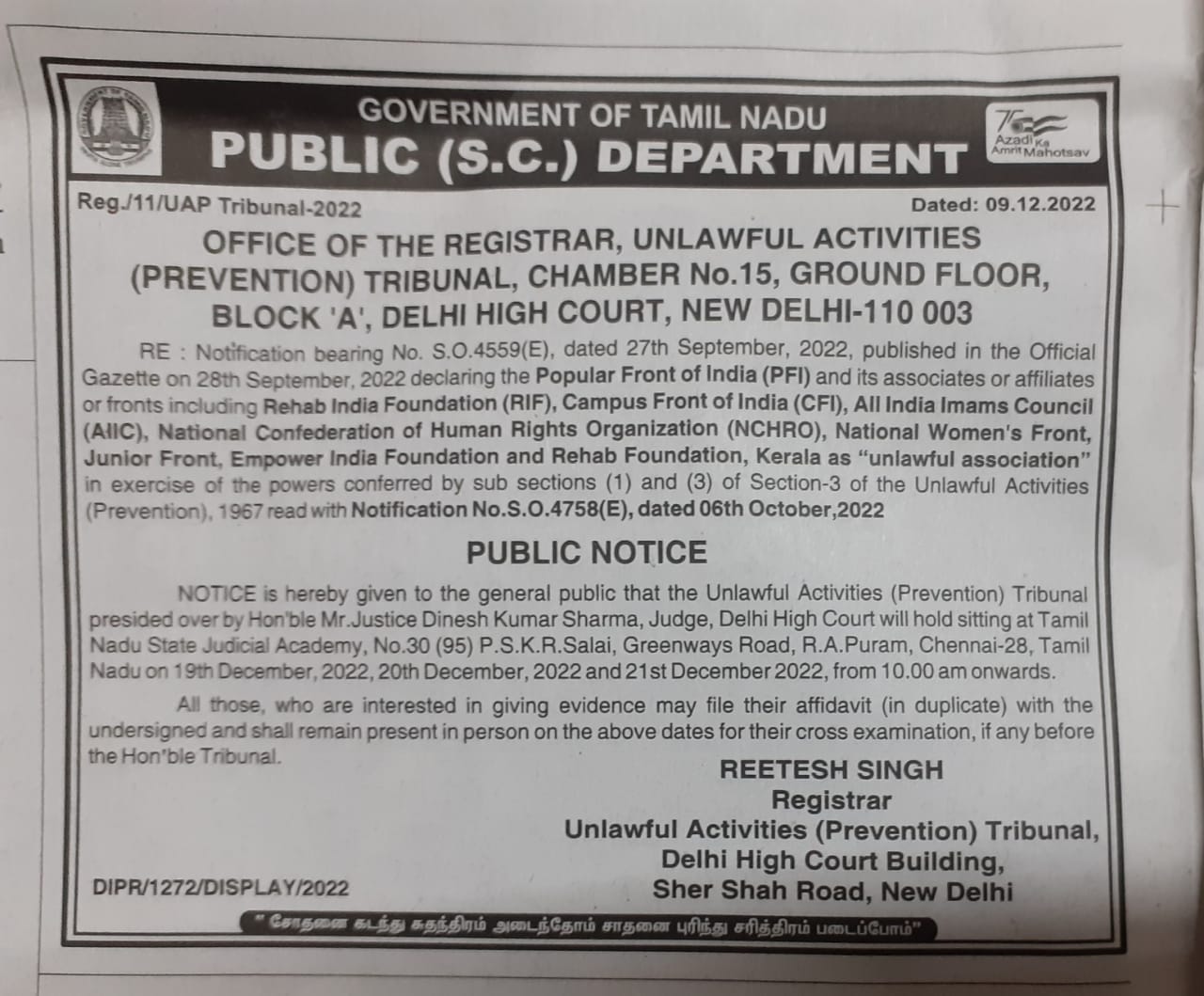
In the matter of Notification published in the Official Gazette on 28-9-22 declaring the Popular front of India and its associates and affiliates as unlawful association a Public Notice was issued in the State of Tamil Nadu on 9/12/2022 where evidence in form of Affidavits was called for against the proscribed PFI and its associated organisations. The Sufi Islamic Board filed an affidavit in the matter, listing evidence against PFI and supporting the ban on the Islamic organisation.
Calling PFI an organisation inspired by the Muslim Brotherhood, the affidavit says that Sufi Islamic Board had written to Tamil Nadu DGP to deny permission for the ‘Unity March’ that was proposed by PFI in several cities on the 10th of March 2022. For that, PFI sent a legal notice to Sufi Islamic Board and a counter notice had been furnished. On the 25th of March 2022, SIB held a press conference outlining the Jihadi threat posed by PFI and Turkish organisation IHH, especially after India had decided to be neutral on the Russia-Ukraine war.
SIB states in the Affidavit that PFI shares its ideology with the Muslim Brotherhood (MB), an International Terror organization, which has been banned in many Countries like Egypt, Syria, Saudi Arabia etc. The PFI dotes Muslim Brotherhood-based International terrorists like Aiman Az Zawahiri and Yusuf Qardawi. The International terrorist Aiman Zawahiri, the leader of the UN-banned Al Qaeda, is also a Muslim Brotherhood activist. He has also pledged allegiance to the Taliban which in turn is spearheaded by another International Terrorist Yusuf Al Qardawi who had issued a fatwa (religious edict) to Kill President Qaddafi of Libya. This Yusuf Al Qardawi had supported terrorism in Kashmir. In 2009, Al-Qaradawi issued a fatwa (religious edict), asserting that “the Kashmiris were properly fighting jihad against the Indian army.” and that the proclamation of jihad was legitimate.
Providing evidence of PFI’s Jihadi activity, the affidavit says that PFI had before the Egyptian Embassy in Delhi against the death sentence awarded to Qatar-based Jihadi Yusuf-al-Qaradawi and the ousted president of the Muslim Brotherhood. It says that PFI is aware of the role played by Qaradawi in the killing of Col Qaddafi and establishing a reign of terror in Libya. He had also called for Jihad against the Syrian government by calling it the ‘party of Satan’. In fact, the affidavit lists PFI Islamists who had then travelled to Syria on the call of Qaradawi and it says that these Islamists had gone to wage Jihad with the held of the Turkish Islamist organisation IHH.
In 2018 the leaders of PFI met had İnsan Hak ve Hürriyetleri İnsani Yardım Vakfı, “IHH” leaders in Turkey with a view to widening the ambit of Jihad. Ali Fuat Yılmazer, former head of the police intelligence department of Turkey specializing in extremist religious groups, testified in a Turkish court hearing on 16 August 2016 that “IHH” campaigns are designed to provide assistance to jihadists engaged in terrorism worldwide and to provide medical assistance, finance, logistics and human resources to jihadists.”He himself had provided detailed reports on the relations of the terrorist organization IHH with Erdoğan when he was Prime Minister. In the Affidavit it has also been stated that PFI knows that Russia revealed the irrefutable involvement of the “IHH” organization in terrorist activities, according to intelligence documents submitted to the UN Security Council on February 10, 2016.
The affidavit then goes on to list the terrorist activity espoused by IHH and says that if IHH is connected to ISIS and Al Qaeda, both proscribed terror outfits then by extension PFI also becomes a terror organisation by virtue of its association with IHH.
The affidavit further says:
On 7th of April 2022 at 11.15 pm the Sufi Islamic Board received a Tweet on its Official Twitter Handle from Dr. Al Massari and His Organization Party of Islamic Renewal stating “For siding with Hindutva-Brahman supremacist fascism against Muslims i.e. Hijabi Muslim school girls & Popular Front of India etc the @sufiboard exposed themselves as munafiq kaffirs”. Along with this Tweet, some other Tweets were also tagged to PFI and its state units. In one of the tagged tweets there is a copy of a letter/statement attached with the heading “Letter to the Popular Front of India. Disregard Bans and re-organise into a Revolutionary Army… in the coming civil war”.
In this letter which was addressed to PFI, it is said that Jihad against the Indian regime is the right of all Muslims on Earth and it is positive to see Muslims in India mobilising under The Popular Front of India. The letter continues: “ as such, Muslims in India have the Islamically legitimate right to carry out insurgency, sabotage and and espionage against the officials of the of the Indian regime involved in the oppression and as well as soldiers and Police officers enforcing oppression.”
In this letter it is also said that already the “Sufi Islamic Board (Shaukat Ali the deponent herein ) has criticized Popular Front of India for radicalizing the Muslims. it is the fascist BJP / RSS Hindutva Brahmin supremacist policies which are alienating the Muslims and if groups like Sufi Islamic board do not fall in line behind the project to protect the Muslims of India from prosecution and potential genocide they should be dismissed as munafiq (hypocrites) / Kafir (non muslims) which the treacherous Shaukat Ali (Advisor, International Affairs, Sufi Islamic Board) has clearly shown to be’…“To achieve in house cleaning must also be done ( Euphemism for killing opponents)…if war should erupt and if they and the enemies of Islam and Muslims either militarily or through propaganda they can be treated as Harbi Worriors / munafik / kafir and can be engaged militarily along with other forces engaged in the operation of Muslims.”.
PFI is fully aware that Al Massari’s call for jihad, insurgency, sabotage, espionage, against India is unlawful activity as defined under UAPA 2(o) which is punishable under section 13 of UAPA. As a so called organization standing for “communal harmony” , PFI is aware it has also committed sedition as it has brought hatred or contempt, disaffection towards the Government of India. It has promoted enmity between different groups on grounds of religion punishable under Section 153A IPC . It has incited others to commit terrorist activity like use of drone, 3D printing(counterfeiting ) , killing army and police officers punishable and cyber terror, under section 15 of UAPA and 66F IT Act respectively. By supporting the Taliban Haqqani Network and Al Qaeda Dr. Al Massari and his organization is their manifestation. By giving tacit support to Dr Massari and his Islamic Renewal Party, the PFI has shown support to an organization banned by the UNSC and UAP Act 1967 .
If PFI were a “law abiding Organization”, PFI would know that Al Massari has deliberately circulated this statement with intent to cause mutiny in the Defence forces and to create fear or alarm in the public or to induce others to commit offences against the State to incite the misguided elements among the Muslims to commit offence against the Hindus which is punishable under section 505 IPC.
If PFI claimed to believe in human rights then it would also be aware that the statement of Al Massari also criminally intimidates the members of Sufi Islamic Board for performing their constitutional duty of fighting disruptive and terrorist forces, Yet PFI remained silent which amounts to agreement with Al Massari, The Letter itself shows that there is a nexus between the Popular Front of India and Terrorists Organizations of the World and together they want to spoil the National Fabric of our Nation. The tweets were also tagged to PFI but till its ban the PFI did not come forward disapproving the tweet which shows an undeniable nexus and decimates PFI’s contention that it stands for “national integration, communal amity and social harmony and rule of law in the Country” .
Like birds of a same feather flying together, Al Massari choose to address PFI not any other organization in India to launch a jihad against the Government of India. From Al Massari’s clarion call to PFI to launch Jihad , any reasonable mind can come to a conclusion that PFI was being held in high esteem by like minded terrorists which lends credence to this ban. From a conspectus of the above, it is clear as daylight that the PFI harbours ill will to communal harmony and wants to bring Global jihad in India in order to convert India into another Syria.
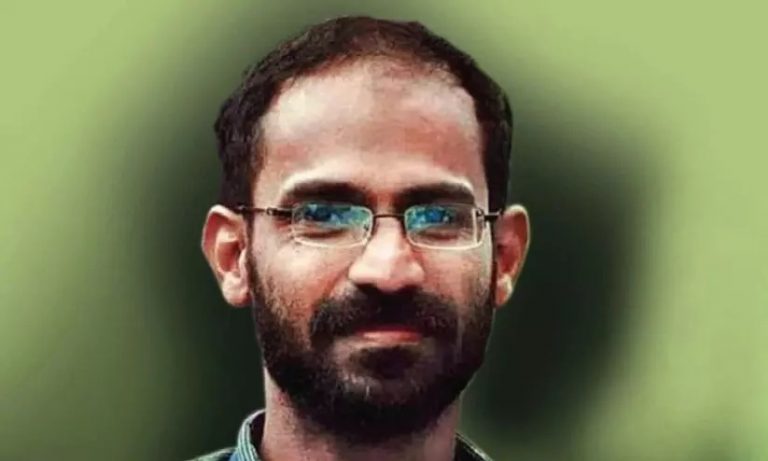
The Allahabad High Court has granted bail to Kerala-based journalist Siddique Kappan, who was arrested in October 2020 by the Uttar Pradesh police on his way to report the Hathras gang rape case.
He was granted bail on Friday in a case lodged by the Directorate of Enforcement under the Prevention of Money Laundering Act, 2002. Justice Dinesh Kumar Singh of the Lucknow Bench of the high court passed the order.
Kappan, who is also the secretary of the Delhi unit of the Kerala Union of Working Journalists (KUWJ), was arrested by the Uttar Pradesh Police along with three others, while they were going to report an alleged gang rape and murder case of a 19-year-old Dalit girl in Hathras.
Earlier on November 1, a local court in Uttar Pradesh’s Lucknow refused to grant bail to the Kerala-based journalist in the money laundering case.
On September 9, the Supreme Court granted bail to Kappan, who was arrested under the stringent Unlawful Activities (Prevention) Act. In the order, Chief Justice UU Lalit, Justice S Ravindra Bhat, and Justice PS Narasimha had directed that the petitioner would be released on bail in the next three days after applying in the trial court.
(This news report is published from a syndicated feed. Except for the headline, the content has not been written or edited by OpIndia staff)
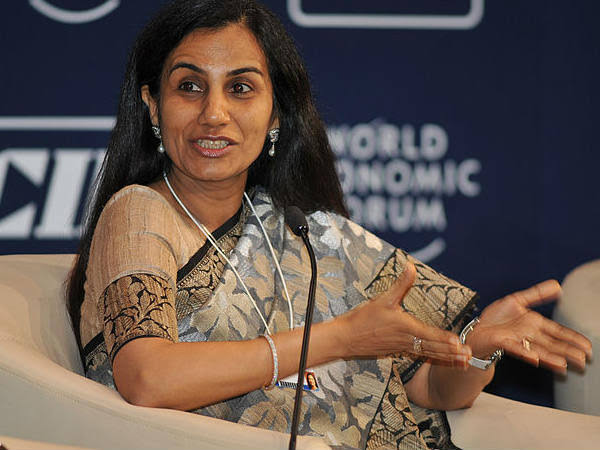
The Central Bureau of Investigation (CBI) on Friday arrested former ICICI Bank CEO Chanda Kochar and her husband in connection with a loan fraud case.
The arrest has been done as part of its investigation into a money laundering case involving the bank and the Videocon Group.
A probe was ordered on Kochhar after fresh claims of ‘quid pro quo’ dealings with the Videocon Group emerged when a whistleblower claimed she had violated rules on the code of conduct and ‘conflicts of interest’ norms. As per reports, the ICICI Bank has stated that the inquiry on Kochhar will be overseen by the bank’s audit committee and will be led by an independent person, most likely a retired Supreme Court Judge. The bank officials have also reportedly stated that the inquiry will begin next week and will be completed within two months. A law firm and a forensic auditor also are expected to be roped in.
Chanda Kochhar has been under the scanner since news emerged that the CBI has started a preliminary enquiry against her husband Deepak Kochhar for being involved in quid pro quo business dealings with Venugopal Dhoot, the promoter of Videocon Group. Though Chanda was not named as a suspect in the initial investigation, it was alleged that the Videocon Group was given a loan of Rs 3,250 crores from the ICICI Bank under Chanda Kochhar’s approval and six months later, Venugopal Dhoot had set up a joint venture with Deepak Kochhar.
The Joint Venture, indirectly funded and financed by Dhoot, was named NuPower Renewables Pvt Ltd. After a series of transactions and questionable transfers of shares came to be owned by Deepak Kochhar, his father and Chanda’s brother’s wife.
It is notable that almost 86% of the 3250 crores loan remains unpaid and was declared NPA in 2017. Both Deepak Kochhar and Venugopal Dhoot have been banned from foreign travel by authorities by issuing a Look out Circular. Deepak Kochharand the family members involved with financial dealings of NuPower Renewables have been questioned several times by the CBI.
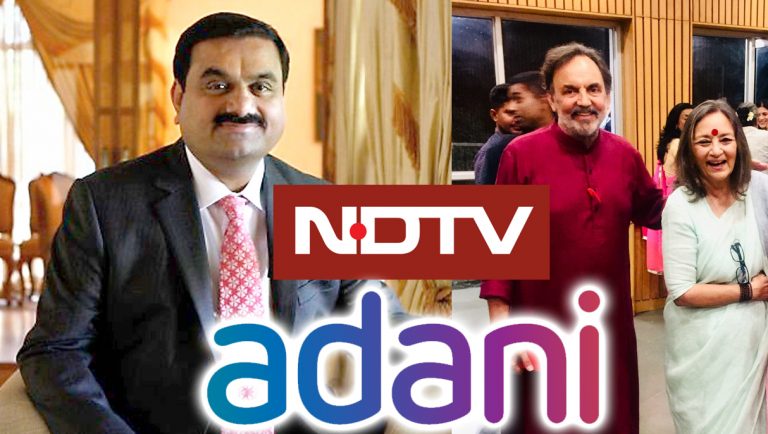
Adani Group has become the majority owner of the news channel NDTV as Radhika Roy and Prannoy Roy – the founders of NDTV – have divested most of their shares to the AMG Media Network of Adani Group in an open offer. The Roys informed about the decision in a public statement issued on Friday in which they hoped that Mr. Gautam Adani will “preserve the trust, credibility, and independence” of the brand NDTV.
Prannoy Roy and Radhika Roy have divested 13.44% and 13.82% of their shares respectively to the Adani Group, a total of 1,75, 77,676 equity shares. This takes the total share of the Adani group in the NDTV to 64.71%. Both Prannoy Roy and Radhika Roy will retain 2.5% shares each in New Delhi Television Limited.
In their statement, the Roys said, “We started NDTV in 1988 in the belief that journalism in India was world-class but needed a strong and effective broadcast platform that would allow it to grow and shine. After 34 years, we believe that NDTV is an institution that has met so many of our hopes and ideals; we are so proud and grateful that across the globe, NDTV is recognized as India’s and Asia’s Most Trusted News Broadcaster.”
The statement further read, “The AMG Media Network, after the recent Open Offer, is now the single-largest shareholder in NDTV. Consequently, with mutual agreement, we have decided to divest most of our shares in NDTV to the AMG Media Network. Since the Open Offer was launched, our discussions with Mr. Gautam Adani have been constructive; all the suggestions we made were accepted by him positively and with openness.”
The Roys concluded their statement by saying, “Mr. Adani has invested in a brand that is synonymous with Trust, Credibility, and Independence, and we are hopeful that he will preserve these values and expand upon them with all the responsibility required of a leader of an organization of this nature. We look forward to watching NDTV, and its entire extraordinary team, delivering the next phase of growth, one that India can be proud of.”
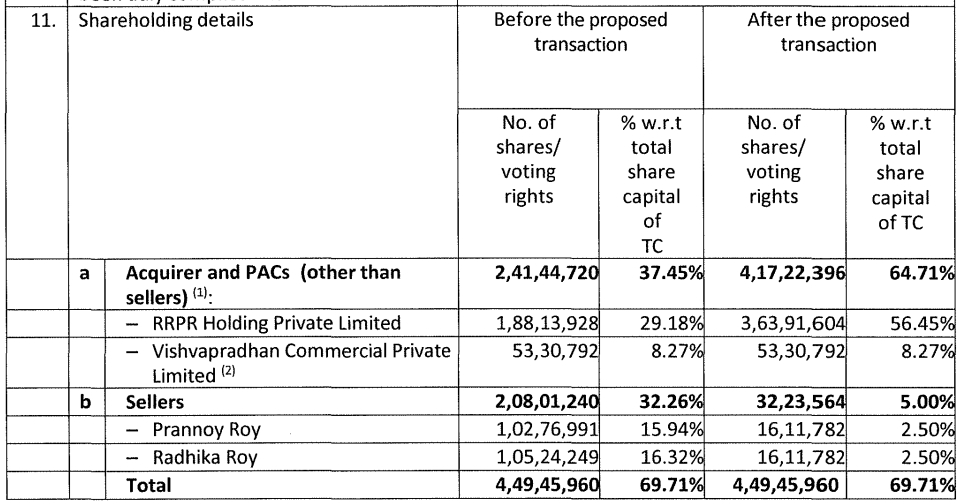
In a regulatory filing with BSE today, NDTV gave details of the share transfer. Prannoy Roy and Radhika Roy held 32.26% share in NDTV in their personal capacity, apart from the holding through RRPR Holding which was already acquired by Adani group earlier. From this personal stake, they have transferred 27.26% of shares to RRPR holding which is now owned by Adani group. After this, the stake of RRPR in NDTV has gone up to 56.45% as it already owned 29.18% stake, while Vishvapradhan Commercial Private Limited, also under Adani group, has 8.27% stake in the media house. Therefore, the total stake of the Adani group in NDTV has gone up to 64.71%, while only 5% remains with the promoters now.
NDTV Shareholding details
Earlier on 28th November 2022, New Delhi Television Ltd (NDTV)’s promoter company RRPR Holding transferred 99.5% of its equity shares to Adani group-owned Vishvapradhan Commercial (VCPL). RRPR owned 29.18 percent of NDTV, hence Adani Group obtained a 29.18 percent stake in NDTV in this manner.
On November 11, 2022, Adani group announced it will launch an open offer to acquire an additional 26% of NDTV’s public shares. On Tuesday, 20th December 2022, Adani Group’s Vishvapradhan Commercial Private Limited acquired an 8.27% stake in New Delhi Television Limited through an open offer. Under the acquisition, it bought 5,330,792 shares with a face value of ₹4 each at a price of ₹294 per share. NDTV share price closed at ₹340.00 today.
With this acquisition, Adani owned a total of 37.45% of the shares in the company. Prannoy Roy and his wife Radhika Roy’s stake in the company following the takeover was decreased to 15.94% and 16.32%, respectively. The Roys, who then jointly owned about 32.26% of the shares, were surpassed by Adani as the largest stakeholder in NDTV as a result of this transaction. Now that the stakes held by both Prannoy Roy and Radhika Roy are reduced to 2.5% each, Adani Group with 64.71% shares has become the owner of NDTV.
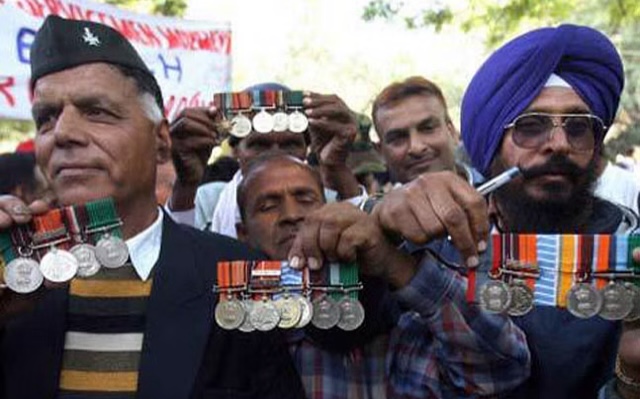
The Union Cabinet on Friday approved the next revision of the pension of defence forces personnel and family pensioner under One Rank One Pension (OROP).
Briefing reporters after a meeting of the union cabinet, Information and Broadcasting Minister Anurag Thakur said the decision will lead to enhanced pension as per the OROP proposal. The cabinet meeting was chaired by Prime Minister Narendra Modi.
The benefit would also be extended to family pensioners including war widows and disabled pensioners, Thakur said.
He said benefits will be extended to about 25.13 lakh armed forces pensioners and family pensioners.
Armed forces personnel retired up to June 30, 2019, are to be covered under this revision. The revision will entail an estimated annual expenditure of Rs 8450 crore. The arrears will be with effect from July 1, 2019, to June 30, 2022.
The move is expected to attract youth to join the armed forces.
The decision to implement OROP was taken by the Narendra Modi government on November 7, 2015, with benefits effective from July 1, 2014.
OROP was a long-standing demand of the armed forces and implies that retired soldiers of the same rank, who have retired after serving for the same length of service, will receive the same pension, irrespective of the date and year of their retirement.
(This news report is published from a syndicated feed. Except for the headline, the content has not been written or edited by OpIndia staff)
Delhi’s Saket court on Friday extended the judicial custody of accused Aaftab Amin Poonawala in the Shraddha Walkar murder case by a further 14 days.
The next date of hearing is on January 6, 2023. A Delhi court on Friday allowed the plea of Delhi Police seeking permission to obtain a voice sample of Aaftab Amin Poonawala, accused of murdering his live-in partner Shraddha Walkar.
During the hearing, Aaftab was produced through video conferencing.
During the hearing, the media persons were asked by the Metropolitan Magistrate Vijayshree Rathore to leave the court. She said that the matter is a sensitive one.
Metropolitan Magistrate Vijayshree Rathore of Saket court allowed the plea of Delhi after hearing the submission of Special Public Prosecutor (SPP) Amit Prasad and Defence counsel MS Khan.
SPP Amit Prasad submitted before the court that the voice sample is required to investigate the matter.
On the other hand, Advocate MS Khan opposed the plea and submitted that he has not been supplied a copy of the application.
According to sources, Delhi police have some videos and audio related to the case. Delhi police want to obtain a voice sample of Aaftab to examine that evidence.
The court said that the accused has no right to deny giving a voice sample. Therefore, he is directed to give a voice sample to the police.
The court directed that the accused would be taken to CFSL at CBI headquarters on Monday.
Metropolitan magistrate Aviral Shukla extended the judicial custody of Aftab for the next 14 days. The next date of hearing is January 6, 2023.
Yesterday, the Saket court dismissed the bail plea of Aaftab Poonawala after he withdrew the same.
Aaftab is in judicial custody after the police interrogation.
Aaftab is accused of strangling to death his live-in partner Shraddha and chopping her body into 35 pieces. He is also alleged to have preserved the chopped body parts in a refrigerator before dumping them in forested areas in Delhi and Gurugram.
Police had earlier said Aaftab, who confessed to killing Shraddha and chopping her body into 35 pieces, was giving misleading answers to questions.
(This news report is published from a syndicated feed. Except for the headline, the content has not been written or edited by OpIndia staff)