Home Blog Page 5911

The Reclamation Project: Here’s how the great Maratha warriors fought to reclaim Ayodhya, Prayag and Kashi

The looming verdict in the Ram Janmabhoomi Case will potentially conclude a centuries-year old aspiration of Hindus to reclaim the land of Ayodhya. Over the centuries, numerous efforts have been made to take back the sacred site for Hindus which was under the rule of the Jihadist barbarians.

However, due to unavoidable circumstances, often a consequence of fate or misfortune, reclamation of Ram Janmabhoomi proved to be evasive. But throughout the many wars that Hindu empires have waged, the holy land of Ayodhya and the sacred sites of Mathura and Kashi always featured prominently in the plans of those who aspired for Hindavi Swarajya. In this article, we shall show that the three sites always remained in the plans of the Maratha Empire.

Maratha Plans to Take Control of Ayodhya, Prayag and Banaras

During Safdar Jung’s second war against the Pathans in 1751-52, the Marathas had cooperated with him after they were invited and after his victory at Fatehgarh, Holkar had requested that the three holy sites be handed over to the Peshwa. But at the time, the request could not be granted in its entirety. Therefore, the Empire had to satisfy itself with other riches, which they were given in plenty. Moreover, the Marathas were playing a ‘double game’ of their own. They frustrated Safdar Jung even though they were aiding him and prevented the Pathans from inevitable ruin. The objective was to ensure that only the Marathas emerged as the sole winners in this whole fight.

Read: Will Ram Lalla finally come home: The culmination of a people’s movement spanning over 491 years

Historian A.L. Srivastava in his book The First Two Nawabs of Awadh describes the situation thus: In addition to acquiring karores worth booty and half the Bangash territory and their daily expenses from Safdar Jung, they exacted fifty lakhs of rupees from Ahmad Khan Bangash and Sadulla Khan Ruhella, not as war indemnity as the historian Sardesai suggests, but as price for having secured for them such favourable terms, while the Nawab Wazir “had no more than the empty gratification of having humbled the enemy.”

Book excerpt of The First Two Nawabs of Awadh

Malhar Rao Holkar, one of the generals under the Peshwa, reached Kashi with a significant army during this time. Once there, he wanted to demolish the Gyanvapi Mosque built by Aurangzeb and reconstruct the ancient Temple at the site. However, he was dissuaded from doing so by the people of Kashi who argued that the Islamic barbarians were too strong in the region and once the Marathas left, they would be massacred.

Why the Gyanvapi Mosque Survived

GS Sardesai in his book New History of the Marathas notes, “The object of the Marathas in all these undertakings was both religious and political. They particularly intended to get the holy places of Prayag and Kashi back into Hindu possession.” In the same book, he notes a letter written by a Maratha agent on the 18th of June, 1751 as saying, “Malharrao has pitched his monsoon camp in the Doab. He intended to pull down the grand Masjid built by Aurangzeb at Benares and restore the original temple of Kashi Vishveshwar. The Brahmans of Kashi feel extremely terrified at such a move for they realise the Muslim strength in these places. What the holy Ganges and protector Vishveshwar can ordain will come true. The Brahmans are going to send a strong appeal to the Peshwa against any such attempt by his Sardars.”

Benaras, Allahabad, Ayodhya: The Peshwa’s Letters

The three places again find mention in a letter to Dattaji Shinde by Peshwa Balaji Rao in 1759. The message was conveyed through Ramaji Anant, the ‘manager’ of the Scindias. He says in the letter, “There are two or three undertakings to be achieved in connection with Shuja-ud-Daulah. Take Benaras, Ayodhya and Allahabad bad from him. He had promised to Dada (in 1757) to cede Benaras and Ayodhya but the case of Allahabad is still under discussion. If a settlement on the last question can be easily reached, make it.”

Another letter a few months later between the same set of correspondents mentions the Holy sites with the exception of Ayodhya. It says, “Camp at Delhi for this monsoon and proceed eastwards later. While in Delhi, arrest that corrupt Antaji Mankeshwar and send him to Pune at once. While proceeding eastwards, make sure that Meerut province is enlisted under the domain of the government (emperor of Satara OR the Pune executive). If Antaji cooperates and turns himself in, make his son a hazaari sardar (chief of 1000 horses). Remember that Najib is a traitor and half Abdali. Do not waste time negotiating with him. If possible unite Shuja and Surajmal against Najib and acquire at least 30 lakhs from the spoils for us. But ensure that Jat and Shuja do not become too friendly with each other. Hence keep the Mughal Vazir as friend.”

Read: Hindus have been demanding restitution since 1528 for the Ram Temple destroyed by Islamist barbarians, Rajeev Dhavan

The Peshwa then adds, “Finally, I repeat, keep the Mughal vazir as your friend as far as possible, above all others. Only if he starts reneging the contract, then replace him with Shuja in exchange of good profit. But take charge of Kashi, Mathura and Prayag in our hands at all costs.”

Thus, we see that the Peshwa was very concerned with the reclamation of the Hindu Holy Sites.

Why couldn’t the Marathas complete the Reclamation Project?

Thus, we see that between 1751 to 1759, reclamation of the sacred sites was indeed a priority for the Marathas. And there’s sufficient indication that Sadashiv Bhau who led the Maratha forces in the third battle of Panipat received instructions regarding the same as well. However, the defeat that the Marathas suffered at the war in 1761 thwarted their plans and although they sprung back from the defeat within the next ten years, the balance of power had altered significantly with the rise of the British.

It is important to understand here that the Marathas projected their power from the Deccan. Therefore, at that point of time, they did not exert control over the Gangetic Plain. @ArmchairPseph, a Twitter handle with significant knowledge on these matters, argues that control over this region was essential towards the reclamation project. He says, “In the North, the Nawabs of Awadh and Bengal still held out versus the Marathas. Thus, given the Maratha armies were based further South, while they could project power into the Gangetic plain, reclaiming the sacred sites on a secure basis was not yet possible. They did not control the state structure, and thus would be unable to protect the reconstructed temples as well as Hindus in the sacred cities once their armies withdrew back to their bases. Thus, securing the Gangetic plain was necessary before the sacred sites could be reclaimed.”

Read: Road to Ram Janmabhoomi, Ayodhya: How Hindus fought for Shri Ram

And as the incident in Kashi demonstrated, Malhar Rao Holkar had to restrain himself from levelling the Gyanvapi as the Marathas did not exert enough influence in the region. If they pursued any such actions, Hindus in the region would have suffered. Even if the three sacred sites had been transferred to the Peshwa, until Maratha power in the region had been consolidated, they wouldn’t have been free to pursue their preferred policies. Thus, although reclamation of the sites was certainly in their minds, circumstances weren’t favourable for it.

Ahilyabai Holkar

That religion figured prominently in the political outlook of the Marathas is most evident, perhaps, from the glorious reign of Ahilyabai Holkar, the daughter-in-law of Malhar Rao Holkar, who became a ruler by her own right in Malwa 1767 as the power of the Peshwas declined significantly post the third battle of Panipat. It was she who built the Kashi Vishwanath Temple, as it stands today, in 1780.

The Ramachandra temple in Puri, Hanuman temple in Rameshwaram, Shri Vaidyanath temple in Parli Vaijnath and the Sarayu Ghat in Ayodhya, Kedarnath, Ujjain and numerous other sites have the unalterable mark of Ahilyabai Holkar. The Somnath Temple, which has suffered numerous blows over the years, was restored by all the Maratha Confederates in 1783 with significant contribution from her.

The Marathas never reached a point where they could reclaim the sites without adverse consequences for Hindus as well as their own political power and the tides of time have flown by since then. For them, Ram Janmabhoomi remained a dream unfulfilled. And thus, after all these years, we stand at the precipice of history with the potential of realizing an elusive goal that has evaded our ancestors for centuries.

Read details: Rajasthan police arrests two honey trapped Army personnel for leaking information via Facebook, WhatsApp

0

On Thursday, Rajasthan police arrested two Indian Army personnel who were involved in a honey-trap, posted at Pokhran in Jaiselmer district, for allegedly leaking classified and sensitive information via Facebook and Whatsapp.

The two soldiers, namely, Lance Naik Ravi Verma and Sepoy Vichitra Behera, who has been taken into custody by the Indian intelligence agencies at Jodhpur railway station had reportedly been caught in a honeytrap by Pakistan’s ISI.


Confirming that both have fallen prey to a honeytrap, Umesh Mishra, Additional Director General of Rajasthan Intelligence said that both have been detained and investigation has been initiated after strong evidence was found. “We have detained two army jawans for their involvement in spying activities. They were deployed at an army unit in Pokhran. They were honey-trapped by Pakistani intelligence agency ISI and were sending information across the border through different social media platforms” ADF police (Intelligence ) Umesh Mishra said.

The agencies are enquiring about the handlers modus operandi and their purported links with India. During investigations, it has emerged that the two personnel were involved with one Facebook ID with the name of ‘Seerat’ that was posing as a woman to honey-trap the two jawans.


Lance Naik of 12 Guards, Ravi Varma of Madhya Pradesh and cook Vichitra Behera, Odisha resident, lived alone in Pokharan. They got introduced to the woman on Facebook. According to the information, both the soldiers who were honey-trapped for the last year and a half had been sending sensitive information to Pakistan through Facebook and WhatsApp.

Even while the woman Pakistan ISI handler was in Pakistan she managed to trick the jawans as she firstly used VoIP (Voice Over Internet Protocol) with a strong Punjabi accent and secondly she called the soldiers from an Indian number, which allegedly misled the accused personnel and deliberated them from sparing tactical information.

Some of the information was regarding army deployment, equipment and manoeuvres etc. in lieu of which the jawans received a sum of Rs 5000 in their respective accounts, investigations have revealed.

The Army has, however, decided to remain tight-lipped on this case of honey-trap. “We don’t have anything to say on this,” said Col. Shombit Ghosh, PRO defence, South Western Command.

‘Honey Trapping’ is a commonly used technique practised for very long by spy agencies to extract sensitive information. In July, Army jawan Ravinder allegedly leaked information regarding weapons used by his unit and their specific locations to a foreign woman via Facebook. He had also allegedly received money from the said woman in the past.

According to reports, 13 serving and retired defence personnel had been arrested for allegedly spying for the ISI or being part of its espionage racket in recent years.

In June, the Army intelligence has issued an advisory to army personnel against an Instagram profile ‘Oyesomya’ who is suspected of being an enemy spy trying to target army officers and special forces’ troops.

In another case, Rajasthan Police had arrested one Army jawan on charges of espionage in Jaiselmer. After interrogations, it was revealed that he was in touch with the Pakistani ISI operatives through social media.

In December, the Intelligence Bureau had said that Chinese and Pakistani girls being used by ISI to ‘honey trap’ Indian officials. Last year, an engineer working at the Brahmos Aerospace facility was also booked for alleged leaking of information to suspected individuals via social media.

Congress leader Navjot Singh Sidhu does a ‘Tara Singh’, nothing can stop him from going to Pakistan

Taking a cue from the legendary character of Tara Singh of the Bollywood film Gadar, controversial Congress leader Navjot Singh Sidhu has written a letter to the External Affairs Minister, S Jaishankar, stating that even if central government does not give him permission, he will go to Pakistan.

Sidhu seeks permission from central government for visiting Kartarpur corridor

Sidhu had applied for permission for visiting Pakistan for the inauguration of the Kartarpur corridor. Sidhu lamented in the letter that despite sending repeated reminders for seeking permission to travel to Pakistan, he has not received any communication from the External Affairs Ministry.

Read: Pakistan’s official song on Kartarpur Corridor features Bhindranwale and other Khalistani terrorists

“The delay and no response is a hindrance to my future course of action. I categorically state that if the government has any inhibitions and say no then, as a law-abiding citizen, I will not go. But if you do not respond to my third letter, then I will proceed to Pakistan like millions of Sikh devotees go on eligible Visa,” Sidhu said.

This reminds one of the resolute determination exhibited by Tara Singh from the movie Gadar, in which actor Sunny Deol, playing Tara Singh, travels to Pakistan against significant odds to get his wife(Ameesha Patel) back to India. Ameesha Patel is held up in Pakistan against her wishes by her family who is attempting for her re-marriage in Pakistan. In the pursuit to get his wife back, a tenacious Tara Singh scares the bejesus out of thousands of Pakistanis by uprooting a hand-pump and consequently thwacks scores of Pakistanis trying to stop him from taking his wife back to India.

Tara Singh uprooting handpump in Pakistan in film Gadar – Ek Prem Katha

Meanwhile, MEA has said that Kartarpur inauguration is a historic event and should not highlight one individual. Responding to question on Sidhu’s reminder, MEA spokesperson Raveesh Kumar said that they cannot afford to focus on an individual traveller.

Sidhu has displayed remarkable alacrity in desiring to visit Pakistan. Even during the foundation stone ceremony of the Kartarpur corridor, Sidhu champed at the bit of visiting Pakistan as soon as he received an invitation for the same from Pakistan PM Imran Khan. This was against the wishes of Punjab CM Captain Amarinder Singh, who had advised him to not visit Pakistan, claiming it might be a ruse by Pakistan to revive Khalistani terrorism. However, Sidhu did not heed his advice and enthusiastically proceeded to Pakistan.

Update: According to the latest report, at last the union government has granted political clearance to Sidhu.


News agency ANI reported that the Ministry of External Affairs has granted Navjot Singh Sidhu political clearance to travel through Kararpur Sahib Corridor on 9th November.

Andhra Pradesh Governor orders investigation into alleged job scam in Raj Bhavan by outsourcing agency

0

The governor of Andhra Pradesh Biswabhusan Harichandan has ordered an investigation into the alleged ‘job scam’ that was supposedly done by an outsourcing agency on the claim of offering jobs in Raj Bhavan.

The Andhra government had tasked the outsourcing agency M/s Sumathi Corporate Services Pvt Limited with the responsibility of recruiting staffs for the Protocol department on an outsourcing basis. But it soon came to the fore that the agency had collected large sums of money from the job seekers while assuring them that their jobs will be permanent.

The press release stated that a complaint was received by the Raj Bhavan authorities that illicit demand for money was made and collected by the supervisors of the outsourcing agency M/s Sumati Corporate Services Pvt Ltd in collusion with some protocol staff and other people for placing their services in the newly formed Raj Bhavan as Attenders, Receptionist, Office Sub-ordinate, etc.

Read: Chandrababu Naidu regrets decision to quit BJP-led NDA, says joining hands with Congress was a big mistake

The press release further added that the committee led by the Secretary to Governor have come to the conclusion that money has been demanded and collected from 9 outsourcing employees by the supervisory staff in connivance with some other people insuring them permanent jobs in the Raj Bhavan vacancies.

According to the sources, the agency had allegedly garnered bribes of Rs 70,000 to Rs 5 lakh for the jobs. In totality, Rs 17.85 lakhs was collected from 9 members for posts of receptionists, attenders, helpers and assistants.

The Governor has directed the Police Commissioner of Vijaywada Dwaraka Tirumala Rao to initiate immediate legal and criminal action against the agency and individuals responsible for this illegal act.

Police are conducting a probe into the alleged job scam. It has registered cases against the culprits under different sections of the IPC including 408, 420, 384, 506 and 120(B).

Uttar Pradesh: Yogi Adityanath government sacks seven police officers over charges of corruption

The Yogi Adityanath-led Uttar Pradesh government has decided to sack seven Provincial Police Service (PPS) officers on charges of corruption. As per reports, there were charges of corruption on these officers.

Reportedly, the Yogi Adityanath government dismissed all the seven officers after the findings of the screening committee report and they were given mandatory retirement. The order for the retirement of these officers, all above the age of 50, was issued on Thursday.

The officers who are forced to retire for their involvement in corrupt activities are – Arun Kumar, (Assistant Commandant of 15th Battalion PAC Agra), Vinod Kumar Rana, (Deputy Superintendent of Police Faizabad), Narendra Singh Rana, (Deputy Superintendent of Police Agra) and Ratan Kumar Yadav, (Assistant Commandant of 33rd Corps PSC of Jhansi), Tejveer Singh Yadav, (Assistant Commandant of 27th Corps PAC Jhansi), Santosh Singh, (divisional officer Moradabad) and Tanveer Ahmed Khan, (Assistant Commandant 30th Vahini, Gonda).

Earlier, Chief Minister Adityanath had warned on several occasions that officers who do not perform or have been found guilty of corruption are free to quit or will be compulsorily retired.

Yogi Adityanath’s government in Uttar Pradesh has been strict over action against corruption and inefficiency that had struck the state for decades. In the drive against corruption, the UP government had warned over 400 corrupt officials of severe punishment and decided to give early retirement to around 200 employees. Nearly 200 employees in 29 of the 72 departments were sacked by July this year.

In an earlier incident, the Uttar Pradesh government had registered FIR against more than a dozen policemen. In June this year, an FIR had been lodged against a dozen other cops over charges of corruption and misbehaviour. The cops were also suspended from duty, according to a statement released by the DGP headquarters in Lucknow.

According to the Public Relation Officer (PRO) to Uttar Pradesh DGP, nearly 192 cops have been suspended, 400 transferred, 40 booked and a probe has been ordered against 400 policemen on the basis of complaints received through social media.

Bahujan Samaj Party rejects Bhim Army’s proposal to join hands to fight BJP

The Bahujan Samaj Party has rejected Bhim Army chief Chandrashekhar Azad’s appeal to party president Mayawati to join hands with him to fight the Bhartiya Janata Party.

Reportedly, a senior party functionary termed a letter written by Bhim Army chief Chandra Shekhar Azad to Mayawati as a ‘ploy to create confusion among Dalits’. He added that the BSP has already launched an awareness campaign in the Dalit-dominated areas in Uttar Pradesh to counter the Bhim Army’s propaganda.

Reportedly, the state and district unit leaders of the party have been directed to make the party cadres aware of Chandra Shekhar’s alleged plan to divide Dalits at the BJP’s instance.

The BSP leader said that Mayawati was the tallest Dalit leader who had not only devoted her life to the uplift of Dalits but also the members of the community considered her as their role model.

Mayawati had already stated that if the Bhim Army leadership or other Dalit organizations were really interested in the empowerment of the community, they should work under the banner of the BSP to take forward the movement launched by Babasaheb Bhimrao Ambedkar and BSP founder Kanshi Ram, he added.

Read: Accusing Twitter of being an agent of ‘Brahmanvad’ shows the hollowness of leftist Dalit activism

After his release from his arrest over the agitations during the Ravidas Temple incident, Bhim Army chief Chandrashekhar Azad had extended a hand of friendship towards BSP supremo Mayawati asking her to come together to fight against the BJP.

Chandrashekhar, who refers to Mayawati as ‘Bua’ or aunt, had written an open letter to Mayawati asking her to join him in a discussion over strengthening the Bahujan movement to fight the incumbent BJP government for its alleged anti-Dalit policies.

In a four-page letter addressed to the BSP chief, Chandrashekhar had written about the important “political turn” the country is allegedly going through, where “communal and casteist powers are rampant.”

“The BJP has formed government in 2014 and then in 2019 and it is a clear indication that its power has increased. Barring South India, the BJP is in a strong position elsewhere, even in Uttar Pradesh which was considered as a stronghold of Bahujan movement once,” the letter read.

Just before the 2019 Lok Sabha elections, Bahujan Samaj Party supremo Mayawati had lashed out at Bhim Army Chief Chandrashekhar Azad on Twitter calling him a BJP mole. She had alleged that Chandrashekhar contesting from Varanasi seat in the upcoming Lok Sabha elections is a BJP conspiracy to divide the Dalit vote and take advantage.

Bengal never sent request to conduct JEE Main in Bengali: National Testing Agency exposes Mamata Banerjee’s propaganda

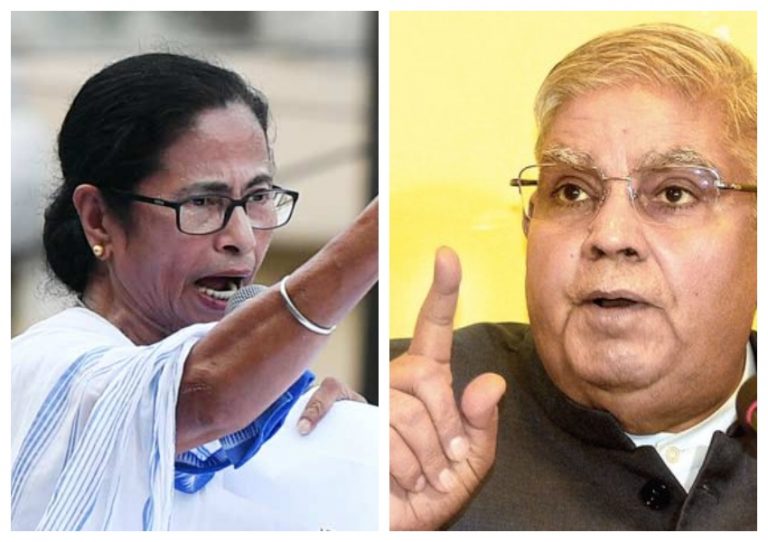
Mamata Banerjee on 7th November had raised a hue and cry and questioned the Modi government over why the JEE-Main exam is conducted only in Gujarati. She asked the Modi government to explain why only Gujarati was being allowed and not other regional languages. Now, the National Testing Agency, which is an Indian government agency that has been approved by the Union Council of Ministers to conduct entrance examinations for higher educational institutions, has issued a clarification and busted Mamata Banerjee’s propaganda.

In a Tweet, Mamata Banerjee had said, “I love Gujarati language. But, why have other regional languages been ignored? If Gujarati has to be there, then all regional languages including Bengali must be there…. Unless this issue is decided gracefully, there will be strong protests all around as sentiments of people who speak other regional languages would be deeply hurt due to this injustice”. In an overdramatic tweet, she had further said, “Our country is India, which is home to so many religions, cultures, languages, creeds and communities.… However, maligning all regions and regional languages is the intention of the government at the Centre…. Why injustice is being meted out to them?”.

Read: Mamata Banerjee says the Modi govt is ‘tapping her phone and getting information’, asks PM Modi to ‘take care of it’

However, Mamata Banerjee’s outburst has now been exposed to be mere propaganda. The National Testing Agency has clarified that JEE-Main started in 2013 with an idea of all states admitting their engineering students through this test. The NTA clarification said:

“The request was sent to all the States in the year 2013 itself. Only the Gujarat State agreed to admit their candidates in State Engineering Colleges of Gujarat through JEE (Main) and requested that the JEE (Main) paper be made available in the Gujarati language. Further, in 2014 Maharashtra State also opted for admitting the Engineering candidates in the State Engineering Colleges through JEE (Main). The Maharashtra State requested to provide the question paper in the language of Marathi and Urdu”. 

Further, the clarification read:

In the year 2016, both these States withdrew the admission to the State Engineering Colleges through JEE (Main). Therefore, the translation in Marathi and Urdu language was stopped. However, the translation of JEE (Main) question paper in the Gujarati language continued on the request of Gujarat State. None of the other States has approached NTA to provide the JEE (Main) question paper in any other Indian National Language.

Read: Pakistan bets on Arundhati Roy, Mamata Banerjee, Congress and Communist parties to drive their agenda over Kashmir

Essentially, the NTA has clarified that while Mamata Banerjee is insinuating bias of the Modi government against all regional languages other than Gujarati, the truth is that Mamata Banerjee herself never agreed to the JEE-Main request for the exam to be conducted in Bengali or any other language that might be needed for the state of West Bengal.

In fact, multiple media reports have indicated that NTA may discontinue Gujarati as a regional language for JEE Main altogether and hold the examinations only in English and Hindi from 2021 onwards.

“The advisory committee of the JEE-Main has decided to drop Gujarati as a medium for question papers from January 2021. The questions will be available in Hindi and English only,” The Telegraph quoted an official of the National Testing Agency (NTA).


Ayodhya verdict: Maharashtra police forms special cyber cell, Bhopal police too orders social media restraint on communally sensitive messages

As the long-drawn-out Ayodhya dispute draws to a close, law enforcement agencies of various states have primed themselves to ensure that no incendiary messages or rumours are circulated online in the wake of the Supreme Court’s verdict on the Ram Janmabhoomi-Babri Masjid title dispute.

The Maharashtra Cyber cell has formed teams to supervise social media to guard against the inflammatory comments and posts made to incite communal hatred ahead of the verdict. The cell will be collecting intelligence and flag alert to the respective state police if any objectionable content is shared by residents of those states. The cyber police team will work from a social media lab situated in the World Trade Centre at Cuffe Parade having essential computer networks, software along with a requisite number of technical experts that will help them in monitoring social media.

The Bhopal District administration in Madhya Pradesh has also been on alert. Proscribing offensive content on the social media platforms such as WhatsApp, Facebook, Instagram, Group SMS and other social media platforms, the Bhopal Collector and District Magistrate Tarun Pithode made it mandatory for users of these social media platforms to inform police if any derogatory content against any religion is shared by miscreants. He also said that in case any hateful remarks or messages are shared on Whatsapp, the admin of that group will be responsible for propagating the hatred.

In order to make sure that law and order prevail in the city, Faizabad police have taken a preventive action by deploying more than 16000 volunteers to keep an eye on the social media platforms ahead of the Ayodhya verdict. According to the Senior Superintendent of Police Ashish Tiwari, a similar number of volunteers have been assigned across 1,600 localities in the district to uphold law and order when the verdict is delivered.

Meerut police have put under scanner several provocative social media accounts who have been posting disparaging religious remarks. The SP(Rural) Meerut Avinash Pandey said that more than 10 Facebook and Twitter that posted objectionable content were brought down by the police. He revealed that many Twitter accounts with Hindu mythological characters names have emerged who are posting insensitive comments. The Meerut police are now trying to ascertain the real identities of these mischief mongers.

A five-judge Supreme Court bench headed by CJI Ranjan Gogoi had heard the Ayodhya case on a day-to-day basis for 40 days and reserved its verdict on October 16. The court is expected to deliver its verdict on a dispute over the possession of 2.77 acres of land in Ayodhya district in Uttar Pradesh before November 17, when CJI Gogoi retires.

Police forces in Uttar Pradesh and other states too have been put on alert ahead of the verdict. Section 144 has already been imposed in the areas surrounding the Ram Janmabhoomi in Ayodhya.

Security beefed up ahead of Ayodhya verdict, MHA sends general advisory to all states and UTs to remain alert

0

Security arrangements in Ayodhya and many adjoining districts have been intensified ahead of the crucial Supreme Court verdict in the Ayodhya dispute case which is expected before November 17. The MHA has sent a general advisory to all states and UTs to remain alert and vigilant ahead of the soon expected Ayodhya case.


Citing intelligence inputs on terror threat, the Ministry has also directed the Uttar Pradesh government to ensure maximum deployment of the police force on the ground and keep tabs on rumours on social networking sites and through SMS.

Apart from Ayodhya, the circular cautioned the Uttar Pradesh government to keep a close eye on other highly sensitive areas in the state and deploy its police force at specific locations, following apprehensions that “anti-social elements” may provoke religious sentiments of the people.

Yogi Adityanath government in Uttar Pradesh is making all possible arrangements to tackle any chaos or untoward incident that can ensue following the judgement on the highly volatile issue. Since the issue directly involves matters of faith and is expected to spark communal tension, the State, as well as the Central government, are making sure that there remains no lapse in the security arrangements.

To ensure law and order remains in control, the Ayodhya district administration has set up eight temporary jails in different schools in Uttar Pradesh’s Ambedkar Naga.


Ayodhya verdict
Administration order setting up temporary jail in schools

The jails have been set up in schools in Akbarpur, Tanda, Jalalpur, Jaitpur, Bhiti, and Allapur. The principal and staff of these schools would require to provide basic amenities to the station in-charges.

Asserting that the verdict shouldn’t be viewed from the prism of victory and defeat, even PM Modi has in a meeting with the council of ministers issued a directive today asking his ministers to refrain from making any unnecessary remarks on it. BJP also told its MPs to visit their constituencies for maintaining calm.

Read- Ayodhya verdict: Mughal descendant Prince Tucy roots for Ram temple, says ‘Inshallah title will go to Hindu community’

The Centre has also given the order to deploy 40 companies comprising of around 4,000 personnel of paramilitary force in Ayodhya, including sixteen companies of Central Reserve Police Force (CRPF), around six companies each of Indo-Tibetan Border Police (ITBP), Central Industrial Security (CISF), Sashastra Seema Bal (SSB) and RAF. A total of 13 CRPF companies have already been sent to Ayodhya and others would be sent in two-three days.

Ayodhya Police had earlier issued notification calling out the rumour-mongers and cautioning them that strict action will be taken against those who will be found inciting unrest through sharing fake news, communally sensitive videos/messages on Facebook, Whatsapp and other social media platforms. The UP Police has assured that they are completely and absolutely ready for the verdict.

The district magistrate had instructed people to not make any defamatory comments against any religion, community, deities, eminent personalities on social media platforms. People have also been prohibited from organising any event regarding the Ram Janmabhoomi-Babri Masjid dispute. Section 144 has been imposed in Ayodhya till December 28. Those violating the orders will be booked under Section 188 (disobedience of an order promulgated by public servant) of the IPC.

Senior Superintendent of Police (SSP) of Ayodhya, Ashish Tiwari has said: “Elaborate deployment of forces, intelligence network and confidence-building measures are in place. We have launched a mobile application connecting 16,000 volunteers in 1,600 villages, 10 volunteers each. We are also actively combating rumours on social media.”

A five-judge Supreme Court bench headed by CJI Ranjan Gogoi heard the Ayodhya case on a day-to-day basis for 40 days and reserved its verdict on October 16. The court is expected to deliver its verdict on a dispute over the possession of 2.77 acres of land in Ayodhya district in Uttar Pradesh before November 17, when CJI Gogoi retires.

Twitter India says it is impartial in enforcement of rules and does not take action based upon ideology or political viewpoint

0

In a series of tweets, Twitter India today said that Twitter is impartial when it comes to development of policies, product features and enforcement of rules. Twitter India said that it does not take actions based on any political ideology or viewpoint.


Read: Communists addicted to Twitter? Full time protestor Kavita Krishnan found using Twitter after announcing boycott

Twitter said that it has its own set of rules and enforces policies judiciously and impartially for all individuals, regardless of their beliefs or backgrounds.

Read: After KRK, another Indian decides to take on Twitter legally for suspending his account

“We have a specialised, global team that enforces Twitter’s Rules. In our trainings we extensively cover topics such as religion and caste to provide them with necessary local context they need to evaluate content,” Twitter said in its tweet.


On rules for hateful conduct on the microblogging giant platform, Twitter India said media depicting hateful imagery is not permitted on the platform.


“Twitter has a higher standard in some areas like profile or header images, where there is limited context (unlike a Tweet that may contain an image with accompanying text),” it said.

Read: Columnist with Shekhar Gupta’s ThePrint bullies his way to ‘blue tick’ by accusing Twitter of being casteist, then demands the blue tick be taken away

On its verification rules, Twitter said that it had stopped public verification of profiles back in 2018. And while the platform is reviewing program on case-to-case basis, Twitter verifies profiles of people who are active in public conversation.


Twitter then reiterated its commitment to provide an open conversation in India and be transparent in its approach.