Home Blog Page 6150

Youth Congress peddles lies, claims Z-category security to Mukesh Ambani was given by BJP govt

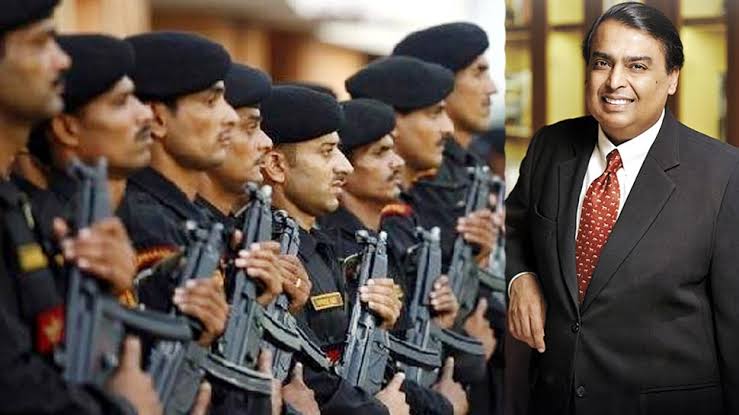
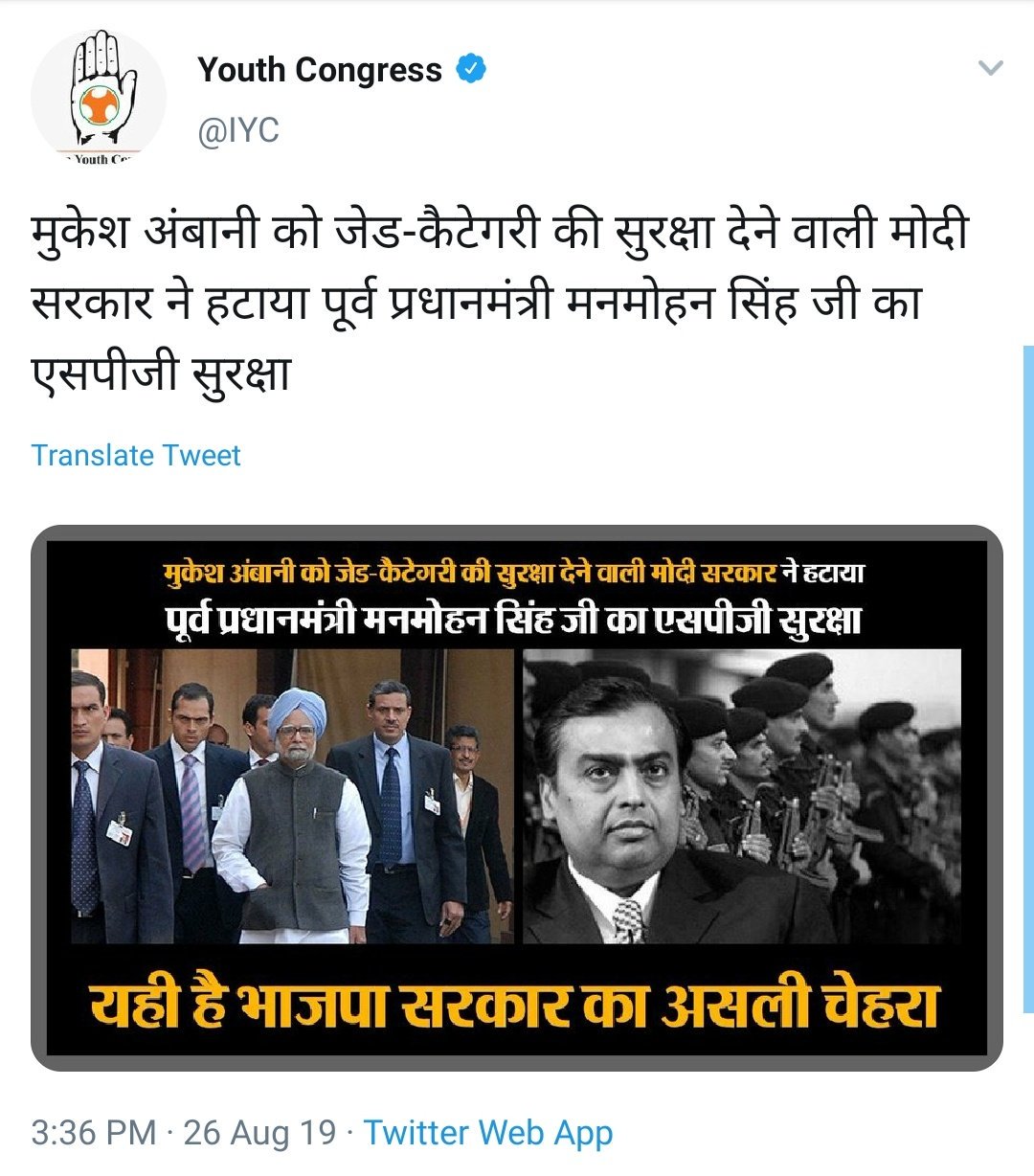
The Youth Congres’s Twitter handle @IYC today posted a tweet falsely alleging that the Modi government had withdrawn the SPG cover provided to the former PM Manmohan Singh while granting Z-category security to the chairman of Reliance Industries Limited conglomerate Mukesh Ambani.

Youth Congress Tweet

The tweet by Congress handle was in response to the Modi government’s move to withdraw the Special Protection Group(SPG) from the security cover of the former PM Manmohan Singh and replace it with CRPF. The decision to remove SPG was taken after the Intelligence Bureau had given a security assessment report in Singh’s case. The IB director, Arvind Kumar, had met the former PM last week.

Singh continues to enjoy Z+ security. According to the government sources, the current security cover review is a periodical exercise based on threat perception that is purely based on a professional assessment by security agencies.

However, Congress was quick to politicise the issue claiming that the SPG removal was a ‘downgrading’ of Manmohan Singh’s security. Insinuating that the Modi government is for super-rich businessmen, Youth Congress asserted that the BJP government granted Z-category security to Mukesh Ambani while reducing the security cover of Manmohan Singh.

This is patently false as Mukesh Ambani was granted Z-category security not by the NDA government but by the UPA-2 government in 2013. The Supreme Court had held a dim view of the centre’s decision to upgrade Mukesh Ambani’s security cover and criticised the Congress government saying why such men are given security cover by the government while the common man continues to feel unsafe.

After the decision to provide commando security to Mukesh Ambani drew flak, the then Congress government had also clarified that Ambani himself would pay for the expenses. In 2013, Ambani was one of the 200 people in Mumbai who had been put under the top-level security cover.

It was a Congress government that had enlisted Asia’s richest man Mukesh Ambani to receive a Z-category security cover, a move that drew flak from the SC. However, in order to project that the Modi government is a purveyor of crony capitalism, Congress has tried to pass off a decision taken by their government as Modi’s government’s move.

The other facet of this controversy, which is lost on the Congress supporters and leaders protesting about the government’s move to strip Manmohan Singh of his SPG cover is that the threat perception to a particular leader is periodically reviewed professionally by security agencies. Moreover, the Z+ category security provided to Manmohan Singh continues to remain in place.

A tribute to the man who brought ‘Nationalism’ to our drawing rooms

0

I’m still struggling to digest the fact that Arun Jaitley is no longer around, but I’d like to pay tribute to a gentleman who was instrumental to my politics.

Most people I meet are a little bewildered when I tell them that I cast my lot with the nationalists in the RSS and the BJP. This isn’t unusual for me and I’m quite used to (and secretly delight in) their expressions of shock and dismay. How could a fairly broad-minded, foreign-educated guy who fits in perfectly into liberal drawing-room conversations support ‘them’?! For that, you can thank (or blame) Arun Jaitley.

Most of you know Arun Jaitley by his achievements (of which there are many) – first ABVP leader to win the DUSU elections; imprisoned for more than a year during the Emergency; Additional Solicitor General at the age of 37; super successful General Secretary and party strategist who delivered impressive election victories (most notably chasing out Digvijay Singh from Madhya Pradesh in 2003 and Lalu Prasad Yadav from Bihar in 2005, besides installing the first BJP government in Karnataka in 2008); Leader of Opposition in the Rajya Sabha; and the de facto ranking Cabinet Minister (holding the Finance and (albeit briefly) Defence portfolios) in NDA-II.

Well before I trained with the RSS and spent time in the ABVP, before I ever picked up a book on Indian politics, when I was just a teenager looking to learn a thing or two about Indian politics following the 2004 national elections results and in the wake of a new government that counted amongst its top ministers men and women who had graduated from Harvard and Cambridge (the kind of institutions my parents encouraged me to aspire to be a part of), Arun Jaitley gave a voice to common sense nationalist impulses in a way that was effective, reasonable and unbelievably smooth. At a time when the English media had nothing nice to say about the BJP and the Sangh was painted out by the media to be a bunch of unreconstructed lumpen elements that resisted any notion of modernity and liberty, Arun Jaitley did yeoman’s service in making nationalism cool to my generation.

As time passed by and I grew more steeped in nationalist ideology and national politics grew more partisan (the Congress’ infinitely stupid decision to make the RSS out to be a terrorist organisation is the watershed moment in my view), I confess to finding Jaitley to be insufficiently ideological, heavily reliant on the bureaucracy and frustratingly bipartisan. His tenure as a ‘tax and spend’ Finance Minister was a particular disappointment and I really do wish he had been shifted out to a different, less important portfolio. The BJP has three articles of faith: the construction of a Ram Mandir at Ayodhya, the implementation of a Uniform Civil Code; and the ‘abolition’ of Art. 370. Among the three, I think the one Jaitley cared about the most was Art. 370 and he must have been pleased to see that achieved in his lifetime (in so small part thanks to his efforts).

For all his faults, Arun Jaitley was a man who loved his country more than anything else and his country benefitted greatly from his hard work and commitment. He lived an extraordinary life and will be remembered fondly for his many achievements, but for me, his greatest achievement lies in swinging me (and many others like me) to the political right. And so, from a one-time fan and ever-grateful karyakarta, let me say: “Thank you, Mr Jaitley!”

(Adhitya Srinivasan is an ABVP karyakarta who holds law degrees from National Law Institute University, Bhopal and Harvard Law School)

Samajwadi Party chief Akhilesh Yadav dissolves the party’s Delhi state unit with immediate effect

In a desperate attempt to repair the rupture created during the Lok Sabha elections, Samajwadi Party chief Akhilesh Yadav has announced to dissolve the Delhi state unit with immediate effect.


Party General Secretary Ram Gopal Yadav made the announcement in a statement, saying the Delhi unit had been dissolved “with immediate effect”.

This decision comes three days after the Party’s similar move in Uttar Pradesh. On August 23, Akhilesh Yadav had dissolved the state unit of the party in Uttar Pradesh.

Attempting a course correction in the party after the Lok Sabha poll debacle, Akhilesh Yadav had on Friday announced to dissolve the party’s entire Uttar Pradesh unitsm, including the state executive, and district and youth wings. The party, however, has retained state president Naresh Uttam.

A senior party leader on conditions of anonymity told PTI that: “Party president Akhilesh Yadav has dissolved the state executive. All district executives and the executives of youth and other wings have also been dissolved. A new executive will be formed soon.”

Despite stitching up an alliance with Mayawati’s BSP in Uttar Pradesh, Akhilesh Yadav’s party had to face severe humiliation in the 2019 Lok Sabha polls as its tally remained stuck at five. Embarrassed with this huge loss, the Samajwadi Party president had in May dismissed the panel of spokespersons of the party.

The appointment of all party panellists was cancelled in one stroke by the party chief who also said that no TV channel should invite any of them for debate.

Furthermore, the BSP and SP parted ways after the humiliating defeat and the so-called ‘Mahagatbandhan’ in Uttar Pradesh, which the two parties had trumpeted big time, had come tumbling down like a pack of cards. BSP chief Mayawati had then held Akhilesh Yadav responsible for their poll rout.

Moreover, what rubbed salt to Akhilesh’s injuries was the shock of defeat of his wife Dimple Yadav, who had entered the fray as a sitting MP. She represented the Kannauj Lok Sabha seat.

P Chidambaram’s CBI custody extended till August 30, CBI to confront him with others accused in the INX Media case

0

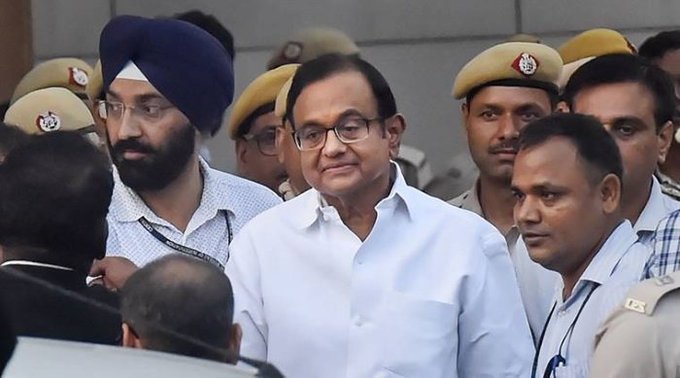
A special CBI court at the Rouse Avenue court complex has extended the CBI custody of Congress leader P Chidambaram by four more days. Accepting CBI request to extend the custody, the court allowed to them to keep him for custodial interrogation till 30th August.

CBI had sought five more days of P Chidambaram’s custody, saying the interrogation of the former finance minister is not over yet. CBI told the court that he was confronted with one of the co-accused, but it could not be completed as the custody was ending today and he needed to be brought to the court. The agency also told the court that they want to confront the former union minister with more co-accused in the case, and that’s why they need 5 more days of custody.

On 22nd August, the special CBI court had granted CBI four days custody of P Chidambaram, against the agency’s request of five day’s custody. CBI had presented him at the court after his dramatic arrest on 21st August.

Today the Supreme Court had dismissed Chidambaram’s petition against Delhi High Court order rejecting his anticipatory bail plea against arrest by CBI, as the agency has already arrested him and he needs to apply for regular bail. His other petition seeking protection from arrest by ED was taken by the court today but it didn’t complete, which will continue tomorrow. Till then the court has extended his interim protection against arrest by ED.

Pakistan President gets notice for tweeting fake news, ‘human rights minister’ calls Twitter a ‘Modi mouthpiece’

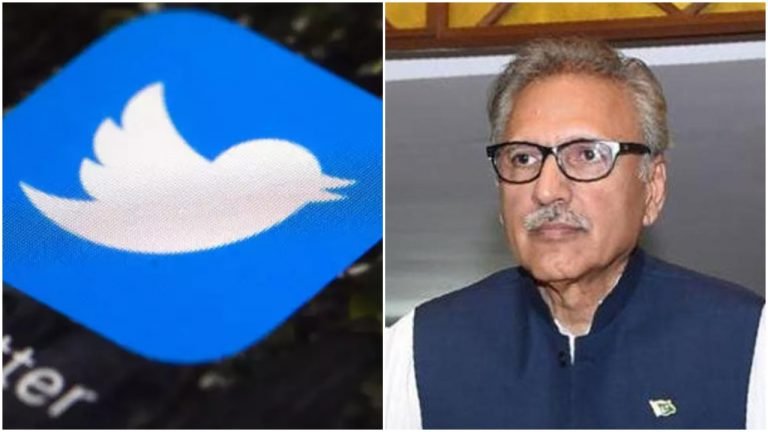
Arif Alvi, the President of the parody country Pakistan, has been served with a notice by micro-blogging site on Monday for spreading disinformation regarding the Kashmir situation.

In a Twitter post, President Alvi had shared a video of a protest march organised in Pakistan-occupied-Kashmir while claiming that the protests had instead happened in Kashmir valley.

“This is Srinagar yesterday despite curfews, bans, blackouts, teargas & firing. No amount of oppression & brutality can suppress the resentment of the Kashmiris against India. They want freedom at all costs. Please retweet and let the world know,” read his propaganda post.


In the video, it can be clearly seen that flags of Pakistan-occupied-Kashmir, which Pakistan refers to it as Azad Kashmir, is being displayed in the protest march indicating that the protest march had happened in the PoK and not in the Kashmir valley.

As Arif Alvi did not delete the tweet despite pushing false information, the Twitter may have sent a ‘notice’ to President Arif Alvi regarding his tweet on Kashmir situation.

Shireen Mazari, Human Rights Minister of Pakistan took to micro-blogging site to vent out her anger against Twitter for sending a notice to Arif Alvi, claimed that Twitter has gone too far and blamed them for being a mouthpiece of the ‘rogue Modi government’. The minister took to social media to share the image of Twitter email regarding the president’s personal account.

“Twitter has really gone too far in becoming a mouthpiece of the Rogue Modi govt! They sent a notice to our President! In bad taste and simply ridiculous,” said Human Rights Minister Shireen Mazari.


However, in its notice, Twitter has said that it has investigated the report content and did not find any violations of the Twitter rules. One wonders how Twitter has turned into a Modi Agent for actually finding no fault with the President of the parody nation tweeting fake news. In fact, the microblogging website should be held accountable for not taking action against clear fake news tweeted by the President of Pakistan.

It is also noteworthy that such emails are often sent when a tweet is reported to Twitter and this does not mean that it was the Indian government that had reported the tweeted. In fact, given the bizarre conduct of Pakistan, one wouldn’t be surprised if low IQ Pakistanis had themselves reported the tweet erroneously. Even so, any Twitter user from within India or outside should be reporting a tweet that spreads fake news.

Sidelined and pushed into a corner for its habit of using terrorism as a state policy, Pakistan is now openly indulging in fake news to fear-monger and incite violence in India. Following India’s historic move to strip Article Article 370, which granted a special status to Jammu and Kashmir state and a subsequent bill aimed to bifurcate the state into two Union Territories, Pakistani establishment seems to have lost their mental balance.

All issues between India and Pakistan are bilateral: PM Modi’s firm statement before US President Trump at G7

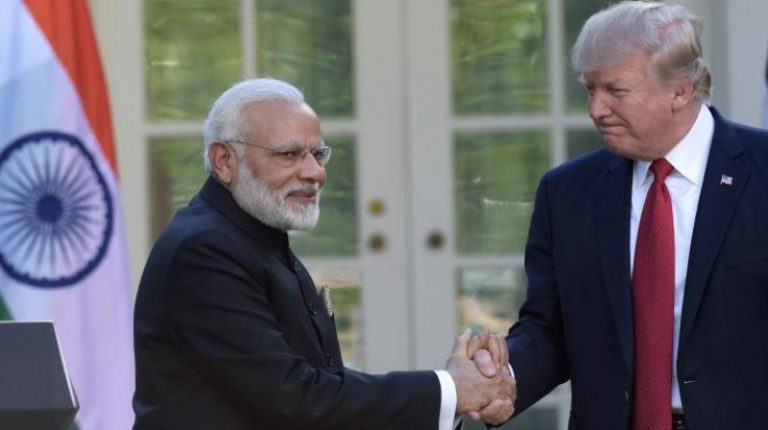
PM Modi and US President Donald Trump have met at Biarritz at the sidelines of the G7 summit here. In the meeting, PM Modi has stated firmly before Donald trump that all issues between India and Pakistan are bilateral in nature, indirectly dismissing his ‘proposals’ to mediate.


PM Modi stated before Donald Trump, “Any issue between India and Pakistan are bilateral in nature, hence we don’t bother any other country over it.” He further added that India and Pakistan were united before 1947 and hence we are capable of discussing and solving our issues between us.

President Trump, when asked by the media his views over the Kashmir issue, stated, “We spoke last night about Kashmir, Prime Minister really feels he has it under control. They speak with Pakistan and I’m sure that they will be able to do something that will be very good.”


It is notable here that PM Modi’s firm stand over the issue and Trump’s affirmation that PM Modi has it under control shows how India has managed to thwart any attempt at interference by the USA over India and Pakistan’s bilateral relations.

US President Trump had earlier, on multiple occasions, hinted that he is ready to mediate between the two countries if needed. While Pakistan had termed it as a major diplomatic victory, India has dismissed it, reasserting its decades-old stand that any discussion with Pakistan will only be bilateral.

Supreme Court extends interim protection to P Chidambaram from arrest by ED till Tuesday

0

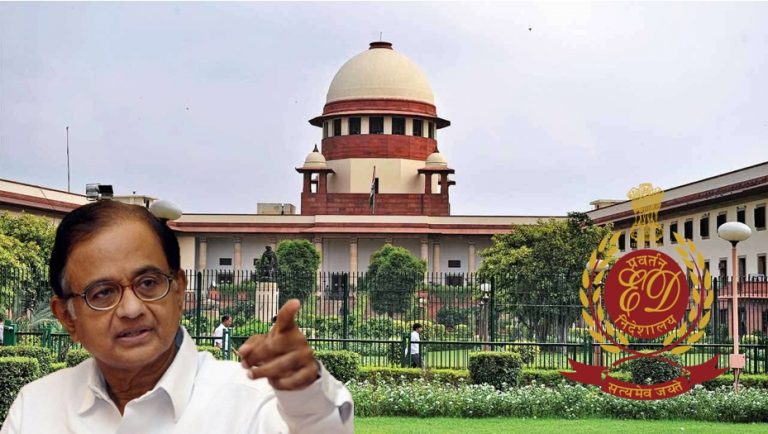
The Supreme Court on Monday extended the interim protection granted to former union minister P Chidambaram from arrest by ED by one day, which was to end today. Now ED can’t arrest him till tomorrow, when the apex court will continue to hear the petition against Delhi High Court order rejecting anticipatory bail.

The hearing for the ED case had started today after the Supreme Court dismissed Chidambaram’s plea against Delhi High Court order denying him anticipatory bail in the CBI’s case. The court said that as he is already arrested by CBI, the plea has become infructuous and he needs to apply for regular bail.

In the ED case, P Chidambaram’s lawyer Kapil Sibal presented his arguments today. The court will hear the counter-arguments by ED tomorrow.

In his arguments, Kapil Sibal objected to ED submitting documents in a sealed cover at the court, saying the defendant need to know the contents of the documents presented by the prosecution to counter them. Sibal alleged that CBI had nothing to ask Chidambaram in the ongoing custodial interrogation, saying that CBI had asked whether he has a Twitter account.

Sibal alleged that a media trial was going on against the former union minister, saying that ED had leaked its statement to media, which was influencing judgements. Sibal had alleged that the Delhi High Court judge had copied the entire note in its judgement. But the ED lawyer Tushar Mehta denied the allegation, saying ED didn’t submit any such note with the Delhi High Court.

Sibal said that Chidambaram is ready to comply with any condition that is imposed on his bail. While he argued that the investigation in the case is over and there is no need of custodial interrogation, ED rejected that claim, saying the probe is still ongoing.

A Delhi court had granted CBI four days of custody of P Chidambaram after his dramatic arrest on 21st August, which ends today. CBI will present him at the court today for further orders.

Missing elements from defunct J&K constitution: Secular govt, equality of status and opportunity, assuring integrity of nation

If one goes by the reports on abrogation of Article 370 in Kashmir, as represented in the global media, two things stand out. One, the official word is overwhelmingly in favour of India and Two, the international media is overwhelmingly against India. The difference between the international agencies and international media seemingly arise from the difference in the knowledge of the facts regarding Kashmir. In an official position, for a nation, it is not possible to be standing with fake rhetoric, unless, of course, if you are Pakistan. Media reports filed by journalists with questionable integrity often stay clear of facts and use typical keywords which are appealing to their unsuspecting young audience. So we often find the terms being used against the abrogation of Article 370 are ‘attack on democracy, secularism’ and such. These are modern symbols of liberal thoughts and when any action is interpreted as the attack on the twin towers of Democracy and Secularism, one is tempted to oppose it. With logic and sanity against the continuance of Article 370, the Islamic State of Pakistan which wants to annex Kashmir on the grounds of religious Muslim majority will use these terms more and more in the rhetoric they are attempting to build around Kashmir.

Articles in Washington Post, New York Times and such media houses are deep on rhetoric and weak on facts. The slant is quite obvious when they never mention Pakistan as the Islamic State of Pakistan and always mention Bhartiya Janata Party, the ruling dispensation in India as the Nationalist Hindutva Party. They are wise people and have wily writers. They know to keep Islamic part of Pakistan hidden and to falsely manufacture Hindutva part of BJP is the only way to wrap up the intended balkanization of India on religious grounds in the fine dressings of democracy and secularism. How else can you defend the attempt of an Islamic state to attempt to annex a part of secular nation merely on the ground of commonality of religion?

As the Cambridge Analytica spokesperson in the Netflix documentary, The Great Hack, says that they built their strategy in Trinidad around the laziness of the youth. The same is being attempted here- counting on the laziness and lack of knowledge of the youth to build a world opinion in the favour of a farce. Siddarth Bhatia of The Wire, in an interview with Gregory Wilpert on The Real News, claims that “It’s going to have an impact on India’s secular tradition and India’s secularism”. The interview is headlined as “De Facto Annexation of Kashmir means the end of India as a Secular State.”

The CPM leader, Sitaram Yechury, with 3 seats in 542 Seats in the Lower House of Parliament (5 together with CPI), claimed that the abrogation of Article 370 is an assault on secularism. The president of the Islamic Republic of Pakistan claimed that “India is playing with fire by revoking Jammu and Kashmir’s special status and same fire will burn its secularism”. In an article co-authored by NYT journalist Suhasini Raj, published in The Irish Times, titled “Modi’s Kashmir move places India’s secular status in doubt”, she quotes the PM of Islamic state of Pakistan, Imran Khan, “lashing out at Modi, accusing him of promoting an ideology that puts Hindus above all other religions and seeks to establish a state that represses all other religious groups.”

Let us see how the State of Pakistan is envisioned in the constitution of Pakistan, the same state which is represented by Imran Khan as PM and by Arif Alvi as the President, both expressed great worries about how secularism will be negatively impacted by abrogation of Article 370 from Kashmir, which would mean the applicability of Indian constitution in full, in Kashmir, like any other state of secular India. I am reproducing the Preamble of Pakistan Constitution, the country which claims that Kashmir is a part of their territory and how supporting this foolish dream of theirs will be supporting Secularism.

“Wherein the State shall exercise its powers and authority through the chosen representatives of the people; Wherein the principles of democracy, freedom, equality, tolerance and social justice, as enunciated by Islam, shall be fully observed; Wherein the Muslims shall be enabled to order their lives in the individual and collective spheres in accordance with the teachings and requirements of Islam as set out in the Holy Quran and Sunnah;” –  Preamble to the Islamic State of Pakistan, which is worried over secularism in Kashmir, post abrogation of Article 370.

Now, after the abrogation of Article 370, the Indian Constitution will apply in full, in the state, at par with any other state. Under Article 370, there were provisions of the Indian Constitution which were not applicable to the State of Jammu and Kashmir. India took the shape of a secular nation in 1947 when the Partition of India happened on the basis of Jinnah’s Two-Nation theory and the Islamic State of Pakistan was carved out of it. The secular and democratic principles applied equally across the length and breadth of the nation, except Kashmir, which was allowed to have its own Constitution, even after a legitimate accession, so that it ripens up for full integration. Through 42nd Amendment, the word ‘Secular’ was introduced by Indira Gandhi while India was under Emergency (Ambedkar had opposed it saying that the idea of secularism was anyway inherent in our constitution and imposing it goes against the idea of democracy). The way it stands post-amendment, the Preamble defines India as :

WE, THE PEOPLE OF INDIA, having solemnly resolved to constitute India into a SOVEREIGN SOCIALIST SECULAR DEMOCRATIC REPUBLIC and to secure to all its citizens – JUSTICE, social, economic and political; LIBERTY of thought, expression, belief, faith and worship; EQUALITY of status and of opportunity; and to promote among them all FRATERNITY assuring the dignity of the individual and the unity and integrity of the Nation; IN OUR CONSTITUENT ASSEMBLY this  26th day of November, 1949, do HEREBY ADOPT, ENACT AND GIVE TO OURSELVES THIS CONSTITUTION.

This is what is now applicable to the state of Jammu and Kashmir after the abrogation of Article 370. Under the limited sovereignty granted to Jammu and Kashmir, article 370, the state could make changes about the extent of applicability of the Indian Constitution and have its own constitution. J&K Constitution officially omitted the applicability of “Socialist, Secular” and “Integrity” of the nation. Thus, the independent constitution of Jammu and Kashmir denied the applicability of “Socialism and Secularism” in the state and refused the obligation to work for the Integrity of the nation. So this is what was applicable in the Kashmir before abrogation-

WE, THE PEOPLE OF the state of Jammu and Kashmir, having solemnly resolved, in pursuance of accession of this state to India which took place on Twenty-Sixth of October, 1947, to further define the existing relationship of the state with the Union of India as an integral part thereof, and to secure to ourselves – JUSTICE, social, economic and political; LIBERTY of thought, expression, belief, faith and worship; and to promote among us all FRATERNITY assuring the dignity of the individual and the unity of the Nation; IN OUR CONSTITUENT ASSEMBLY this  17th day of November, 1956, do HEREBY ADOPT, ENACT AND GIVE TO OURSELVES THIS CONSTITUTION.

Between the Constitution of India and the Constitution of Kashmir, the missing parts are:

  • Secular Government
  • Equality of Status and Opportunity
  • Assuring Integrity of the Nation.

Since the minds of the people cannot be moved to support a constitution, a law of exclusivity merely based on the religion of the majority, the same is being attempted to be done in the name of democracy and secularism. As we can see, abrogation of article 370 in Kashmir is the first step toward the restoration of democratic and secular principles by ensuring its applicability. Those fanning separatism today and fanaticism under the garb of democracy and secularism will not tell you the truth, nor would they take you to the abandoned and closed theatres of Kashmir. The dynasties which ruled over Kashmir as if it was some fiefdom from the middle-ages, were prompt to pick the central directives which suited them, like extending the term of assembly from five to six years and never rolling it back. It is for the sake of secularism, we must ensure that any exclusivity based on religion must never come back and the state of Kashmir where a Pandit converting to Islam continues with his Hindu heritage, calling himself Ayyub Pandit is never allowed to drift into the Islamic theocracy called Pakistan.

Bareilly: Ashfaq bites mother-in-law’s nose, his father slits her ear for refusing to pay additional dowry

A woman’s husband and father-in-law thrashed her parents, chewed her mother’s nose and slit her ear during a dispute related to dowry on Sunday in Bareilly. An FIR has been registered against the accused at Bareilly Cantonment police station under IPC sections 323 (voluntarily causing hurt), 326 (voluntarily causing grievous hurt by a dangerous weapon) and 504 (intentional insult with intent to provoke breach of trust).

The severely injured woman was rushed to the district hospital, which then referred her to Delhi for surgery. As per reports, Gantha Rehman, a fourth-class employee of the Food Corporation of India (FCI), married off his daughter Chand Bi to Mohammed Ashfaq, a property dealer in Bareilly, about a year ago.

The groom’s family had demanded Rs. 10 lakh as dowry at the time of marriage, which was paid, but after Chand Bi gave birth to a daughter, her in-laws started demanding Rs. 5 lakh more. Rehman refused to pay the amount following which his daughter was thrashed by her in-laws.

When the father came to know of the matter, he rushed to his daughter’s house along with his wife, Gulshan, to talk to the groom’s family. But soon, an argument ensued during which Ashfaq, his father Izhaar and other family members started thrashing the wife’s parents.

Ashfaq bit the mother’s nose while Izhaar slashed her ear with a knife. After the police were informed, the father-son duo fled the scene leaving Gulshan unconscious. The Police rushed her to the hospital.

Station House Officer Avanish Singh Yadav said: “On getting information of the incident, we took the victims to hospital and ensured their first aid. An FIR has been registered against five identified and one unidentified persons, and the accused will be arrested soon.”

Historians need to reevaluate our freedom struggle: Vikram Sampath talks about Congress being a British creation, Savarkar and more

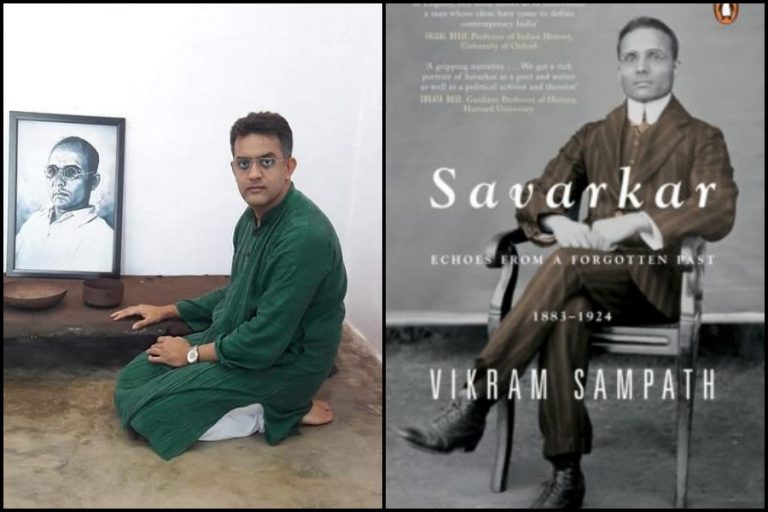
Ever since it’s release, scholar Vikram Sampath’s book, ‘Savarkar: Echoes from a Forgotten Past’ has earned great praise from every quarter. Touted to be the definitive biography on the great Hindutva thinker, Sampath’s book has garnered serious attention across ends of the political spectrum.

OpIndia.com had the opportunity to interview Sampath on the book which was released recently. The following is an interview conducted over an email conversation.

What inspired you to write this book?

Savarkar had been an addiction since the time I first heard about him in 2003-04 when the whole controversy of dislodging his plaque at the Cellular Jail by Mani Shankar Aiyar happened. We had no reference to him in our school history books -I had studied in the CBSE and ISC syllabus. Yet, this was a figure from the past who was intruding contemporary political discourse and that is what piqued my interest in him.

However, it’s only in the last 3-4 years that I managed to get down to serious research around him. A Senior Fellowship from the Nehru Memorial Museum and Library (NMML) further aided this process. I was quite amazed to know that a man who evokes such strong, polarizing reactions even now, and whose philosophy and thoughts have shaped India in so many ways and continue to do, has been so less researched or written about.

I have been rummaging several archives across India and abroad, gathering original archival and court documents—be it at the National Archives of India, Nehru Memorial Museum and Library, Maharashtra State Archives, the India Office at British Library London, National Archives of UK, archives in France, Germany etc. A lot about Savarkar and also his own writings are in Marathi and these have seldom been accessed by mainstream historians.

Accessing these documents opened up a new dimension to the man’s life and vision and helped clear the cobwebs that history and politics have shrouded his image in. Interviews with old-timers, his proponents and opponents and support from his family, especially his grandnephew Mr. Ranjit Savarkar, who heads the Savarkar Smarak in Mumbai, travels to various places associated with him from Bhagur, Nashik, Port Blair, Mumbai, London, etc completed the research journey.

This incidentally is just the first volume of the two-volume series and covers the story of his life from his birth in 1883 to his conditional release to Ratnagiri in 1924. The second volume would cover the remainder of the journey—the social reforms that he undertook in Ratnagiri, his active political days as President of All India Hindu Mahasabha and his alleged role in the Gandhi murder.

How is this book of yours different from the other books about Savarkar?

That is honestly for the readers to judge! But i can say that I have tried my level best to make this a balanced and authentic account of the man, without resorting to the usual extremes of hagiography or demonization that has largely been the trend with books on a subject as important and also contentious as Savarkar. Like I mentioned earlier, it is also based on extensive research and documentation across countries and also the Marathi writings and records that are seldom accessed.

In an article of yours, you had argued that Gandhi and Savarkar represented the poles of Indian politics. Considering the events since 2014, where the BJP has shown great reverence towards both of them, do you believe that dichotomy still exists?

Gandhi has become this overarching political father figure of whom every party now wants to draw inspiration from or appropriate. The BJP is thus doing the same and I am not judging their political compulsions. I am talking about the polarities from a strictly ideological and academic viewpoint. In that sense, the twain do not seem to converge on any issue.

In the prologue, you say that the book is neither a hagiography nor does it demonize Savarkar. So, could you tell our readers certain things about Veer Savarkar which the Hindu Right is likely to find problematic since we already know what the Left does not like about Savarkar?

I do not foresee anything that Savarkar said or did that the “Hindu Right” will or needs to have a problem with. His vision of a modern, progressive India where everyone is equal irrespective of caste, creed, religion, and one that is driven by an industrialized, rapidly urbanized capitalist model of the economy is what India is becoming to a large extent.

His modern views on social practices, be it caste system and its complete dismantling in order to ensure a Hindu unification or the total eradication of untouchability, are things that posit him in a very liberal light. If at all, his views on cow worship vs. cow protection might raise some hackles where he mentioned that while he had no objections to people worshipping the cow, he personally did not endorse it.

Priority was the cow’s protection and its utilitarian aspect for Savarkar. Hindutva’s reigning deity needed to be Narasimha and not a docile cow for him. He also drew attention to how invaders had always used the cow as a shield and protection to weaken us and for those wishing to convert and break up Hindu society to use the cow as a means to deracinate the community.

The Hindus must not give their opponents such a chance by being so emotionally attached to the cow, he maintained. So, while these are very controversial and provocative statements, if one mulls over them, the rationale becomes clear.

You have mentioned in your book that the Indian National Congress was formed as part of the British government’s strategy to further strengthen their hold over the country. Do you believe such a book could have been written at a time when the Congress party was still the dominant political power in the country? Do you believe these facts call for historians to relook at the events of the Indian independence movement from a more nuanced perspective?

Since I am not associated with any political party, I can say with certainty that this series is coming out now not because of the BJP or that the party is in power. Savarkar is an important figure in history and needs to be assessed and re-evaluated. It’s a historian’s burden for me to make this process possible. There has been no sponsorship or support from the Government or BJP or any organization associated with them in the writing of the book. Hence I do not attribute this book to them in any case.

What the Congress might have done is only speculative. Their track record when it comes to banning books and films that go against their ideology has been miserable, right from the times of Nehru to the UPA. So they might have well banned the book, maybe, but then this is again speculation.

Do historians need to re-evaluate our freedom struggle? Most certainly, especially since it’s been 72 years thence and it’s time to take a look again as a mature democracy must, in a dispassionate and authentic manner. The monochromatic narrative of the non-violent struggle that we have been fed for seven decades is now being challenged in the wake of more and more documents screaming to be heard and read that talk of a parallel freedom struggle, an armed revolution that had an unending chain right from the 1857 War of Independence to the 1946 Naval Mutiny in Bombay.

If we flip the historical narrative to make that the focus, then a completely different picture emerges. And history is a discipline with multiple view points, interpretations and assessments, so i feel this subaltern voice that has not found resonance so far, needs to be heard more and more through the works of several scholars. The rest is for the people of this country to make up their minds by comparative analysis of both accounts.

In your book, apart from Savarkar, you also touch upon a previous generation of like-minded freedom fighters such as Wasudev Balwant Phadke and the Chapekar brothers. In what ways, according to you, was Savarkar similar to them and in what ways did he differ?

Savarkar drew inspiration from these early revolutionaries. It was the execution of the Chapekar brothers that inspired him to take a vow in front of the idol of his family Goddess Ashta Bhuja Bhawani that he would keep fighting with the enemy till his last breath. Unlike his predecessors, Savarkar created strategic thinking and organization within the revolutionary movement.

Being the founder of the first organized Secret Society of India, the Mitra Mela (later became the Abhinav Bharat), he inspired thousands of young men across Maharashtra and outside to form part of these organizations. They called for arms training and creation of a network across India, especially with Bengal and Punjab to create a planned, coordinated and simultaneous armed uprising to overthrow the British.

This was in some ways a correction of the flaws of 1857. Savarkar also led the first student bonfires of foreign clothes in Pune in protest against the Partition of Bengal, as a student of Fergusson College. Theirs was among the first to give a call for “Complete Freedom” at a time when Moderates in the Congress were petitioning the Government for concessions and even the ‘Extremists’ were calling for ‘Responsive Cooperation’.

That these different revolutionary organizations did not achieve their goal entirely is another matter. Savarkar also created a vast intellectual corpus for the revolutionary movement. Savarkar’s five years in London were stormy and with a host of amazing revolutionaries—Shyamaji Krishnaverma, Madame Bhikaji Cama, Lala Har Dayal., Madan Lal Dhingra, Virendranath Chattopadhyay, MPT Acharya, VVS Aiyar, Sardar Singh Rana and others became a kingpin of a vast intercontinental effort to liberate India through armed struggle.

Savarkar’s works –the biography of Italian revolutionary Joseph Mazzini and his magnum opus on the 1857 uprising which he called as the First War of Indian Independence for the first time were veritable Bibles for the revolutionary movement in India. they inspired future revolutionaries, be it Bhagat Singh and Sukhdev who made a study of these criteria for entry into their HSRA or Rash Behari Bose and Netaji Subhas Chandra Bose who had copies translated and distributed to several members of the INA.

As Rash Behari Bose said in a Japanese magazine Dai Aija Shugi of March-April 1939 where he called Savarkar “A rising leader of New India”- “In saluting you, I have the joy of doing my duty towards one of my elderly comrades in arms. In saluting you, I am saluting the very symbol of sacrifice itself.”

How much of an impact did the work of Bal Gangadhar Tilak have on Savarkar?

Tilak and the editor of the Kaal Magazine Shivaram Mahadev Paranjape were his ideological gurus. He grew up reading the writings of Tilak and Paranjape and was deeply influenced by them. In fact, both of them recommended him to Shyamaji Krishnaverma for a scholarship to study law in London. But Savarkar went beyond Tilak’s idea of responsive cooperation to complete freedom through armed struggle and revolution.

What, according to you, is Savarkar’s greatest contribution to Indian politics?

Creation of a Hindu identity that had never existed so far; consolidation of Hindu society without the fetters of caste and creed. When every other community was being mobilized on their religious identities, be it the Khilafat movement by Gandhi that sought the Muslims to act for the sake of Caliphate in Turkey or the rampant conversions through force and allurement, it was unfair to expect the Hindu to take all of this quietly only because she was in the majority. This “Hindu consciousness” which need not be at odds or in conflict with other religions and identities and which has now become such an integral part of Indian politics is in my view Savarkar’s greatest contribution.

What is your personal opinion of Savarkar?

I have always categorized him as a historian’s enigma, a bundle of contradictions. He means many things to many people. But nonetheless, his life, his views and his philosophy are critical to be examined to understand the trajectory that India has taken and continues to take.

Lastly, considering that your book has a lot of facts that certain ends of the political spectrum don’t like discussing too much, did you face any difficulty finding publishers for your book?

Not at all. Penguin Randomhouse India was more than happy to commission this project and I am deeply thankful to my editor Premanka Goswami and Meru Gokhale of PRHI for reposing the faith in this book!