Home Blog Page 7157

Stone pelting and communal clashes follow after a goat hits a man in Uttar Pradesh

Reports of communal violence have emerged from Ghaziabad, Uttar Pradesh after a goat had allegedly hit a 55-year-old man in Indira Vihar Colony. The man had then advised the owner to keep the goat tied up in his home following which clashes broke out between two communities. Other reports claim that clashes broke out because the goat entered the house of a neighbour. As per reports, the two communities indulged in pelting stones at each other as well.

According to reports, however, there is no mention of any goat in the FIR filed by the victims. As per the victim, a member of the accused, Raees’ family, engaged in inappropriate behaviour with the housemaid. When the victims objected, Raees his son Javed, Nazim, Shoaib, Shahid, his son Sahil, Ehsan entered their house and assaulted the family. The victim has also alleged in the report that the accused want to grab his house. The Police have registered a case under section 147, 149, 452, 354, 323 and 506 of the IPC.

Goats, contrary to their generally peaceful demeanour, have been known to be a reason for communal clashes. We had reported earlier that a village in Azamgarh, Uttar Pradesh, was mired in clashes for 4 days after a goat belonging to a Hindu family had gone grazing in the field of a man named Ahmed. Ahmed and three other people were arrested by the Police. In an instance in Fatehpur, communal clashes had ensued after Gangaram’s goat had strayed into the fields of Nusrat Jahan following which it was badly beaten. Apart from communal violence, goat related violence has been a much more regular occurrence than one is likely to think.

Madhya Pradesh set to provide relief to the poor by announcing outstanding power bill waiver scheme

As per reports, the Madhya Pradesh government has announced an outstanding power bill waiver scheme for labourers falling under unorganized sector and poor families.

The state cabinet headed by the Chief Minister Shivraj Singh Chouhan approved the Bijli Bill Mafi Yojana 2018 (Power Bill Waiver Scheme) which is expected to benefit about 77 lakh people of the state. Alongside the state cabinet also approved Mukhyamantri Jan Kalyan (Sambal) Yojana 2018 (a scheme to provide subsidized power) in a meeting.

Under these schemes, registered labourers of the unorganized sector and people below poverty line (BPL) would be provided electricity at a cost of as less as Rs 200 a month. In case the bill is lower than Rs 200, the recipient will have to pay the actual bill amount and in the instance of the bill amount crossing Rs 200, the difference amount would be subsidized by the state government.

People consuming monthly power, less than 1000 watts will become eligible for this scheme. Under the power bill waiver scheme, pending dues (as on June 1, 2018) of registered labourers would be waived completely. This scheme is likely to come into effect from 1st July 2018.

In 2013, the Chouhan-led government had announced a similar waiver which had burdened the state government with an amount of Rs 2,000 crore of which the government paid a subsidy of Rs 652 crore while the rest was borne by discoms.

This time, it could cost over Rs 5,100 crore, of which the government will pay Rs 1,806 crore as subsidy to discoms; 50% of the bill, or Rs 1,806 crore, will be borne by discoms, which will also have to forgo the surcharge, close to Rs 1,500 crore.

While this announcement definitely comes as a respite to many, congressmen do not leave a single opportunity to malign the government initiatives. State Congress unit president Kamal Nath has termed the power bill waiver scheme as a “political stunt” of the CM, and another senior Congress leader Jyotirdaitya Scindia has dubbed Chouhan as “Ghoshnaveer” or the one who only makes popular announcements in a press conference.

The Mughal syndrome : A disease which clouds the objectivity of ‘intellectual’ Hindu minds

0

Recently a railway station in Uttar Pradesh was renamed as Pandit Deen Dayal Upadhaya Junction. The erstwhile name of the station was Mughalsarai Junction. Many secular hearts wept because the station which was called ‘Mughal Sarai’ was renamed. Apparently, it had a musical ring and aura to it according to some people.

The reason for renaming the station was entirely forgotten. It was the place where the Jan Sangh leader’s murdered body was found on the railway tracks of this station. The renaming is a mark of respect for the departed leader of Jan Sangh.

This episode unmasks a phenomenon in the ‘intellectual’ circles of India which has not been called out in public discourse. I propose the name ‘Mughal syndrome’ for the unjustified obsession with the Mughal rule in India and an outrage over renaming of the railway station.

The renaming of Prayag

Let us start with the example of another renaming. Akbar renamed the city as Illahabas and later, Shah Jahan renamed the city of Prayag as Allahabad (The City of Allah). What was the need for renaming it in the place considered a holy site for Hindus as a city of Allah? Clearly, he had the intention of erasing the erstwhile history and Hindu identity of the place with an Islamic name. The original name Prayag meant a ‘place for offerings‘ in Sanskrit. The Mughals have vanished, British left India and still, secular India has retained this obscene name of ‘Allahabad’ for a city considered holy for Hindus.

Some Mughal emperors had Hindu mothers. So what?

Some ‘intellectuals’ say that Indians must be grateful to Mughals because they settled down in India and made it their home. In fact, one journalist said that all Mughal kings were born to Hindu Rajput mothers and therefore we must be proud of Mughal history.


Jahangir was born to a Hindu Rajput Queen Jodhabhai ( who is known by the name of Mariam Us Zamani ). But that did not make him a tolerant ruler. He executed the Sikh guru Arjan Dev in a brutal manner. According to Tuzuk- i-Jehangiri , a memoir written by the emperor himself, he executed Arjan Dev because Sikhism was spreading and the guru refused to convert to Islam. Having a Hindu mother did not change the nature of Mughal ruler in any way. They continued to further the cause of Islam and expansion of their empire.

Mughals did no favour to India by settling down in India

Posterboy for liberals in India, Shashi Tharoor had the following answer to a question about Mughals in an interview :

Question: How does the Mughal Empire fit into your narrative? Early on in the book, you note that the British were very different to previous invaders of India.

Shashi Tharoor: The British were different in the sense that they had no commitment to the country. The Mughals were invaders who had come to India previously and then they stayed on and assimilated. For example, every single Mughal emperor (with the exception of the first one) was the offspring of an Indian woman. And the Mughals saw India as home: they never went back, nor did they send all their assets and resources back. They invested in India, they brought in artists and architects, doctors, musicians and painters and enriched the civilisation of this new territory.

The founder of Mughal empire, Babur had originally inheritied a tiny kingdom called Ferghana. Once he defeated Ibrahim Lodi in the first Panipat war and saw the riches of India, he decided not to go back to the life of poverty in Ferghana. Therefore, Mughals did not do a favour to India by settling down in India.

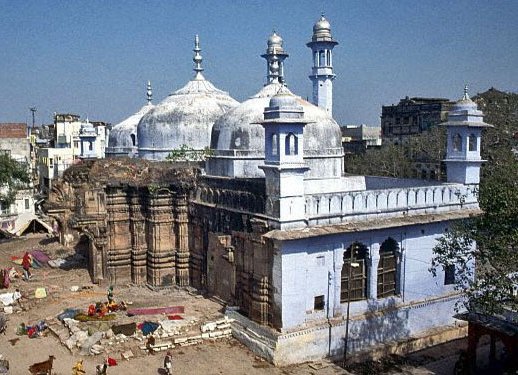
What was the investment of Mughals in India? The forts, palaces and monuments they built were for their personal use. The were not indulging in social sector programs like MGNREGA. All structures were built to enhance their image, power and status in the eyes of the ruled population. They not only built their structures but also destroyed those which were related to Hinduism. The Gyanvapi Mosque’s structure clearly indicates that it was an erstwhile temple. It was demolished under the reign of Aurangzeb. Today Hindus are still fighting to reclaim this temple in Allahabad high court.

Mughal rule of India is not worth eulogizing

Mughals were Islamic invaders of India and they left their mark on the history of India. Their history is to be read objectively by every Hindu citizen of India. There was nothing positive about their rule worth eulogizing in the present day. The tourist revenues from Mughal monuments is perhaps the only positive impact of the Mughal rule.

It is only the foolishness of certain Hindu ‘intellectuals’ that makes us feel proud about ‘Mughal invaders’ of India. The gang which harps on ‘Brahminical persecution’ of Dalits for thousands of years in India does not see a case for Muslim persecution of Hindus by Islamic invaders like Muhammed Ghori. Mughals were no different from British who sought to enjoy the wealth of India, subjugate its population and rule the land as emperors. Anyone who intends to eulogize them is only manipulating history for the sake of force – feeding secularism to the Hindu population of India.

Modi government plans to make power companies pay penalty for load-shedding

The Modi government is planning on penalising power distribution companies – also known as discoms, if they indulge in load shedding from the next financial year, Times of India has reported. The quantum of the penalty would be decided by the power regulatory authority present in every state.

As per power minister RK Singh, this proposal has been included in the Centre’s draft power policy which would soon be made accessible to the public for its input, following which a finalised document would be implemented from Financial Year 2019.

Under the draft, the government has also proposed that discoms have to bear the aggregate transmission and commercial losses exceeding 15 per cent.

As per a Deccan Herald report, the draft amendment to the 2016 National tariff policy proposes that it would be mandatory for a power company to prove to the electricity regulatory commission that it has made medium to long-term power purchase agreements which would be enough for meeting the average requirement of its clients.

The amendment as per the report warns that, failing to prove the same would render the discom liable for getting its license revoked. The draft also proposes that power cuts not emanating out of technical failures and force majure conditions would be liable for a penalty, as deemed fit by state electricity regulatory commission (SERC).

Such a proposal by the Delhi government was also recently approved by LG Anil Baijal wherein power companies would need to pay Rs 100 per hour, after the first hour, to customers owing to power cuts.

Incidentally, it isn’t the only proposal made by the Modi government to try and make state service providers accountable for their actions.

We had reported how Railway Minister Piyush Goyal had warned zonal general managers about their promotions being hampered if they failed to arrest the chronic problem of train delays in their respective zones. The general managers were given a time up to 30 June to improve the situation.

Haryana Government grants paternity leave to its male government employees

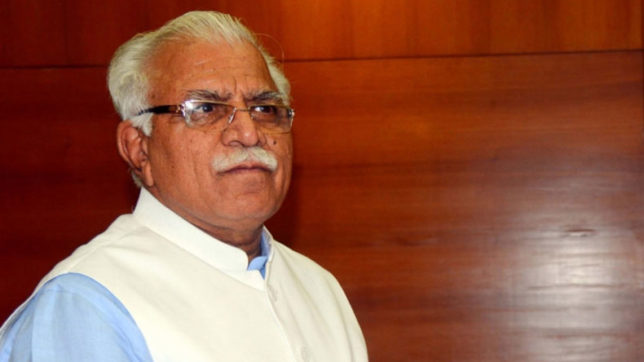
Haryana Chief Minister Manoharlal Khattar on Sunday announced a 15-day paternity leave to all male government employees to take care of the newborn child. This decision makes Haryana the first state government to grant paternity leaves to its employees. This decision comes after The Haryana government’s decision to increase the strength of women in police forces by increasing it from existing 11 percent to 20 percent.

In 2016, after repealing Punjab Civil Services Rules (1953) and put in place Haryana Civil Services Rule, under which all male employees were eligible to get 15 days paternity leave. Haryana Finance Minister had said, paternity leave would be admissible to male employees with less than 2 surviving children.

In 2017, a Paternity Benefit Bill was introduced in Lok Sabha where paternity leave could be extended up to 3 months. Currently, only All India and Central Services Rules allow a paternity leave of 15-day. Some private players also give paternity leaves. The bill aims to push for equal ‘parental’ benefits for both the mother and the father since raising a child is a joint responsibility of both the parents. This bill is expected to benefit 32 crore men in the private and unorganised sector, especially those doing the blue collar job.

Karnataka: Congress corporator’s son stabs his girlfriend’s friend, police register FIR

The son of a Congress corporator in Karnataka has stabbed his girlfriend’s friend in Davanagere. The victim is currently receiving treatment at a hospital and an FIR has been lodged by the Police over the incident.


As per reports, the accused, Rakesh, has not been arrested yet. The accused and the victim are said to have known each other from before and the latter was stabbed after they had a dispute over a woman and his head was also injured. The Police told Times Now that they will take all action necessary to ensure justice for the victim.

This is not the first time that the son of a Congress leader has been accused of being involved in the assault. Earlier in February, son of a Congress MLA, Muhammad Haris Nalapad, was accused of brutally assaulting a person at a pub after an argument. Nalapad was himself a Youth Congress leader. Another woman had alleged that she had been assaulted by Nalapad and his supporters but had not received help from any quarters. She even claimed that she was receiving death threats from Nalapad and his supporters. Another Congress leader and her son in Uttarakhand were accused of kidnapping a girl after which the mother was sent to judicial custody.

Playing Jekyll and Hyde – The academic pathosis of Sheldon Pollock

0

 “She had an evil face, smoothed by hypocrisy; but her manners were excellent.”

        — RL Stevenson describing the housekeeper of Mr. Hyde

Few books in recent Indian history have stirred up such a controversy, polarised debates, stirred up Indian academia and general masses alike. Amongst those books, Rajiv Malhotra’s books are pre-eminent. His latest magnum-opus ‘The Battle for Sanskrit’ explores the not-so-noble movements in the field of Indology. He unearths, consistent with his other works, the nefarious personalities involved who are scheming to hijack Sanskrit and Samskruti and thereby influence the academic, political and religious narratives in India.

The central character of this book is Sheldon Pollock who is a leading figure in Sanskrit studies. Reading through the book has sparked the author’s curiosity on Pollock. This led the author to follow Pollock and his works which are available in public domain. Inspired by ‘The Battle for Sanskrit’, these pursuits soon revealed an interesting dichotomy in Pollock’s presentation of his views. This article is brief compilation of the glaring discrepancies between Pollock’s academic works and his public appearances.

Jekyll and Hyde

The strange personality of Pollock displays irreconcilable and incoherent attitudes towards Sanskrit. His academic anthology is diametric to his utterances in his public appearances. One would associate epistemic virtues like honesty, humility, truthfulness, integrity from intellectuals. Instead, Pollock seems to carry obverse facades to suit the setting which we usually associate with politicians.

For the masses, Pollack portrays himself as a genuine and honest scholar who is at pains to rescue and resuscitate the grand narrative of Sanskrit from its indisputable death. He wants to be seen as someone who is in anguish over India’s indifference and ignorance at their colossal and magnificent Sanskrit heritage. He misses no chance to dish out his frustration at Indian’s own apathy towards Westerner Scholars like him who are spending their lifetimes to bring back the glory of Sanskrit. I call this facet of Pollock as “Jekyll Pollock”.

Contrast this with his academic works, where he demonises Sanskrit for its oppression, racism and divisiveness which still continues to be the tool of Hindu communalism in modern India. He hypothesises that Sanskrit has caused problems wherever it spread, therefore, it needs to de-fanged by secularising it. I call this academic doppelganger as the “Hyde Pollock”.

Sanskrit – Splendid or Sinister

Mr Jekyll Pollock at Jaipur literary Festival 2015 on Classical Texts sponsored by Murthy Classical Library (MCL), goes at length to praise Sanskrit– that it ‘made bridges’ with Buddhists, Jains and most languages in South-East Asia. According to him Sanskrit was a world of ‘cosmopolitan inclusiveness’ and goes onto quote Sanskrit phrase ‘Vasudaiva Kutumbakam’. Again during the same year, he appeared for a sales pitch interview for MCL in NDTV. There he was oozing concern for India’s ‘cultural ecocide’ (cultural suicide) that is leading to ‘dramatic moment of discontinuity’ in Indian competencies to conserve, preserve and nurture its classics. In an interview to Tehelka in 2011, he praises Sanskrit as ‘expression of 2000 years of some of the most sophisticated consciousness’. In 2014 accepting the Friend of Indian award he voiced his concern at ‘extraordinary luminous tradition we are possibly about to lose’.  For a layman, Jekyll Pollock appears to be a godsend – his missionary zeal to preserve dying language is unparalleled even within its own scholars.

Hyde Pollock, in contrast, when he is in safe confines of his academic burrows has a different narrative to weave. He denigrates Sanskrit as the ‘principal discursive instrument of domination in premodern India’. He insinuates that Sanskrit promotes political hegemony and it has a strange pernicious influence on all the societies it spread – whether Indian, British or German.  The class oppression finds in roots in the strict grammatical structures and ‘traditional domination as coded in Sanskrit’. He has gone where no Indologist has gone before by claiming that Sanskrit literature directly influenced Nazism. He believes that the Sanskrit’s history has not been sufficiently been critiqued enough that the ‘stored energy’ (of traditional domination) is still surviving in various harsh forms. He proclaims that it is his ‘compelling project’ to neutralise such forces.

Pithless Rama – Benevolent Samkara

Malhotra devoted an entire chapter to document how Pollock vilified Ramayana and its characters. Hyde Pollock declared that Ramayana supplanted Buddhist Jataka tales and that Valmiki weaved a bardic tale to reinforce political hegemony of Hindu kings which is craftily legitimised by cunning Brahmins. Le motif of Valmiki, according to Pollock, is no more than to consolidate the doctrine of raj dharma. He lampoons Lord Rama as one with no free will or choice and that Ramayana is the cause of all current Hindutva strife in the country.

Malhotra in ‘The Batlle for Sanskrit’ reveals that Sringeri Vidya Bharati Foundation (SVBF) USA supposedly had plans to invite Pollock to head the committee to set up a chair of Adi Samkara Chair in Hindu Religion and Philosophy. Now the interesting aspect of the development is that Adi Samkara was, though, philosopher par excellence, he was deeply rooted in bhakti tradition. He is considered as Shiva incarnate himself, who took birth to restore dharma. Adi Samkara wrote countless strotrams on various deities. Among them is ‘Sri Raama Bhujanga Strotram’ on Lord Rama where he says – ‘त्वदन्यं न मन्ये न मन्ये न मन्ये’ – I will not think of any other God apart from thee. Traditionalist would not miss the significance of fact that Adi Samkara repeats ‘न मन्ये’ three times. Further Hyde Pollock’s ignorance is on full display when one reads Adi Samkara’s bhashya on Vishnu Sahasranama. Commenting on name ‘Ramah’, Adi Samkara says ‘स्वेछया रमणीयम् वपुर्वन्हन्वा दाशरधी रामः’ – the one who willingly chose to be an adorable son of King Dasharadha is called Ramah. Now to say that there is no free will in Ramayana is just bogus scholarship.

Again the pattern is unmissable – while Hyde Pollock demonises Rama and Ramayana, Jekyll Pollock seems to have no qualms to head the committee to set up a chair in the name of Adi Samkara whose bhashyas run diametrically opposite to his works.  It is not hard to infer that, currently, Adi Samkara’s followers are blessed with fat purses while poor Rama is still homeless in Ayodhya.

Pandit or Political Demagogue

Impressed by Pollock’s scholarship on Sanskrit literature Indians, generous and gullible as they are, elevated Pollock to the level of ‘The Pandit’.  With veshti and angavastram to match his Sanskrit skills, Jekyll Pollock sealed his position as a distinguished scholar in his field. His public utterances are all about passionate pleas to preserve and share the grand Sanskrit heritage. His reputation is such that our own Jnanapeeth awardee Girlish Karnad, a Brahmin, reached out to Pollock for background material on Vedic India!

A ‘Pandit’ so fervent about reviving Sanskrit should be elated at similar movements in India. Instead, Hyde Pollock finds Samskruta Bharati’s efforts of rejuvenating Sanskrit through its popular speaking courses as ‘nauseating’. His impatience with ‘BJP/RSS/Hindutva and the alphabet soup of forces’ places him on the ‘secular’ side of Indian politics rooting for M3 – Mullahs, Missionaries and Marxists. When he articulates his liberation philology to instigate social activism in India he is not shirking his political ambitions. By attempting to dilute the brutality of British colonialism and manufacture a new narrative of ‘Deep Orientalism’ Hyde Pollock has metamorphosed himself into a political demagogue.

Conclusion

For laymen who hold academia in high esteem because of their objectivity and integrity, Pollock’s public and academic faces appear as contrapositions. Malhotra has done an exemplary job of stripping naked Sheldon Pollock of his pretences. He has methodically unveiled the sinister side of Sheldon Pollock who, otherwise, would have been passed off as demi dieu of Indology. All Indians are truly indebted to his works. He evokes the same spirit as that of Swami Vivekananda and Sri Aurobindo who woke up and invigorated India from its slumber. Its time all Indians in general and Hindus in particular, heed to Malhotra’s warning of ‘(Pollock’s) attack on spiritual roots of the culture is not only fundamentally wrong but also counterproductive’.  In light of these

  • Do we want this double-dealing, academic rabble-rouser to be the curator of our sacred Sanskrit texts?
  • Do we want this naastika who has neither shraddha nor bhakti nor adhikara nor samskara to represent Adi Samkara chair?
  • Do we let his political philological demagoguery dictate the Indian political, religious and democratic discourse?

These are the questions every Indian need to ask about Sheldon Pollock and It would be interesting to see if Sheldon Pollock would accept if an academic chair were to be set up in name of “Sri Valmiki Chair of Ramayana Studies.

Bibliography

  1. The Battle for Sanskrit [Abstract]. (n.d.). Retrieved from http://thebattleforsanskrit.com
  2. Jaipur Literary Festival 2015. (n.d.). Retrieved from
  3. https://www.youtube.com/watchv=c1dqWohJWnY
  4. Tehelka Interview – Part1 [Video file]. (n.d.). Retrieved from https://www.youtube.com/watch?v=VXhInNUVZ6U
  5. Tehelka Interview – Part2 [Video file]. (n.d.). Retrieved from https://www.youtube.com/watchv=Mk8WVyyyst8
  6. shrIrAmabhujanga stotra .. (n.d.). Retrieved from http://Sanskritdocuments.org/doc_raama/raamabhujanga.html?lang=sa
  7. Vishnu Sahasranama With The Bhasya of Sankaracharya:Sankaracharya, R.Ananthakrishna Sastry : Free Download & Streaming : Internet Archive. (n.d.) Retrieved from https://archive.org/details/Vishnu.Sahasranama.with.the.Bhasya.of.Sankaracharya    (1999). Sri Vishnu Saharsranaama Strotra Bhashayam (1999 ed., Vol. 7, Samkara Grantha Ratnavali). Tenali, Andhra Pradesh: Sadhana Grandha Mandali. Translated by Sri Varanasi Subramanya Sastri
  8. India Abroad’s Person of the Year 2013. (n.d.). Retrieved from https://issuu.com/indiainny/docs/poy_2013 e=10810770/10966857
  9. Sanskrit Scholar Sheldon Pollock: India Abroad Friend of India Award. (n.d.). Retrieved from https://www.youtube.com/watch?v=Y179Qkz7Uuc Published on Jun 21, 2014 Sanskrit Scholar Sheldon Pollock’s acceptance speech at the India Abroad Person of the Year 2013 event held in New York on June 20, 2014.


Allahabad University students run riots when asked to vacate hostel rooms and this is not the first time

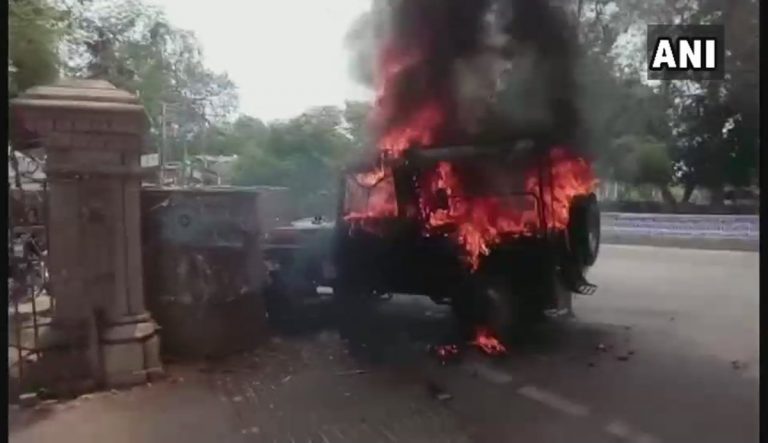
After Allahabad University asked students to vacate hostels during summer break, students ran riot in protest and torched two police vehicles. Hindustan Times reported that according to sources, the students pelted stones at passing vehicles and set a bus and a motorcycle on fire as well before they were chased away by the Police.


Allahabad University has a history of its students clashing with the Police and damaging public property. Earlier in February, the Police and the Rapid Action Force (RAF) had to be deployed at the University campus after protests over the death of an LLB student had turned violent leading to state roadways bus being torched.

In April last year, it was reported that the students had torched four vehicles and attacked the Police while protesting against alleged corruption in the institute and demanding an inquiry into the matter.

In December 2015, some students belonging to Holland Hostel of Allabahad University reportedly pelted stones at shops, exploded crude bombs and damaged vehicles after a couple of them were thrashed for eve-teasing at a function.

In April 2012, violence had erupted at the same university when the Police lathi-charged students who were protesting against their eviction from hostels and attacking the VC. The rampaging mob of students then torched two private vehicles, an official vehicle of the ADM and a UPSRTC bus.

In November 2005, supporters went on a rampage setting ablaze 15 vehicles, including 2 police jeeps, while protesting against the murder of Kamlesh Yadav, a contestant in the Allahabad University Students’ Union Elections.

The current situation at the University is reported to be under control.

Pro-Khalistan slogans raised inside Golden Temple in Amritsar on Operation Bluestar anniversary

Pro-Khalistan slogans were raised inside the Golden Temple in Amritsar yesterday while observing the 33rd anniversary of Operation Bluestar. According to reports, Shiromani Akali Dal (Amritsar), President Simranjit Singh Mann and other Sikh hardliners raised the slogans.


The slogans reportedly started when Akal Takht Jathedar Giani Gurvachan Singh started his formal address. Slogans were raised against Giani Gurvachan Singh too and hardliners accused him of hurting Sikh sentiments in the issue of pardoning Dera Sacha Sauda chief Gurmeet Ram Rahim Singh. Sikh radical Group Dal Khalsa‘s chief Kanwar Pal Singh reportedly told media persons that their members boycotted Giani Gurvachan Singh’s address and staged a walkout. He also criticised the Shiromani Gurudwara Prabandhak Committee which appointed him despite the objections by the ‘Panth’. The supporters of SAD(Amritsar) have shown their anti-India stance earlier when they reportedly sold magazines hailing terrorist Burhan Wani as a hero. Their magazine also contained pro-Khalistan literature.

The Radical Group Dal Khalsa had also reportedly called for a bandh in Amritsar city yesterday. Plainclothes Policemen along with SPGC task force personnel were deployed in the city to tackle any law and order situation.

June 6th was the 33rd anniversary of the Operation Bluestar which was a military operation ordered by the then Prime Minister Indira Gandhi. The Army had entered the Golden Temple to flush out the militant Sikh leader and Khalistan separatist leader Jarnail Singh Bhinderwale form the Harminder Sahab complex inside the temple. This incident led to the assassination of Indira Gandhi in November that year by her own Sikh bodyguards.

Giani Gurvachan Singh, in his address, reportedly told that the Sikh community will always remember the unhealed wounds of the Operation Bluestar.

Expecting unrest in the state ahead of the anniversary, the state and central machinery had been on high alert. As many as 15 companies of paramilitary forces including the CRPF and ITBP were reportedly deployed in different parts of the state and 7 companies were deployed in the Amritsar city alone.

Radical groups have reportedly been increasing their activities in Punjab. There were reports of them infiltrating the Aam Aadmi Party too and there were also cases of prominent nationalist Hindu leaders getting murdered.

As BJP rises in Bengal, three of Mamata’s ministers ‘resign’

Three ministers from Mamata Banerjee’s West Bengal government handed in their resignation on Tuesday, reportedly for the sharp rise of BJP in Bengal, especially in tribal areas in West Bengal. The BJP has done quite well in these districts in the recent panchayat elections. Backward Class Welfare Minister Churamani Mahato, Tribal Development Minister James Kujur and Abani Joardar, who did not hold a portfolio have ‘resigned‘ to concentrate on TMC’s organisational work for the upcoming general elections in 2019.

As per reports, Kujur and Mahato were forced to resign as the Chief Minister became agitated when it became apparent that her party has failed to keep the confidence of tribals in Bankura, Purulia, West Midnapore and Jhargram. The tribal area, which is also referred as Jangal Mahal, used to be a den of Maoist rebels. They shifted their alliance to TMC in 2011 but in the recent Panchayat polls, BJP emerged as a very strong contender in these areas.

It is believed that internal differences of the TMC is the cause of these resignations. One of the cabinet ministers reportedly told Hindustan Times, that last week, Trinamool secretary general Partha Chatterjee went to Jhargram and held a meeting with local leaders where several people complained against Mahato. Chatterjee then reported the matter to Mamata Banerjee. Following the scrutiny of their performances, decision was taken to remove them.