Home Blog Page 841

Ola Electric unveils made-in-India 4680 ‘Bharat Cell’: CEO Bhavish Aggarwal says he hopes to lower EV costs and increase India’s battery production capacity

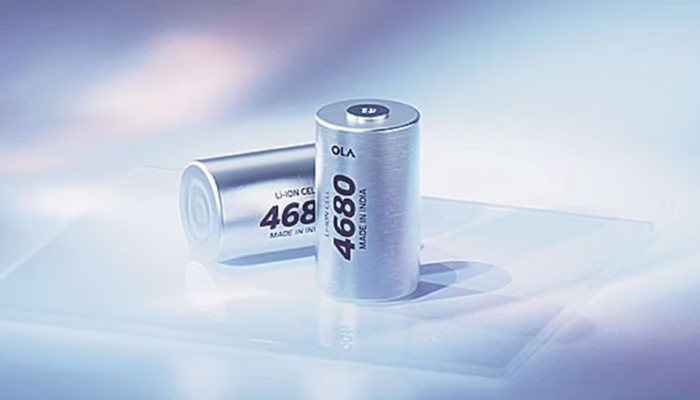
“The smallest unit of a big leap. The Bharat Cell, now made in India,” OLA Electric posted on its official X (earlier Twitter) handle on 27th August giving a sneak peek into the indigenous Bharat Cell created by the company. Reportedly, it is a state-of-the-art 4680 lithium-ion cell that was fully developed and designed in India.

The move aligns with the country’s larger goals of leading the world in electric mobility and furthering the campaign for battery production to become more self-sufficient. The 4680 Bharat Battery Cell was launched on 15th August during Ola’s Sankalp annual flagship event to expedite the country’s electric vehicle (EV).

The “Bharat” cell seeks to develop Ola Electric’s and the Indian EV industry’s technological capabilities. “We didn’t import the tech, we built it ourselves,” stated Bhavish Aggarwal, the founder of Ola Electric, underscoring the company’s dedication to innovation. The Bharat cell, which has received over 70 patents as per OLA, aims to provide five times the energy density of the 2170 cells currently utilized in Ola’s electric scooters.

Furthermore, Ola Electric is gearing up to launch its electric motorcycle line into the Indian motorbike market. Aggarwal noted that motorcycles make up over two-thirds of all automobile sales in India, highlighting the strategic value of the move.

Ola Electric wants to establish itself as a leader in the sector by capturing a significant portion of the growing EV market with its entry into this category. Aggarwal’s statement is in tune with the Indian government’s desire for indigenous manufacturing and technological independence, especially in the expanding EV market. Agarwal stated that the Bharat Cell will work to reduce the dependency on imported battery technology while promoting indigenous innovation. Ola Electric’s popular S1 and S1 Pro models have helped the company establish a solid presence in the electric scooter market.

‘A new era for EV revolution and indigenous technology’, claims OLA

The “Bharat Cell” is reportedly a significant advancement in technology over earlier battery designs. Compared to the 2170 cells now in use, the battery has five times higher energy density because of its 4680 shape. Longer EV ranges are a result of this higher energy density, which is essential for the widespread adoption of electric mobility in a nation the size of India. Additionally, the cell offers reduced charging times, which solves a major issue for EV users, the convenience of charging. Ola claims that the cell lowers production costs by utilizing less cobalt.

The Bharat Cell is produced at Ola’s gigafactory in Krishnagiri, Tamil Nadu. Aggarwal hopes to enhance this factory’s capability to 20 gigawatt hours (GWh) capacity by 2026, and 100 GWh by 2030.

‘EVs 25-30% cheaper with Bharat Cell’, says Bhavish Aggarwal

Aggarwal stated that the company wants to cut the cost of its electric vehicles by 25–30% by producing its own 4680 Bharat battery lithium-ion cell. “The cell is the costliest component of an eV. It’s the heart of an EV. In the ice era, the position that an engine had an engine one is automotive company engine guardian. Similarly, in the EV era, that’s the cell. Because the cell defines the weight, it defines the range, it defines the charging speed. The charging speed is not a function of the charger. It’s the function of the cell. So all these things of your vehicle depend on the cell and if we make our own, we will be able to make it about 25-30% cheaper,” he conveyed during Business Today’s summit on 20th August.

Aggarwal estimates that 90% of the world’s production capacity, or 2,000 GWh, is located in China. “India has one and a half gigawatt, that is mine. I hope to set up about 100 gigawatt hour through the course of this decade,” he added. “When we set up our cell effort four years back, when we started Ola electric, that’s when we set up our cell effort, we decided that we would build the frontier technology in cell not just the current. We will not license technology from China or elsewhere. We will not just use some old generation of technology, but we will build what, four years ago we felt was the frontier tech, and that was the 4680 format. It’s much bigger, more energy-dense and much less to charge. And then from here on, we can go into solid state cells which are the holy grail of energy storage in the modern world,” he shared during the event.
Karnataka: Order to remove electric poles with Dhanush, Gada designs on SDPI’s demand revoked after outrage by Hindus. Read what happened

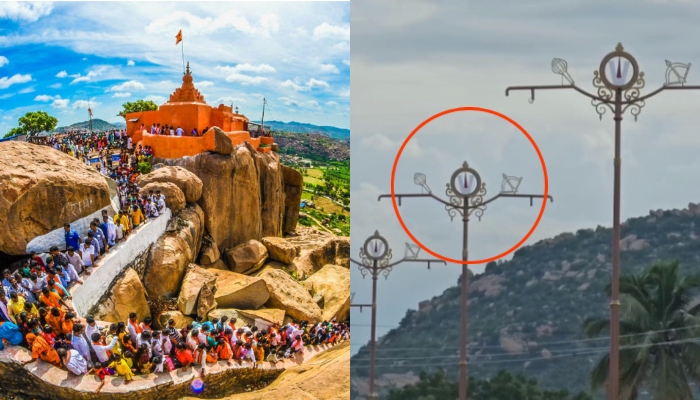
On 28th August, Wednesday, the Koppal district Tehsildar ordered the removal of decorative electric lamps on the streets of Gangavathi taluka, which is believed to be the birthplace of Lord Hanuman. The electric lamps on the streets of the city portrayed ‘Gada’ and ‘Dhanush’ like ornamental structures, to symbolise the weapons carried by Lord Rama and Lord Hanuman.

Tehsildar U. Nagaraj also ordered to register a police case against Karnataka Rural Infrastructure Development Corporation (KRIDL) for allegedly hurting religious sentiments by portraying “Hindu religious symbols” on public lamps.

The action was taken after the Social Democratic Party of India (SDPI), which is the political wing of the banned Islamist terrorist organization Popular Front of India (PFI) raised objections over the lamps and stated that these were allegedly hurting their religious sentiments. However, later the order was revoked on the verbal order of the District Collector.

These poles are notably installed on the road between the Rana Pratap Circle and Julia Nagar in the Gangavathi region for beautification. The official notification by the tehsildar stated that these poles could disturb the religious harmony in the city. “Since there are possibilities of disturbing public peace in the city, the poles should be immediately cleared. File a case against the KIRDL engineers for carrying out this work and take appropriate action,” the official notification read in Kannada.

It is important to note that Anjanadri Hills in Gangavathi (Koppal district) is celebrated as the birthplace of Lord Hanuman. Earlier, BJP’s Janardan Reddy had demanded the development of Anjanadri hills on similar lines to Ayodhya, the birthplace of Lord Rama in Uttar Pradesh. He had also demanded the release of Rs 120 crores from the state funds for the development of the area, which is believed to be the birthplace of Lord Hanuman.

Local reports say that the electric poles portraying symbols of arrows and ‘gada’ have been installed to instil religious motivation in the minds of devotees who travel on the path while on their way to the Anjanadri Hills. During the installation, it was also made clear that the act was being executed with no other communal intention. Attempts are made to beautify the birthplace of Lord Hanuman on the models of Ayodhya and Tirupati, and the decorative electric poles were part of that effort.

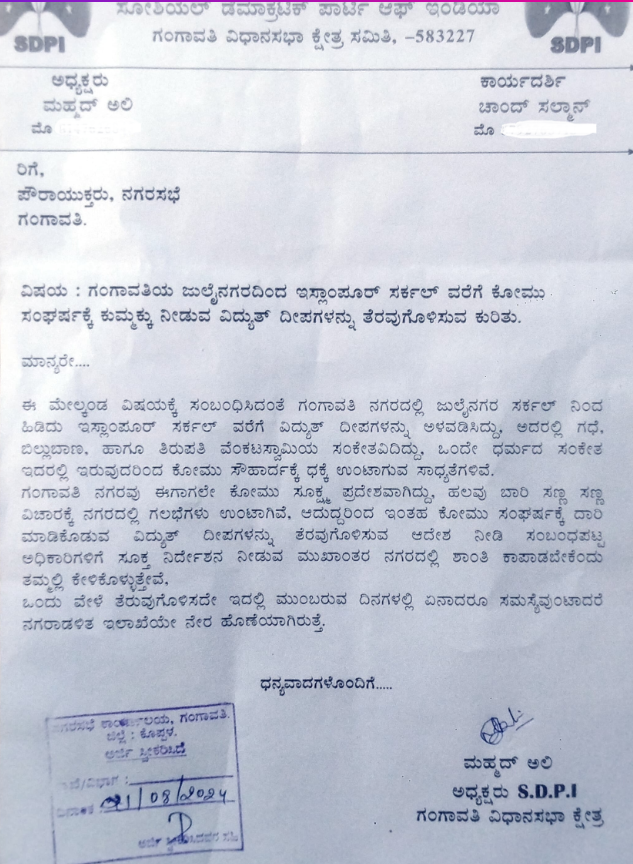
However, the Tehsildar asked removal of the lamps citing communal disharmony after protests by SDPI. Social Democratic Party of India (SDPI), which is the political wing of the banned Islamist terrorist organization Popular Front of India (PFI), raised objections over the lamps and stated that these were allegedly hurting their religious sentiments. “The electric poles contain religious symbols that might disturb communal harmony in Gangavati,” the SDPI had stated in the official notification on 21st August appealing to the Gangavati Municipal Assembly Commissioner for clarification.

The SDPI also claimed that these Hindu religious symbols on the electric poles threatened the society’s peace.

However, after the outrage over the Tehsildar’s order to remove the poles and police action against authorities, the District Collector issued a verbal order to revoke the order.

On 28 August, Tehsildar U. Nagaraj issued another notification, saying that no electric poles will be removed and no case will be filed against the police. The Tehsildar added that the earlier order is being withdrawn. The new notification said, “As this matter falls under the purview of the municipal council, a proposal was made in the general meeting, the matter was presented and approved, and the background order was made without my notice. The order has been withdrawn.” 

The Tehsildar asked the police to dispose of the case at this stage. The police have been directed not to register any FIR against the officials concerned and not to take any action to remove the electric poles.

It is crucial to note that the poles have been installed on the streets of Gangavathi leading to Anjanadri Hills. The route lasts 12km. Local reports suggest that these religious symbols have been installed just to encourage the devotees walking on their way to Anjanadri Hills to worship Lord Hanuman.

Note: This report has been updated with latest developments in the matter

Paris: Telegram boss Pavel Durov released on bail bond of $5.5 million, asked not to leave France and report to a police station twice a week

Pavel Durov, the founder and CEO of Telegram, is under formal investigation related to illicit activities on the messaging app. French authorities have also prohibited him from leaving the country, CNN reported.

Notably, Pavel Durov, who had an arrest warrant issued against him, was detained by the French authorities at an airport outside Paris, CNN had earlier reported.

Officers from France’s anti-fraud office, attached to French customs, took the French-Russian billionaire into custody on Saturday evening after he arrived at Bourget Airport on a flight from Azerbaijan, according to CNN affiliate BFMTV.

Durov was wanted under a French arrest warrant due to the lack of moderation on Telegram, which allegedly led to the platform being used for money laundering, drug trafficking and sharing pedophilic content.

Earlier in the day, Durov was released from police custody in France and was transferred to court for questioning, CNN reported.

Laure Beccuau, the Paris prosecutor, said in a statement that Durov had been ordered to pay bail of USD 5.5 million, and was released but must check in at a police station twice a week, according to The New York Times.

Beccuau also asserted that Telegram has featured in several criminal cases in France in connection with child sexual abuse, drug trafficking and online hate crimes, but has shown a “near-total absence” of replies to requests for cooperation from prosecutors.

Prosecutors around France, along with legal authorities in Belgium and other European countries, “have shared the same observation,” Beccuau said, leading organised crime prosecutors to open a probe in February on the “potential criminal liability of executives at this messaging platform,” The New York Times reported.

Beccuau further said that if Durov is convicted, he could face up to 10 years in jail.

Durov is being probed for several suspected offences related to criminal activity on the messaging app, including complicity in illegal gang transactions, laundering of crimes in an organised gang, and refusal to communicate information to authorities, as per the French prosecutor’s statement, CNN reported.

Notably, France issued an arrest warrant for Durov on charges of complicity in drug trafficking, crimes against children and fraud due to the lack of moderation on Telegram and his failure to cooperate with law enforcement, the Moscow Times reported, citing French local media.

The Russian-born founder of Telegram, which he says boasts over 900 million users, is currently based in Dubai. He became a naturalised French citizen in August 2021.

Durov, who is also the founder of the VKontakte social network, left Russia in 2014 after he refused to share VKontakte users’ data with Russian security services. Later, Russia unsuccessfully attempted to block Telegram over its refusal to provide users’ online communications to security services. 


(This news report is published from a syndicated feed. Except for the headline, the content has not been written or edited by OpIndia staff)

Bengaluru: Retired teacher dies after 10-12 stray dogs attack her during morning walk

0

On Wednesday, August 28, a 76-year-old woman was mauled to death by a pack of stray dogs during a morning walk at the Jalahalli Air Force Campus in Bengaluru. The deceased was identified as Rajdulari Sinha, a retired teacher from Bihar.

According to reports, Sinha, mother-in-law of an airman had come to Bengaluru. She was out for a morning walk when 10-12 stray dogs suddenly attacked her in the playground at Air Force East 7th Residential Camp in Jalahalli around 6.30 am. She sustained multiple injuries and died on the way to the hospital.

A case of unnatural death has been registered at the Gangamma Gudi police station, according to a senior police officer.

Meanwhile, a social media user, who claimed to have witnessed the incident, took to X to narrate what transpired. “It’s a tragic scene in the morning itself. Dozens of stray dogs attack a lady. I shouted, and my family joined me until a gentleman comes the dogs attacked. Jalahalli Airforce playground, Vidyaranyapura. I am guilty that I couldn’t help her because of this wall.”

“I was the helpless eyewitness. Due to their big wall, I couldn’t save her. I shouted and called some people and they took her to hospital, but no use,” he said in another post.

Jalahalli police inspector Sidde Gowda was quoted by HT as saying, “Raj Dulhari Sinha, a retired teacher from Maharajganj in Sivan district, Bihar, was staying at her son-in-law, Airman Amit Kumar’s house. The attack happened about 200 metres from the house when a pack of 10-12 dogs attacked her, inflicting grievous injuries. She was immediately shifted to MS Ramaiah Hospital but she died during treatment. The autopsy has been conducted. We have registered a case of unnatural death, and the investigation is ongoing.”

Bruhat Bengaluru Mahanagara Palike Zonal Commissioner Karee Gowda stated that this is the first incident of its kind in the Yelahanka zone. “Last year, there were 35 reported cases of dog bites in our zone; this year, so far, seven cases were reported. We regularly conduct anti-birth control measures for street dogs and will take extra precautions to protect the lives of people, including relocating stray dogs if necessary,” he said.

Stray dog attacks have become increasingly common. In fact, only on 27th August, Nayeeb Shaikh, a four-year-old girl from Bhiwandi who was bitten by a dog in July this year, died while receiving treatment at Sion Hospital. The reason for her death is believed to be a severe dog bite. She was admitted to three separate government hospitals for proper treatment but could not be saved.

Fake currency racket busted in Madarsa, Prayagraj police arrest Maulvi Mohammad Tafseerul, mastermind Zahir Khan and 2 others

On Wednesday, August 28, Prayagraj police uncovered a fake currency racket operating within a madrasa in the city, leading to the arrest of the madrasa principal, Mohammad Tafseerul, the mastermind, Zahir Khan alias Abdul Zahir, and two other students, Mohammad Afzal and Mohammad Shahid. The madrasa, identified as Jamia Habibiya, was being used to print counterfeit currency.

Authorities recovered 1,300 fake 100-rupee notes, 234 sheets of printed fake currency, three bundles of paper, a printer, a cutter, a laptop and other related items from the scene.

Giving information about the operation, DCP City Deepak Bhukar stated that the Civil Lines Police received a tip-off about individuals coming to the Civil Lines bus stand to deal in counterfeit currency. Acting on this information, the police conducted a raid, apprehending three suspects. Following their interrogation, a raid was carried out on Wednesday at a madarsa near Kalyani Devi Petrol Pump in the Atarsuya area, where fake currency was being printed in a room. During the raid, police discovered 234 counterfeit notes that were yet to be cut.

The acting principal of the madarsa, Maulvi Mohammad Tafseerul Arifin, was also arrested. According to the DCP, the acting principal was actively involved in the operation, providing a separate room for the gang to print the fake notes. The leader of the gang, Zahir Khan, a madarsa student from Orissa, was identified as the mastermind behind the operation.

We lost pride in Indian stuff, test our Indigenous weapons against global benchmark: Indian weapon maker makes important points after govt orders 73,000 more riffles from US

On Wednesday (28th August), the CEO of a major Indian defence company, Vivek Krishnan expressed disappointment and discontent over the fact that the Ministry of Defence awarded another order for the procurement of assault rifles from the American firm instead of prioritising ‘Made in India in Defence Sector’ and indigenisation of defence hardware. 

Notably, this comes a day after American weapons manufacturer Sig Sauer announced on Tuesday that India’s Ministry of Defence has placed an order for 73,000 SIG716 rifles. The US firm said that the company is honoured to announce a second procurement contract with the Government of India, Ministry of Defence to supply an additional 73,000 SIG716 rifles. This is India’s second procurement order awarded to US firm Sig Sauer in the last five years. The Indian government previously ordered 72,400 rifles from them in 2019. Now, once their new deal is completed, the Indian Army will have more than 1.45 lakh Sig Sauer SIG716 rifles in service. 

While this new order will fulfil the much-needed requirement of guns for Indian armed forces, this has been seen as a major setback for the government’s own make-in-India in defence sector initiative. While India now manufactures fighter planes, helicopters, tanks, artillery guns and many other equipment, local production of small arms has been less than expected.

In 2019, there was a lot of buzz about two new snipper riffle prototypes developed by an Indian company, SSS Defence from Bengaluru. It was expected that the company would supply to the Indian Army, as the army was looking to acquire sniffer riffles. Now, the recent order has meant that the company has missed out on the opportunity this time.

Now, responding to this development, the Indian Entrepreneur Vivek Krishnan has written a long post on X stressing that India needs indigenous weapons, especially when it is surrounded by hostile neighbours. Krishnan is the CEO of SSS Defence, a new age Defence company that is backed by 70 years of manufacturing excellence, as per the company’s X (Twitter) bio. Their focus is manufacturing small arms, ammunition, high-end optics & military accessories. 

In his post, the Indian Entrepreneur exhibited confidence in Indian defence manufacturers and posed a challenge stating that indigenous weapons can be tested against global benchmarks, alluding that they will be at par with their global competitors. 

While expressing confidence in the capabilities of Indian defence manufacturers, Krishnan, however, lamented by pointing out what he called “a lack of self-esteem”. He explained by saying, “…we brown skinned Indians have always found that we’re respected by our own global peers before the country wakes up. It’s a self esteem thing…”

He noted that he has reacted to this development as he was getting a lot of messages asking “his” opinion about this procurement order of assault rifles from the US firm. 

He said, “Well, we knew this was coming. So, just went about our work. But some plainspeak is well worth it.” 

Afterward, he raised several points in his post, while displaying raw emotions –

Major points raised in his post

Krishna outrightly mentioned, “I wish the govt had not acquired more of these,” referring to the repeat order for SIG716 rifles. He argued that India could have gotten more contenders in the race had the govt insisted on Indian design and content. 

He noted that despite the order going to the US firm, his defence company SSS Defence will continue “to be the most fearless dog in this business”. He added, “We shall still have a weapon for each caliber and the user to us is still the man in uniform. We will be global”. 

Highlighting the need for patience to see the success of Make in India for in defence, he said, “What about Make in India for defence? There are a handful of guys really doing good work in the small arms space. There’s commitment from them and all it’ll take is patience. With our neighbourhood, only a fool can imagine doing without indigenous weapons. They’ll have to come and buy from us”. 

He asked, “What about pride in Indian stuff?” adding that we lost pride a long ago by building substandard weapons in the government-controlled space which the private sector is trying to regain.  

Lamenting about the lack of pride in Indian talent, he added, “But making good weapons & getting them accepted is a difficult task. We know since going global has taught us that. In any case, we brown skinned Indians have always found that we’re respected by our own global peers before the country wakes up. It’s a self esteem thing…”

He concluded by demanding a fair test in which the indigenous weapon is tested against the global benchmark. 

He said, “Here’s the challenge – we’ve heard from the buyer for a long time that “we’re not there on metallurgy” or “our designs are behind time”. I say put an Indigenous weapon of ours against a global benchmark in each caliber and test out. Make the results open like real serious armies do. Test protocols are clearly defined. It would be the best for both sides. How difficult is that ?” 

SIG716 vs Sniper rifles developed by SSS Defence

As per the Live Mint report, the SIG716 rifle is said to be an improved version of a rifle in the ArmaLite Rifle (AR) platform chambered 7.62 NATO. It has a higher recoil and higher calibre, meant to shoot-to-kill targets at 600 metres. This assault rifle reportedly has a higher range, more lethality, and higher recoil than the INSAS and the AK-47, which fires a smaller round.

It features a 16-inch barrel, an M-LOK handguard, and a 6-position telescoping stock. According to the statement released by the US firm, it designs and builds rifles for the Indian Army and various other clients in the United States. 

Based in Bengaluru’s Koramangala, SSS Defence is reportedly India’s first private firm in defence production. In 2019, it had designed and developed two sniper rifle prototypes meant for the armed forces, indigenously. Back then, it was gunning to put its two weapons on trial with the special forces. 

As per the Times of India report, it had developed two rifles: Viper which uses .308/7.62x51mm cartridge, and Saber which fires .338 Lapua Magnum cartridge. While Viper has proved its accuracy from a distance of more than 1,000 metres, Saber has proved it on a 1,500 metres range. The Minute of Angle (MoA), which is used to measure the accuracy of rifles, the firm claimed, is the best in the class, comparable to global weapons.

UP: Son of farmer leader and friend arrested for trail derailment attempt in Farrukhabad

Two men, one of whom is the son of a local farmers’ leader, have been arrested for allegedly trying to derail a train by placing a wooden log on the tracks in Uttar Pradesh’s Farrukhabad over the weekend. The police reported on Wednesday that an alert locomotive pilot managed to prevent an accident by timely applying the brakes.

The arrested individuals, Dev Singh and his neighbour Mohan Kumar, both in their twenties and residents of Ariyara village in Farrukhabad, confessed during interrogation that they committed the act to gain fame. “The accused believed that the incident would bring attention to their names and make them famous,” said Ram Avtar, the Station House Officer of Kayamganj Police Station.

Singh’s father, Kamlesh Kumar, is a prominent farmers’ leader in the region.

The police reported that Indian Railways employee Jaheer Ahmed Khan filed a First Information Report (FIR) on August 24 against unidentified individuals for placing a wooden log on the railway track, putting passengers at risk and causing damage to government property.

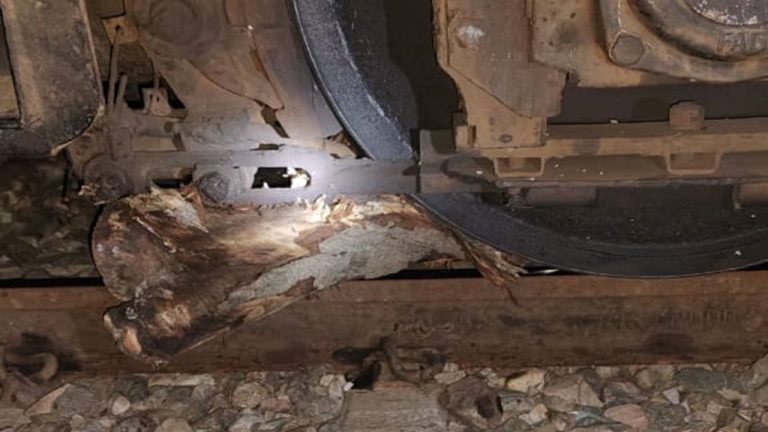
On Friday (23rd August) night, the Farrukhabad Express plying between Kasganj and Farrukhabad narrowly averted a major accident after coming in contact with a wooden log placed on the railway track.

As per reports, the train experienced a sudden jolt, forcing the loco pilot to apply emergency brakes and bring the train to a halt. It was later discovered that the wooden log had stuck to the train’s engine.

After that, the railway workers removed the wooden log and cleared the track. The train resumed services after 25 minutes. On reaching the Shamshabad railway station, the loco pilot reported the matter.

During their investigation, the police used local intelligence and surveillance to identify Dev Singh and Mohan Kumar as suspects. “The accused confessed to the crime, stating that they arrived at the field around 9 pm on Saturday. Seeing no one nearby, they took a wooden log from the field and placed it on the railway track, about 80 meters away,” said a police officer.

Singh and Kumar, both farmers, have been charged under Section 327 of the Bharatiya Nyaya Sanhita (BNS) for mischief with intent to destroy or make unsafe a rail, aircraft, decked vessel, or a vessel of 20 tons burden. Additionally, they face charges under the Railways Act.

Interim govt in Bangladesh says no evidence of involvement of Jamaat-e-Islami in violence, lifts ban

In an expected move, the interim govt in Bangladesh today officially lifted the ban on Jamaat-e-Islami and Islami Chhatra Shibir. The public security division of the home ministry issued a gazette notification in this regard on Wednesday, as per reports. Notably, the Muhammed Yunus led government already has pro-Jamaat ministers, called advisors.

The gazette notification said that no specific evidence was been found that Jamaat-e-Islami, Islami Chhatra Shibir and its associate bodies were involved in violence. The government believes Jamaat-e-Islami, Islami Chhatra Shibir and its associate bodies are not engaged in violent activities, the home ministry said.

Jamaat-e-Islam and the Chhatra Shibir were banned by the Sheikh Hassina government on 1 August, at the peak of the students moment and days before her govt fell and she fled to India. The notification banning Jamaat, Chhatra Shibir and their affiliated organisations were issued by the Awami government under section 18(1) of the Anti Terrorism Act.

Just four days after the notification, Hasina-led government was toppled on 5 August and Sheikh Hasina left the country and went to India. The interim government led by Nobel laureate Muhammed Yunus was formed on 8 August.

While the ban on Jamaat-e-Islami has been lifted, the organisation remains banned from contesting elections. It was banned in 2013 from contesting elections after high court ruled that its charter violated the secular constitution of the Muslim-majority country. The High Court had declared the registration of Jamaat-e-Islami as a political party illegal. Therefore, the party was barred from contesting polls in 2014, 2018 and 2024.

In November last year, the Supreme Court of Bangladesh upheld the order, dismissing an appeal filed by Jamaat-e-Islami challenging the High Court verdict that scrapped its registration with the Election Commission as a political party.

Prototype of Indian 5.5 generation Advanced Medium Combat Aircraft to be ready in next four years

0

As part of plans to develop an indigenous advanced combat aircraft, India is planning to be ready with the first prototype of the 5.5 generation fighter jet by 2028.

The project was discussed in detail at a recent meeting between the Indian Air Force and the Defence Research and Development Organisation where its roadmap was reviewed.

Senior defence officials told ANI that the 5.5 generation Advanced Medium Combat Aircraft would be a stealth aircraft and weigh around 27 tonnes with the capability to carry huge weapons load.

The agencies involved are looking at developing capabilities that would allow the plane to carry the missiles in a completely concealed configuration for stealth, they said.

Conventionally, it would be able to carry much more weapons, they said.

The officials said that if engine production and other concerned activities move in time, the first prototype would be ready by 2028.

The aircraft would require at least six to seven years for development and preparing it for fighting wars of the future.

The aircraft project would also see the DRDO selecting a development cum production partner which will include a public sector unit and a private sector firm.

The mass production of the Advanced Medium Combat Aircraft (AMCA), a 5.5-generation fighter, is expected to start by 2035.

The IAF and the DRDO have worked out a timeline for the LCA Mark 2 program also. The prototype of a 4.5 generation fighter, initially expected by early 2025, has been delayed by approximately a year, attributed to delays in the release of approved funds, linked to the engine deal for the next indigenous fighter.

The LCA aircraft are scheduled to be powered by American GE engines; LCA Mark 1 and Mark 1A by GE-404 engines, while the LCA Mark 2 will utilize the more advanced GE-414, manufactured in India with indigenous content.


(This news report is published from a syndicated feed. Except for the headline, the content has not been written or edited by OpIndia staff)

Delhi: Mohammad Sharif rapes a 12-year-old girl in a graveyard, media gives it a Hindu spin by referring to him as a ‘Tantrik’

On a day when the President of India Droupadi Murmu has expressed concerns over the heinous cases of crimes against women, another shocking case of rape of a 12-year-old girl has come to light from the Kanjhawala area of Delhi. A 52-year-old man named Mohammad Sharif has been arrested in connection with the heinous crime. He is a peer working in a cemetery. He had taken the minor victim to the graveyard on the pretext of exorcism where he raped her. The victim has been admitted to the hospital for treatment. 

The incident is said to have occurred on Monday (26th August). According to reports, the case pertains to the Kanjhawala police station area of Delhi. Both the victim and the accused hail from the same community. It is pertinent to note that the age of the minor victim is not clear as some media reports have claimed that the minor was even younger, with some reporting her age as 9 while others said she was just 7. 

The minor victim’s father filed a Police complaint in this matter on Tuesday (27th August). In the complaint, he stated that he is a fruit seller and a father of 2 daughters and 1 son. He is suffering from chronic illness. The 52-year-old accused, Mohammad Sharif often used to visit the victim’s house on the pretext of curing his illness through exorcism. It is said that he had evil intentions towards the minor girl.

On Monday, Mohammad Sharif once again visited the victim’s house. After reaching there, he asked the minor girl to come to his house on the pretext that he would give her a ration. However, it is said that his plan failed when the victim’s brother went there. 

The accused then asked the victim to approach him for exorcism. Later on, Sharif took the girl to the bushes near the cemetery where he raped the victim. When the victim started crying, he tried to soothe her by offering money. 

Mohammad Sharif is also accused of threatening the minor victim and warning her that if she told anything about it to anyone, her father would be killed. 

Scared of his threat, the victim came back home and remained silent. A day later, her health suddenly deteriorated. When her elder sister became suspicious, she inquired. Ultimately the victim narrated her ordeal to the family members after which her father filed a Police complaint on Tuesday.  

A day later, the officials said that a minor girl was allegedly raped by a 52-year-old man in a graveyard in west Delhi’s Rohini under the guise of performing occult rituals to cure her ailing father.

According to the complaint, accused Mohammad Sharif first took her to a graveyard in Delhi’s Kanjhawala area claiming that he would perform ‘black magic’ to cure her ailing father who is suffering from a chronic disease. However, the accused raped her at the graveyard. 

As per reports, the Delhi Police received a PCR call on 27th August detailing the sexual abuse. A senior police officer said, “A call regarding the sexual assault of a girl was received at Kanjhawala police station on Tuesday. A police team was sent to the spot.”

Based on the complaint, the Police filed an FIR and booked the accused Mohammad Sharif under section 65(2) of Bharatiya Nyaya Sanhita (BNS), and relevant sections of the POCSO Act, the Police said. 

The police officer said, “We have arrested Mohammad Sharif. The girl was also medically examined at Sanjay Gandhi Memorial Hospital. Further investigation is underway.”

Incidentally, while reporting about the case, several media houses have carried misleading headlines claiming that a ‘Tantrik’ raped a minor girl. 

Several media houses in their reports have addressed Mohammad Sharif, who works and does exorcism at the cemetery, as a Tantrik. However, this is not the first time the media have described an accused peer, or exorcist in such cases as ‘Tantrik’. In several cases in the past, attempts to secularise the crime has been undertaken when the accused, ostensibly belonging to the minority community, is referred to as a Tantrik to obscure his religious identity.