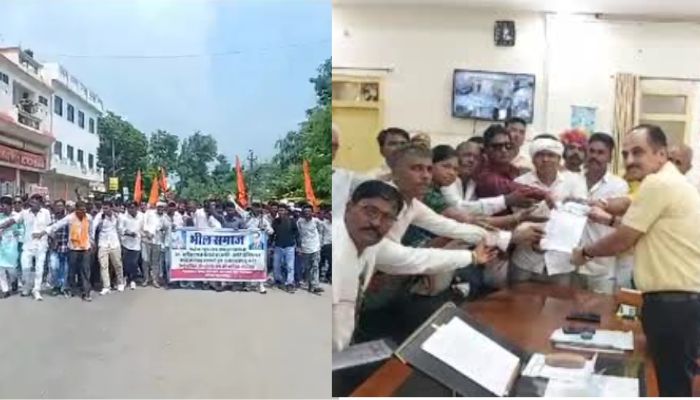
On Monday (3rd September), the Bhil community took out a rally in support of the creamy layer exclusion and the sub-classification of Scheduled Tribe (ST) reservation in Rajasthan. The community members reached the Mini Secretariat and sought that the benefits of classification be offered to the community’s underprivileged members immediately. After the sloganeering, the Rajasthan Samagra Bhil Varg Aarakshan Manch, District Branch Jhalawar, presented a memorandum to Collector Ajay Singh Rathore.
The Bhil community members started the rally from Radha Raman Mangalik Bhawan carrying saffron flags in their hands and reached the Mini Secretariat to hand a memorandum to the Collector. During the rally, heavy police force was deployed to uphold law and order in the area.
Bhil community took out a rally in Rajasthan in support of sub-classification & reservation within SC & ST community.
The best part is that only saffron flags were visible and no blue flag was in sight.
District President Jamnalal Bhil stated that on the 1st of August this year, the Constitutional Bench of 7 judges of the court made recommendations to the Government of India and the state governments to establish quotas within quotas to provide the advantage of reservation to castes that are under-represented or missed in SC/ST reservation. He said that the Bhil community respects and endorses these recommendations made by the Supreme Court adding that this will benefit the deprived communities of the ST reservation, such as Bhil, Garsia, and Saharia.
Meanwhile, Arvind Bhil of Bhil Samaj Samiti stated that the quota for the Bhil community in the ST reservation should be set separately based on their population in Rajasthan ensuring that the downtrodden people can take advantage of reservation and get into government jobs, improve their living standard and join the country’s mainstream.
Notably, on the 1st of August, a 7-judge constitutional bench of the Supreme Court ruled by a 6:1 majority that sub-classification of Scheduled Castes/Scheduled Tribes is admissible in order to give distinct quotas for more backwards within the SC/ST categories. CJI DY Chandrachud stated that the ruling contains six views. While six out of seven judges agreed that sub-classification is permissible, Justice Bela Trivedi dissented. Justice Trivedi opined that such sub-classification is not permissible.
The seven-judge Constitution bench led by CJI DY Chandrachud and Justices BR Gavai, Vikram Nath, Bela M Trivedi, Pankaj Mithal, Manoj Misra, and Satish Chandra Sharma overturned the 2005 decision in EV Chinnaiah v. State of Andhra Pradesh, which ruled that sub-classification of SC/STs violates Article 341 of the Constitution, which grants the President the authority to prepare the list of SC/STs.
In his decision, CJI DY Chandrachud cited historical evidence to support his contention that scheduled castes are not a homogeneous entity. He opined that sub-classification does not violate the principle of equality established by Article 14 of the Constitution. Additionally, sub-classification does not violate Article 341(2) of the Constitution. Nothing in Articles 15 and 16 stops the State from subclassifying a Caste. The CJI had emphasised that the basis of subclassification must be supported by quantitative and demonstrable evidence from States.
Notably, right after the Supreme Court ruling, misinformation about it started spreading across social media. A Bharat Bandh was also called by the National Confederation of Dalit and Adivasi Organisations (NACDAOR) and other such bodies against the SC ruling. The protests were also reported to be backed by Congress, Jharkhand Mukti Morcha (JMM), Bahujan Samaj Party (BSP) and Rashtriya Janata Dal (RJD) among others. According to the protestors, the SC ruling undermines the earlier verdict of a nine-judge bench in the landmark Indira Sawhney case, which had set up the framework of reservations. However, the Supreme Court was of the view that the sub-classification of SC and ST castes would benefit the more backward caste groups within SCs and STs.
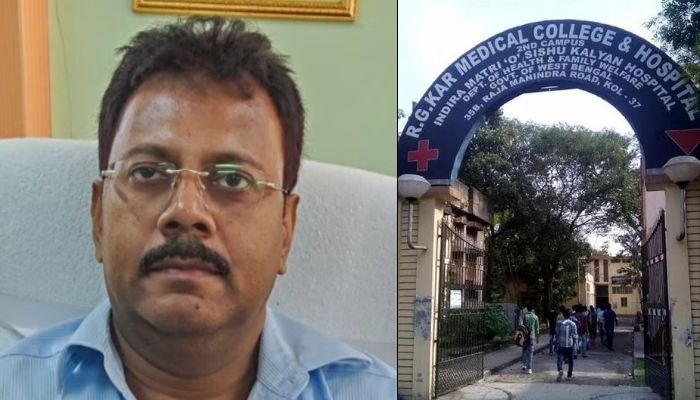
On Monday (2nd September) evening, the Central Bureau of Investigation (CBI) arrested Sandip Ghosh, the former principal of RG Kar Medical College and Hospital, over financial irregularities in the running of the facility.
As per reports, there were irregularities in the procurement of medicines at the RG Kar Medical College and Hospital during the tenure of Ghosh as its principal. A CBI official, familiar with the development, had confirmed that there was plenty of evidence against the accused.
The central agency initially took Ghosh to Nizam Palace and arrested him under charges of corruption and cheating. CBI had previously raided his house in connection to financial irregularities at the RG Kar Medical College and Hospital.
Kolkata Horror: CBI's big catch in #RGKar hospital case; top doctor among 4 held | Dr Sandip Ghosh
The ex-principal of the RG Kar Medical College and Hospital was earlier subjected to a polygraph test along with the prime accused Sanjay Roy and four doctors.
Besides Sandip Ghosh, the investigative body had also arrested his security guard Afsar Ali Khan (44) and hospital vendors Suman Hazara (46) and Biplav Singha (52).
Allegations against Sandip Ghosh
In August this year, the ex-deputy superintendent of RG Kar Medical College and Hospital Dr Akhtar Ali moved the Calcutta High Court demanding a probe by the Enforcement Directorate (ED) into the financial misconduct at the facility.
Ali had accused Ghosh of trafficking biomedical waste, illegally selling unclaimed dead bodies and passing tenders in exchange for commission from medicine suppliers.
He also informed the court that the former principal was involved charge ₹5 to ₹ 8 lakhs from students in return for passing them in exams. The case pertaining to financial irregularities was being handled by the State-appointed SIT prior to its transfer to CBI.
A heinous case of gang rape of a Dalit teenager has come to light from Uttar Pradesh’s Meerut. The Police have named three persons and four unknowns in the FIR. They have been booked under the POCSO Act after it was confirmed that the Dalit victim was gang-raped. This heinous case of gang rape of a Dalit teenager studying in Class 11th has sparked tensions in the area as all the accused hail from the Muslim community. Several Hindu organisations have staged a protest demanding strict action against the accused.
According to reports, the victim hails from the Dalit community and is currently studying in class 11th. Seven youths kidnapped her when she went out for defecation. They then took her to the jungle of Loiya village where they took turns to rape her. It is said that the accused committed the heinous act for 48 hours until the victim’s health deteriorated, after which they fled from there, leaving the victim in a critical state.
On 29th August, minor victim had gone out for defecation from where the accused kidnapped her. For 2 days and nights, they kept her hostage in the jungle where they gang-raped her for hours until her health worsened. Afterward, they fled from there, leaving the victim in a distraught state. When her family came to know about it, they reached the jungle on Friday evening and brought their daughter home. Subsequently, she narrated the brutality committed by the accused.
Following the incident, members of the Hindu organization staged a protest on Saturday demanding strict action against the accused and Justice for the victim.
SSP Dr. Vipin Tada had ordered strict action against the accused.
On Sunday (1st September), the Police recorded the statement of the Dalit victim who was kidnapped and gang-raped by seven accused. She lives in a village that comes under the jurisdiction of the Falavada Police Station.
Sharing her ordeal, the victim stated that the accused Samir, Raja, and Sameer along with four accomplices kidnapped her. They took her to the forest of Loiya in the Daurala police station area and gang raped her continuously for 48 hours near a tubewell in the field. As per the information received, one accused Samir is a resident of the Mahalka area, while Raja and Sameer are residents of Nangla Hareru.
On Saturday (31st August), a case was registered at the Mawana Police Station based on the complaint of the victim’s family. The Police have booked Samir son of Salim, Raja son of Salim, another accused named Sameer, and four unknown persons. They have been charged with relevant sections of kidnapping, gang rape, and POCSO Act.
Rural SP Rakesh Mishra said that they recorded the statements of the victim under Section 161 after the completion of the victim’s medical examination. He added that her statements under section 164 will be recorded in the court on Monday.
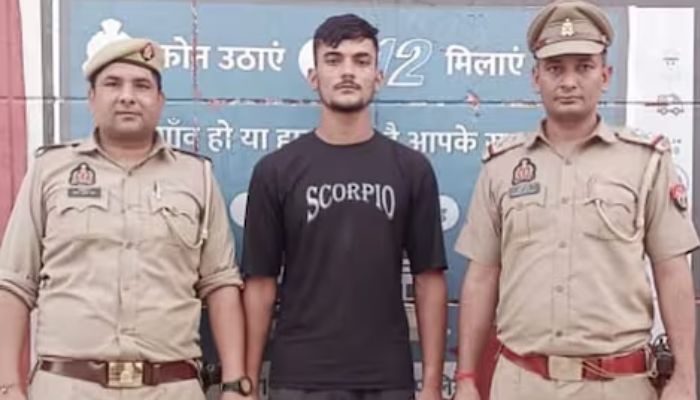
The Police arrested the main accused Samir late evening on Sunday. Three police teams are conducting raids to arrest the absconding accused.
SHO Falavada Rajesh Kamboj said that the police have arrested the main accused of gang rape, Samir. He added that raids are being conducted to nab the other accused in this case who will be arrested soon.
Meanwhile, several BJP leaders also visited the victim’s house to assure support to the aggrieved family.
Police also book village Pradhan Aslam for helping the accused
Based on the complaint of the victim’s family, the Falawada police have also registered a case against Aslam, the Village Pradhan. In their complaint, the victim’s family stated that on 31st August, Pradhan Aslam told them that he made every effort to recover their kidnapped daughter so they should not file a report in this matter. According to them, Pradhan Aslam is in cahoots with the accused and has been trying to save them. The complaint added that he had threatened to kill them in the police station.
Atish Sarkar, a leader of the All Indian Trinamool Congress (AITC/TMC), has been suspended for an year by the party after he threatened protesters protesting against the rape and murder of a trainee doctor in RG Kas Hospital in Kolkata.
There have been fierce protests ongoing in West Bengal against the rape and murder of the 31-year-old trainee doctor at RG Kar Medical College and Hospital in Kolkata on 9th August.
Former councillor Atish Sarkar, who is the spouse of a TMC councillor from Habra, lashed out at the demonstrators on 1st September.
“Didi has instructed us to hiss,” the leader who comes from Ashoknagar in North 24 Parganas, around 50 kilometres northeast of Kolkata, said.
Atish Sarkar threatened, “Those of you who are abusing Didi, engaging in her character assassination, if we make obscene posters of your mothers and sisters and put them on your walls, you won’t be able to remove them. I will make a distorted picture of your mother and sister and hang it on the door of your house. You will not be able to leave your house. That day is going to come soon.”
He further said, “Be careful, TMC men are on the streets,” and challenged, “If we start hissing at every locality in the mornings and evenings, will you be able to step out of your homes?”
While the entire nation and West Bengal are demanding justice for R.G.'s sexual harassment and condemning government failures, TMC leaders are unleashing vile threats.
TMC goons, emboldened by Mamata Banerjee's call to 'create chaos,' are now threatening to deface homes with… pic.twitter.com/pjWUWWdvWG
The party then suspended Atish Sarkar for one year soon after his comments went viral on social media. Notably, he was not the only leader who attacked the protesters over the gruesome incident. TMC Lok Sabha MP from Bankura, Arup Chakraborty, earlier on 1st September, stated that those protesting against the rape and killing of a junior doctor at RG Kar Hospital and “misleading people” will “flee like dogs” as soon as party members make a stand and hiss.
“Awaken your conscience,” he claimed in a party meeting in his constituency and added, “Save (West) Bengal. Stand with Mamata Banerjee. We are there in Delhi’s Parliament. Trinamool Congress workers will have to hiss. Friends, you hiss and they will flee like dogs, they will run like foxes.
He also said, “We wanted change, not revenge, after coming to power in 2011. But they have crossed all limits. They are misleading the people and making them say that people will not accept Kanyashree or Durga Puja grants (in protest against the rape and murder case). If they have guts, they should take out a rally and show how many people are with them.” He urged the party’s female members and student workers to oppose demonstrators.
“If doctors, instead of treating patients and in the garb of protests, roam about with their boyfriends or go home and the patients die, there will be public outrage. If hospitals get gheraoed, they should not come to us to save them,” he had expressed in another public meeting on 19th August.
There have been protests for over three weeks in Bengal after the rape and murder of the trainee doctor in Kolkata. The lack of progress in the case, dubious conduct of the administration, and the West Bengal government’s determination to clamp down on the protests with unbridled force have only strengthened the agitation in the state.
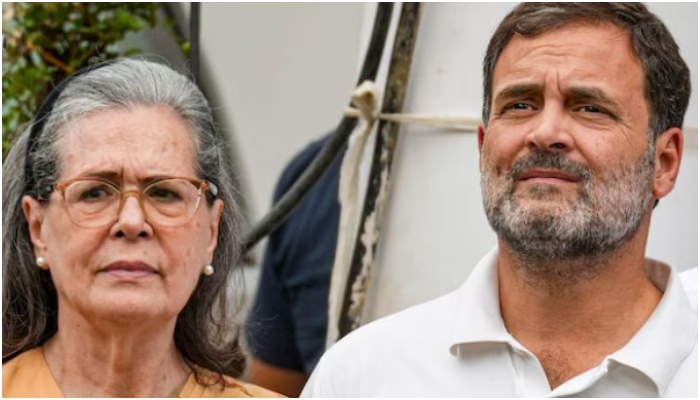
On Sunday, 1st September, the Bengaluru police charged a Bangladeshi journalist along with the staff of Jaipur Dialogues, an Indian news portal, for spreading alleged false information about Congress Leader Rahul Gandhi and his mother Sonia Gandhi with an alleged intent of negatively impacting their public image.
The High Grounds police filed a charge against Salah Uddin Shoaib Choudhury, a journalist and editor of the Bangladeshi weekly Blitz, and Aditi of Jaipur Dialogues. As per the reports, Srinivas G, a member of the Congress legal team, went to the police to file a First Information Report (FIR).
According to Srinivas’ allegation, Choudhury claimed on his X account that Sonia Gandhi was a Pakistani ISI spy. The Congress official added that Choudhary, with the objective of inciting animosity between two religions, claimed in his post that Sonia Gandhi still practices Christianity despite having interfaith marriage and obtaining Indian citizenship. Srinivas told the police that Choudhury alleged Rahul Gandhi and one of his foreign coworkers had sexually assaulted a woman.
Srinivas further claimed that Aditi shared Choudhury’s post on her X account, The Jaipur Dialogues, which helped it reach more people.
Jaipur Dialogues commented on the FIR in the case and called the Congress party a ‘fascist’. “This is the Mohabbat ki Dukaan that Rahul Gandhi and Congress talks about. While they yell about Freedom of Speech and how they are against Fascism, their actions portray that they are much worse. A member of our team has been booked by Bengaluru Police for writing an article against Rahul Gandhi. If this is not Fascism, we don’t know what is,” the portal posted on X (formerly Twitter).
This is the Mohabbat ki Dukaan that Rahul Gandhi and Congress talks about. While they yell about Freedom of Speech and how they are against Fascism, their actions portray that they are much worse.
A member of our team has been booked by Bengaluru Police for writing an article… pic.twitter.com/zjGD1vGRkA
It also mentioned that the power of media was being silenced. “We find it deeply troubling that the Bengaluru police weaponize the law to target critical discourse. They label accusations of promoting enmity and circulating false information as thinly veiled attempts to intimidate and suppress dissent. This isn’t about maintaining harmony; it’s about protecting the powerful from accountability and shielding them from public scrutiny,” the Jaipur Dialogues said in a report.
“Freedom of speech belongs to every citizen, not just to those who toe the line set by the powerful. The selective enforcement of the law clearly shows that this isn’t about justice but about censorship. It targets only those who criticize certain political figures. This calculated move creates an atmosphere of fear where questioning the actions of those in power meets legal retribution,” it said.
“We call on all those who value free speech to condemn this attack. This is not just about Jaipur Dialogues or Salah Uddin Shoaib Choudhury. It is about the future of free speech in India. We urge the Bengaluru police to reconsider their actions and to uphold the democratic values that are the foundation of our nation. The real threat to society is not the free exchange of ideas, but the suppression of those ideas through fear and intimidation,” it added.
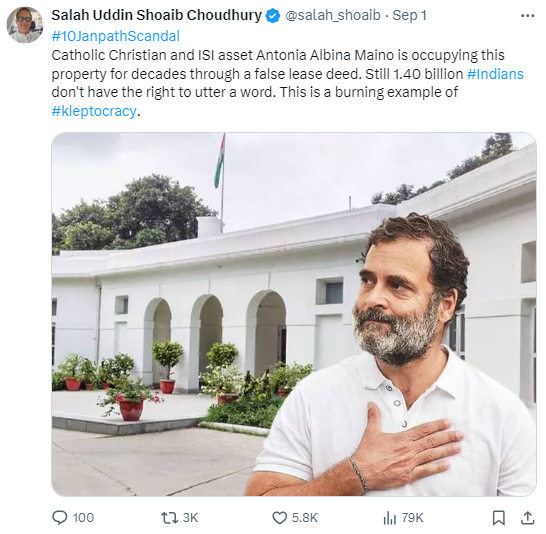
Bangladeshi journalist Salah Uddin Shoaib Choudhury has been making several posts on X against Congress leader Rahul Gandhi. In one of his posts on September 1st, he said that the Gandhi family had been illegally occupying the house at 10 Janpath, Delhi.
“Catholic Christian and ISI asset Antonia Albina Maino has been occupying this property for decades through a false lease deed. Still, 1.40 billion #Indians don’t have the right to utter a word. This is a burning example of #kleptocracy,” he posted.
In an exclusive article, the Bangladeshi journalist also stated that the Congress party deliberately never called Sonia Gandhi by her original name. He also called Antonia Albina Maino a ‘mafia queen’ and a ‘Pakistani ISI asset’ who has been carrying out her ‘activities’ in India.
The Bangladeshi journalist further added that Gandhi was illegally staying at the 10 Janpath residence in Delhi, given she was using her fake name and not her original identity viz Antonia Maino.
“Antonia Albina Maino obtained Indian citizenship using her original name. This means that this is her legal name. But for decades, she has been using a fake name, and there is no document proving she legally changed her name through an affidavit. As per legal provisions, only Hedvige Antonia Albina Maino or Antonia Albina Maino has the right to reside in the government bungalow located at 10 Janpath. Anyone using a fake name does not have the legal right to stay on that property. Similarly, Antonia Albina Maino’s son, Raul Vinci, who also uses a fake name, has no right to use that property,” the Bangladeshi journalist said.
He also said that Sonia Gandhi should be evicted from the 10 Janpath home and should be declared ineligible to lead any political party or continue to practice politics in India. At the same time, he said Indian authorities should seek full compensation and financial penalties from Sonia Gandhi for concealing her true identity and utilising the 10 Janpath property under a false name. “Any public official or high-profile politician who engages in such falsehoods should be permanently barred from politics,” he said.
— Salah Uddin Shoaib Choudhury (@salah_shoaib) August 31, 2024
The article further raised several questions about Sonia Gandhi’s religion, her connections with the Pakistani spy agency ISI, her father, her nationality, and more.
The FIR was filed by the High Grounds police under sections 196 (promoting enmity between different groups on the basis of religion, race, place of birth, residence, language, etc., and doing acts prejudicial to the maintenance of harmony) and 353 (2) (publishing or circulating false information to create hatred on the basis of religion, etc.) of the Bharatiya Nyaya Sanhita.
Canada Immigration Minister Marc Miller has declared that foreign students studying in Canada will be allowed to work outside the campus for only up to 24 hours per week. The decision will be implemented beginning in September.
The new law is projected to cause serious financial issues for Indian students in Canada, who make up the majority of international students. The new regulation replaced the interim exemption of the 20-hour workweek cap that was implemented in place during the COVID-19 outbreak to help with the labour shortage but the exemption ended on 30th April.
International students are not subject to any limitations on their employment hours during school breaks, including summer and winter vacations in Canada. Indian students who work off-campus find relief in covering their living expenses and grocery bills by working outside. The new law limits students to three part-time working shifts each week, which makes it impossible for them to compensate for their expenditures because most normal work periods are eight hours.
The minimum wage in Canada is currently fixed at 17.36 Canadian dollars per hour as of May 2024. In 2023, the minimum wage was $16.65 an hour prior to the increase. It is anticipated that the 24-hour restriction will make it difficult for students to make money for living expenses in expensive places like Toronto. “That’s going to be hard with the rent in Toronto and the groceries and eating out with friends and travelling. I have to think about all of that,” voiced Neeva Phatarphekar, an international student in Toronto. She was formerly working 40 hours a week.
She has already reduced her spending and moved in with friends to reduce her rental costs. She was enrolled in York University’s public relations certificate program, but she is going to switch to Seneca College to study brand management. The Barbra Schlifer Commemorative Clinic’s executive director and attorney, Deepa Mattoo, emphasised that overseas students work because they have to. “Not every student can afford to go to school without that extra income. In any structure, you have to have an equity framework,” he said.
Professor of Economics, Moshe Lander of Concordia University in Montreal, questioned if 24 hours is enough considering the amount of time needed for learning. “As an instructor, I’m a little doubtful that 24 hours still means that you can focus on your courses, or at least focus well on your courses,” he mentioned and added, “What student is not going to choose money over studying? And so, it’s just going to make the education at the post-secondary level a little weaker. It devalues the education a little bit, it devalues the degrees a little bit.”
Of the 5.5 lakh international students studying in Canada in 2022, 2.26 lakh were from India. 3.2 lakh of these students were there on student visas and worked as gig workers to support themselves and aid the country’s economy.
Canada has declared that it anticipates 606,000 applications for study permits by the year 2024. This indicates that just 364,000 of these applications will be accepted, based on a 60% approval rate nationwide. The genuine study permit cap will be established by counting the number of study permits that expire in 2024, that is, the total number of foreign students admitted to Canada will roughly equal the total number of students whose permits expire in that same year.
A shooting incident was reported outside the residence of Punjabi singer and rapper AP Dhillon in Vancouver, Canada. Although an official confirmation regarding the same is awaited, sources told India Today TV that sounds of gunshots were heard near the singer’s home in the Victoria Island area on Sunday night. According to reports, the assailants also set his car on fire and fired multiple shots.
The firing incident took place on the night of September 1. A video, which can not be independently verified, has surfaced on social media and is going viral. In the viral video, a man can be seen standing outside a house firing multiple shots at night.
Punjab gang violence&separatism issues have made solid inroads into #Canada because of politics there.
India has been very clear that it is not India but Canada that will face the biggest threat to their soft hand approach to the issue. #APDhillon
Visuals are said to be of AP Dhillon Vancouver, Canada residence. Gangster Lawrence Bishnoi claims the responsibility of firing at AP Dhillon residence. https://t.co/yqoD7lnFDZpic.twitter.com/qrG8aTQYwX
A shooting incident was reported outside Punjabi singer and rapper AP Dhillon's house in Canada's Vancouver. Though an official confirmation regarding the same is awaited.
Following the firing incident, a post also started doing rounds on social media. In the viral post, Rohit Godara (Lawrence Bishnoi group) claimed responsibility, not just for the firing incident in Vancouver, but also in Woodbridge, Toronto. Apart from taking responsibility, the post also issued a death threat to the Punjabi singer AP Dhillon citing his closeness with Bollywood actor Salman Khan.
It is pertinent to note that the development comes weeks after AP Dhillon released a music video titled, “Old Money” featuring Salman Khan.
The threatening message claimed that on the night of 1st September, they carried out shootings at two locations in Canada — one on Victoria Island and the other in Woodbridge, Toronto.
Kutte ki maut maroge ….. Lawrence Bishnoi Group to AP Dhillon
The post also threatened AP Dhillon citing his connections with Bollywood actor Salman Khan and warned him to “stay within his limits”, otherwise he would meet a “dog’s death”.
The Canadian law enforcement agencies are currently investigating the authenticity of the post which claimed responsibility for the two shooting incidents. However, the Police have not released any official statement in connection with these developments.
Previously, in November 2023, the Lawrence Bishnoi gang claimed responsibility for a firing incident that was reported outside the residence of singer Gippy Grewal in Vancouver, Canada. The incident took place in the White Rock area.
In April, this year, two bike-borne assailants, opened fire outside Salman Khan’s residence at the Galaxy Apartments in the Bandra area of Mumbai and fled the spot. However, they were later apprehended. The assailants were said to be linked with the Bishnoi gang.
Lawrence Bishnoi gang is one of the notorious gangs accused of being behind several targeted killings, gang wars, and criminal activities. The National Investigation Agency (NIA) had earlier revealed that Salman Khan was one of their targets.
The jailed gangster Lawrence Bishnoi has reportedly made a list of ten individuals whom he wants to eliminate and Salman Khan is said to be one of them.
The gang’s motive stems from the 1998 black buck hunting case in which Salman Khan is an accused. The group claims his act deeply offended the Bishnoi community.
When people travel to another country in search of better opportunities, they bring countless dreams, hopes and aspirations from their motherland. However, these ambitions are dashed when what the person expected to be a place where his dreams would turn into reality becomes an epicentre of harassment and oppression. This is exactly what has been happening with Arpit Kumar Pandey, a resident of Daulatpur in Gonda district of Uttar Pradesh.
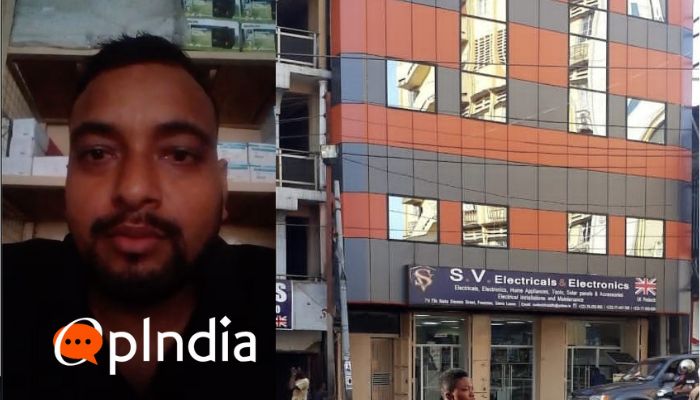
According to the information obtained by OpIndia, Arpit, who used to work in Delhi, went to the West African nation Sierra Leone in 2020 to work at S.V. Electricals shop at 73 B, Siaka Stevens St, Freetown, Sierra Leone, owned by an Indian origin man named Suresh Vatnani. For the first four months, everything was going fine and Arpit Kumar Pandey was given his salary on time, however, after that his employer allegedly refused to give him his salary saying that he would give all the money together as a lump sum payment. Since then, contrary to the alleged assurance given by Vatnani, Arpit has not received his salary.
Moreover, the victim has alleged that he is being tortured by his employer and has been made to work like a bonded labourer illegally.
Arpit being mistreated by employer in Sierra Leone, passport and original documents taken away: Victim’s father writes in a letter to EAM MoS
The victim’s father, Moolchand Pandey, has appealed to the Minister of State for External Affairs Kirti Vardhan Singh to bring his son back to India. In his appeal, Pandey said that the operators of a travel agency named Starlite Tour & Travels in Ajmer Rajasthan have “misled” and “trapped” his son in the garb of offering a better package. Notably, this travel agency is run by Ajay Rakani.
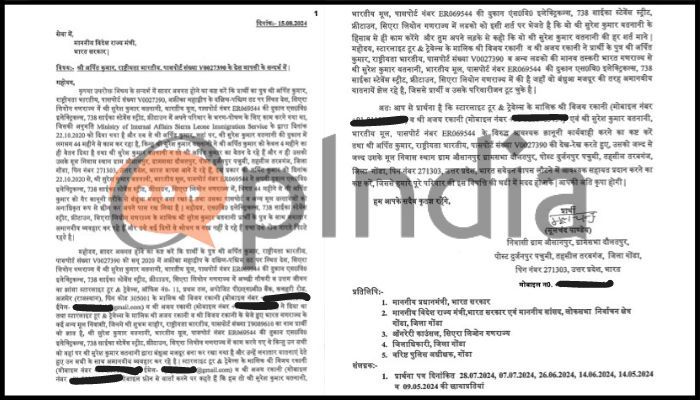
In his letter to External Affairs Minister (MoS), Kirti Vardhan Singh, dated 15th of August 2024, as seen by OpIndia, Moolchand Pandey said that his son Arpit Kumar Pandey has been working there in the shop of Suresh Kumar Vatnani for about 44 months, who paid him the decided salary for initial four months and stopped paying the same afterwards. Pandey said that Vatnani is neither giving salary to Arpit nor letting him return to India. Moreover, Vatnani is said to have confiscated Arpit’s passport and other original documents.
“Thus, since 22.10.2020, Mr. Suresh Kumar Vatnani, Indian origin, passport number ER069544 has illegally kept Mr. Arpit Kumar as a bonded labourer in his shop S.V. Electricals, 738 Saika Stevens Street, Freetown, Republic of Sierra Leone, for the last 44 months and has unauthorizedly snatched his passport and other original documents and kept them with him,” Pandey said in his letter to EAM MoS.
Pandey further informed the Minister that Vatnani is allegedly meting out inhumane treatment to his son in Sierra Leone and has not been providing him adequate food and clothing, and beating him daily. In a similar case to Arpit, another Indian national Shubham Mahaur, among some other youths, is also allegedly harassed by the owner of S.V. Electricals.
The victim’s father said that when he confronted Starlite Tour & Travels owners Ajay and Vijay Rakani about Vatnani’s inhuman treatment of Arpit, they said that they send boys of Indian origin to work at S.V. Electricals shop in Freetown, Sierra Leone only on the condition that they will work according to the wishes of Suresh Vatnani. Both Ajay and Vijay Rakani asked Moolchand Pandey to ask his son to follow Suresh Vatnani’s instructions.
The victim’s family are now scared for their son’s safety and have requested the government to provide Arpit with the necessary assistance to return to India and ensure that his full salary is paid.
On 14th June 2024, the affected family’s lawyer Ravi Prakash Pandey, who happens to be the victim’s cousin, wrote to the Indian High Commission in Sierra Leone informing him about the matter and sought immediate intervention. OpIndia has a copy of the letter.
Advocate Ravi Prakash Pandey also raised the matter with Minister Kirti Vardhan Singh’s office via email. In the email sent by Minister Singh’s office to Pandey in July, it was informed the matter was taken up by the Indian Embassy in Sierra Leone on Singh’s direction. The Minister’s office said that both Arpit Kumar Pandey and his boss Suresh Vatnani had mutually negotiated acceptable settlement. Moreover, the family was informed that Vatnani had assured that he would facilitate an air ticket for Arpit soon.
“As directed by Hon’ble MoS, Shri Kirti Vardhan Singh, the matter was taken up with our Embassy in Sierra Leone, who met Shri Arpit and his employer S.V. Electricals SL Ltd. As per the understanding of the Mission, both of them had negotiated a mutually acceptable settlement and it was informed that the employer will facilitate an air ticket for Mr. Arpit soon,” the email seen by OpIndia reads.
However, Vatnani has not returned Arpit’s documents and provided him air ticket for his return to India till now. Consequently, the victim’s family and their counsel recently raised the matter again with the ministry informing them about the false promises Vatnani made regarding Arpit’s repatriation. The victim’s family has said that Arpit is being mistreated by his employer regularly and they are deeply worried and concerned about Arpit’s safety.
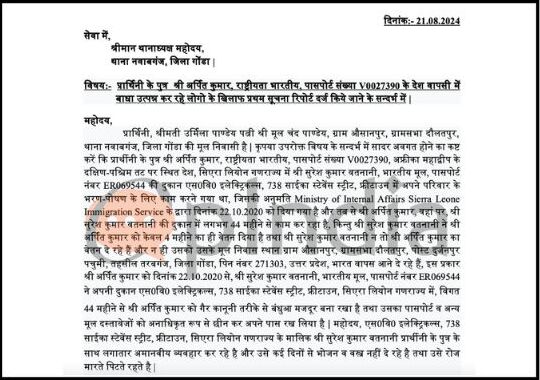
On the 21st of August 2024, Arpit Kumar Pandey’s mother Urmila Pandey complained to Nawabganj Police Station and sought the police’s help in bringing Arpit back to India. OpIndia has a copy of the complaint letter addressed to the Nawabganj Police Station in charge.
Arpit’s heart-wrenching appeal to the Indian government
In the latest video accessed by OpIndia which Arpit recorded from the shop where he works in Sierra Leone, he said that he came to Freetown in Sierra Leone to work at S.V. Electricals.
“It has been four years since I started working here, I am neither getting any salary nor being allowed to go back to India. When I ask them about it, I am threatened that I will be implicated in a bogus case and jailed here. I am also being threatened to be assaulted and that my phone will be snatched away,” Arpit said in a video.
He further stated that his employer is forcing him to work every day with no weekly off and even on Sunday he is forced to work. “I appeal to the Indian government and our foreign minister to take me out of here. I appeal with folded hands, please save me from here…”, Arpit added.
Threat calls, fake claims and more: How Arpit is being held hostage at his workplace
In an audio call recording shared by the victim’s family with OpIndia, Arpit said that his employer forced him to call his family and speak to them as per the employer’s instructions. Vatnani also allegedly threatened Arpit. He said that when Arpit’s family told Vatnani that they were in touch with an Indian minister, Vatnani said that he would call the police and get Arpit arrested. Vatnani also allegedly demanded Rs 11 lakh from Arpit’s family.
Arpit said that he went to the Indian Embassy in Sierra Leone seeking their help, however, the officials spoke to Arpit in Vatnani’s presence who assured the officials that he would send Arpit back to India. Vatnani, however, reneged on his promise. The victim also alleged that Vatnani threatened to handle him in his own way if he didn’t comply with his demands. Arpit added that Vatnani can do anything with him now.
“You will not listen to me. I will ask the Embassy officials to step aside, and then I know how to handle it in my way,” Vatnani said as claimed by Arpit.
Suresh Vatnani was interrogated by Sierra Leone’s Immigration Department in 2008
Back in 2008, Suresh Vatnani was questioned by the Immigration Department in Sierra Leone. He was picked up for questioning for allegedly locking up one of his employees Vikas Jagwani for two weeks in a store over claims that Jagwani embezzled his money. A local media report said that Jagwani was allegedly tortured by Vatnani when his employee was held captive for two weeks. Vatnani, however, was released later.
OpIndia spoke to Arpit’s family
Speaking exclusively with OpIndia, Arpit’s mother Urmila Pandey told us that 3 years after working at S.V. Electricals in Freetown, Sierra Leone, when Arpit’s visa expired and he sought to return to India, his employer Suresh Vatnani allegedly claimed that his business suffered losses. Thus, Arpit will have to compensate for his losses and only then he will allow the victim to go back to India. However, Arpit said that it was not his fault. She added that Arpit received salary only four times and when she asked her son to speak to his employer over unfairly withholding his salary, Vatnani allegedly ignored his calls and messages.
The victim’s family has alleged that Arpit’s employer levelled fake allegations against Arpit that he stole items from the shop and sold it to someone else. Vatnani demanded Rs 11 to 12 lakhs from Arpit’s family in exchange for letting the victim return to India. The victim’s mother said that if they had been rich enough to send such a huge amount of money to others, why would they have sent their son to a foreign nation?
Urmila Pandey told us that initially Suresh Vatnani demanded Rs 18 lakh, then Rs 11 lakh, and now has come down to Rs 5 lakh. She said that on the one hand, Vatnani is claiming that he suffered losses, on the other hand he is accusing Arpit of stealing goods from his shop.
“These are all fake claims being levelled against my son. There is a CCTV camera in the shop, my son was going to the shop and from there to his room, this was his fixed routine, how could he have sold the shop’s items to anyone else. He is facing food shortage and other struggles. His salary has also been stopped. He is my only son. We are very poor people”, she said.
OpIndia asked that since Arpit’s visa has expired, how is he staying in Sierra Leone without a valid visa and if the local authorities ever questioned him for the same. In response, Arpit’s mother told us, “He [Arpit] is in the captivity of those people [his employer]. Only if someone goes and inspects the shop they will get to know about what is happening there. They let the boys employed there go only after forcibly keeping them for 8 to 9 years.”
“There is no free time, my son goes to the shop from his room and returns to his room after work, he is not allowed to go anywhere else. Everywhere else employees at least get Sunday offs but my son doesn’t get any day off,” Arpit’s mother said adding that she can hardly talk to her son now since his phone has been taken away. She added that she spoke to Arpit last month for a few minutes. Pandey said that now Arpit has been shifted from the shop to some office where Suresh Vatnani also visits.
Speaking about the role of Starline travel agency, she said that nobody is listening to them. Arpit’s mother said that the agent also sided with Vatnani saying that if the owner has suffered losses, Arpit will have to compensate the same. Hinting that the travel agency could be complicit in the alleged “human trafficking”, Urmila Pandey said that the agency’s agent may have known about what happens when Indian boys are taken to Sierra Leone to work at S.V. Electricals. She added that there was another youth Shubham who worked at the same company and faced the same harassment as Arpit is facing, and he has been brought back to India. Urmila Pandey further said that none of these youth received their salaries after initial payouts and their phones were also taken away.
The victim’s mother added that she has spoken to ministers and local leaders, however, so far, Arpit has not received any assistance.
In her emotional appeal to Prime Minister Narendra Modi, EAM S. Jaishankar and the Indian government, Urmila Pandey said that Arpit is her only son and that she has been struggling for many months to get him back to India. She said that PM Modi and the Indian government should save her son as well as bring him back to India.
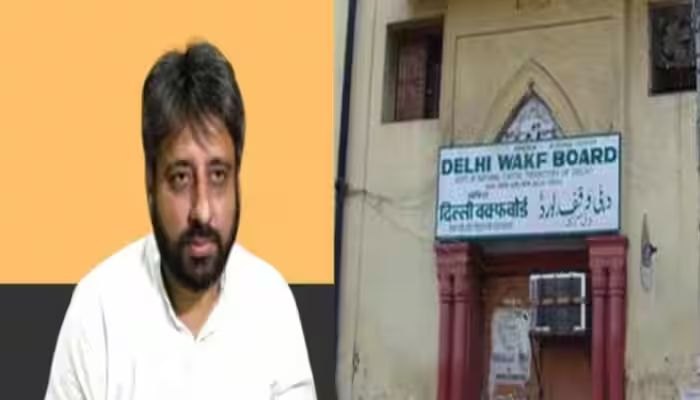
On Monday (2nd September), the Enforcement Directorate arrested Aam Aadmi Party (AAP) MLA and Delhi Waqf Board Chairman Amanatullah Khan in connection with a money laundering case. The ED officials took him into custody under the provisions of the Prevention of Money Laundering Act (PMLA) hours after they searched his residence in Delhi’s Okhla area at around 6:30 am earlier today.
The AAP leader is facing the heat in connection with the Delhi Waqf Board scam as well as evading ED summons multiple times, resulting in his arrest for non-compliance.
It is pertinent to note that Amanatullah’s arrest comes weeks after the Delhi High Court refused to stay the trial court proceedings against him for skipping multiple ED summons issued to him in the Delhi Waqf Board case. The development came after he evaded at least ten ED summons. He was last questioned by the agency in this case in April this year.
In March, the Delhi High Court had refused to grant him anticipatory bail, citing his repeated evasion of ED’s summons. A month later, the Supreme Court also denied him anticipatory bail after criticising his repeated absences from ED summonses.
Strikingly, the AAP leader is facing the heat in a money laundering case related to the financial irregularities in the functioning of the Delhi Waqf Board as he has served as the Chairman of the Delhi Waqf Board multiple times and is also its current chairman. The Delhi Police’s Anti-Corruption Branch, CBI, and ED all have been investigating this case.
Details of the Delhi Waqf Board scam and major developments in the case
Amanatullah Khan’s legal trouble stems from two FIRs. An FIR was filed by the Delhi Anti-Corruption Branch (ACB) and in September last year, the ACB officials arrested him for alleged financial mismanagement and other irregularities within the Delhi Waqf Board.
According to the ACB, the initial FIR in this case was filed in January 2020. It was filed under Section 7 of the Prevention of Corruption Act, along with Section 120B of the Indian Penal Code (IPC). They later invoked Section 13 of the Prevention of Corruption Act and Section 409 of the IPC.
During the investigation, a witness revealed several issues related to the tenancy of Waqf properties. The witness said that in 2021, he submitted a bid of Rs 30,000 for a Waqf Board shop at Fatehpuri Masjid. His bid was the highest but he was still asked to pay Rs 10 lakh. He was then instructed to withdraw his bid when he refused to pay Rs 10 lakh for the shop. According to the Investigative Officer in court, Amanatullah Khan subsequently accepted a lower bid of Rs 19,000 from another bidder which led to financial loss for the Delhi Waqf Board.
Additionally, the ACB also recorded a statement from a female employee of the Delhi Waqf Board. She said that files related to the Waqf Assets Management System of India (WAMSI) project were removed following the directions of Amanatullah Khan. She added that Khan wanted to avoid transparency regarding Waqf Board properties to conceal his alleged illegal activities.
Notably, the WAMSI project had an aim to computerise Waqf Board properties. After a two-year investigation, the ACB summoned Khan on 16th September last year. The agency officials also raided four locations linked to the AAP leader and uncovered incriminating evidence. He was then placed in four-day police custody, which was then extended as the ACB needed more time for interrogation due to Khan’s health issues.
ED filed another FIR based on the CBI FIR against the AAP leader
In its FIR, the CBI alleged irregularities in the Waqf Board. According to the CBI, Amanatullah Khan appointed various persons to the Delhi Waqf Board against non-sanctioned and non-existent vacancies, which caused financial loss to the Delhi government and illegal gains to himself.
In October 2023, the ED also conducted searches at several locations linked with the AAP leader. Later, in January, the ED again carried out searches at nine locations connected to Khan in connection with this money laundering case in the Delhi Waqf board scam case.
In February, the Delhi High Court rejected his plea seeking immediate relief from ED summons in a Rs 36 crore property case which was unearthed through the diaries of his close aide, Hamid Ali Khan.
These diaries exposed significant transactions between the AAP leader and Javed Imam Siddiqui, including the purchase of a Rs 36 crore plot in Tikona Park, Okhla.
The Delhi Police’s ACB had already arrested Hamid Ali Khan in September 2022. Following that, Amanatullah Khan withdrew his plea challenging the ED summons.
However, in April this year, the Supreme Court also rejected his anticipatory bail pleas and the ED also filed an FIR against him. This ED FIR was based on the CBI’s FIR lodged against the AAP leader. On 4th April, the ED filed a complaint against Amanatullah Khan under CrPC sections 190, read with IPC section 174 and PMLA section 63(4) for not complying with the summons issued to him.
Meanwhile, the ED arrested Khan for the first time in April but later the Delhi Rouse Avenue Court granted him bail on a personal bond of Rs 15,000 and one surety of the same amount.
The ED case is based on allegations that Khan illegally recruited staff and unfairly leased Waqf Board properties between 2018 and 2022, resulting in financial gains through illegitimate means. Allegations have been made that unlawful leasing of Waqf Properties worth Rs 100 crore was carried out. Additionally, under Amanatullah Khan’s administration, the Delhi Waqf Board appointed 32 contractual workers in breach of the guidelines.
Previously, the ED officials quizzed Amanatullah Khan for over 12 hours in this case. According to the agency, he acquired “huge proceeds of crime” in cash through these illegal activities and invested these proceeds in purchasing immovable assets in the name of his associates. Chargesheets have already been submitted in the case against one company and four individuals.
In its chargesheet, the ED said that Khan laundered his illegal gains by purchasing immovable properties through his associates – Jawed Imam Siddiqui, Daud Nasir, Zeeshan Haider, and Kausar Imam Siddiqui.
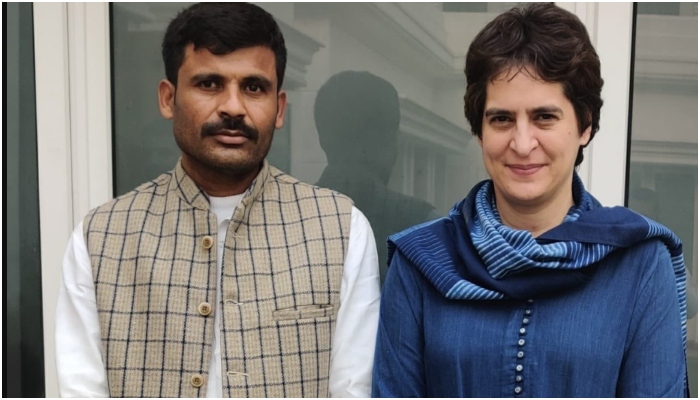
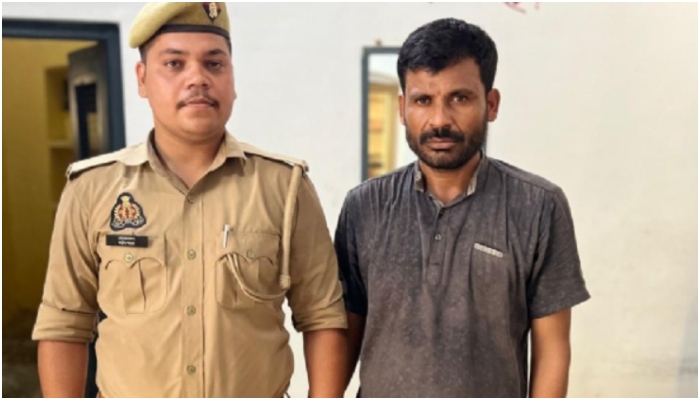
On Sunday (1st September), Congress leader Mufti Mehndi, who is believed to be a close aide of Priyanka Gandhi Vadra, was arrested for molesting a woman working at his house for the past 10 years.
Mufti Mehndi, a resident of Jaunpur in Uttar Pradesh, has lured the woman by making false promises. As per the reports, he sexually assaulted his maid by making her feel assured that he liked her and that he intended to marry her.
He also attempted to lure the victim by gifting her sarees and footwear. The woman was 15 years old when the Muft Mehndi molested her for the very first time.
Image- Hindustan Samachar
She stated that he kept on issuing fake promises of marriage for several years. When asked about marriage, he would avoid the talks altogether. However, he kept on sexually assaulting her for all the while.
Later the leader also began threatening the woman to kill her and her family members. “He had captured my intimate photos and videos and he would threaten me saying that he would make them viral if I failed to satisfy his needs. He also asked me to have relations with other people and on refusal, he would physically assault me,” the woman said in an official complaint to the police.
This continued for years but came to the fore only on August 27th at seven in the evening. As per the woman, Mufti called her home and forced her to have sex with him, but the woman refused. However, he hit the woman and sexually molested her. He also threatened the woman saying that he would kill her family if she told anything to the police.
According to City Congress President Vishal Singh, Mufti was previously the City Congress Vice President, but he resigned on 26th March 2022. A case of rape has been registered against Mufti Mehndi and he has been arrested. He is believed to have kept close ties with Congress’ Priyanka Gandhi Vadra for several years. Further investigation in the case is underway.