

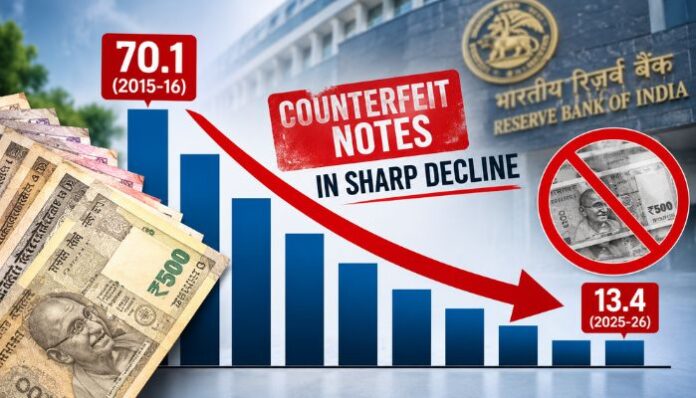
Ten years ago, on 8th November, 2016, the Modi government announced the demonetisation of high-value currency notes of Rs 500 and Rs 1,000 in a dramatic bid to curb black money and push India towards a cashless economy. The sudden decision withdrew the two denominations from circulation and introduced new currency notes. A decade later, Reserve Bank of India (RBI) data show a sharp decline in the number of counterfeit notes detected relative to the currency in circulation.
According to RBI data, the number of counterfeit notes detected per one crore notes in circulation across all denominations fell from 70.1 in 2015-16 to just 13.4 in 2025-26. This marks a substantial decline in the detection rate of fake currency over the last ten years.
2014 में बैंकिंग सिस्टम में पकड़े गए 5.94 लाख नकली नोट नोटबंदी के बाद तेजी से गिरा यह नंबर, 2020-21 तक करीब 2 लाख पर अटका कैसे नोटबंदी ने ISI की फेक करेंसी सप्लाई पर लगाई लगाम? @jayeshmatiyal https://t.co/fN1WFEM94v
— ऑपइंडिया (@OpIndia_in) November 8, 2026
The trajectory of Counterfeit notes: From past surge to Post-demonetisation relief
According to RBI official figures from 2006-07 onwards, the number of counterfeit notes detected in the banking system had been increasing before demonetisation. In 2006-07, banks detected around 1.04 lakh fake notes. By 2008-09, this number had increased nearly four times to 3.98 lakh. The figure continued to rise over the following years, reaching around 5.94 lakh by 2013-14. The figures show that counterfeit notes were flooding the system continuously.
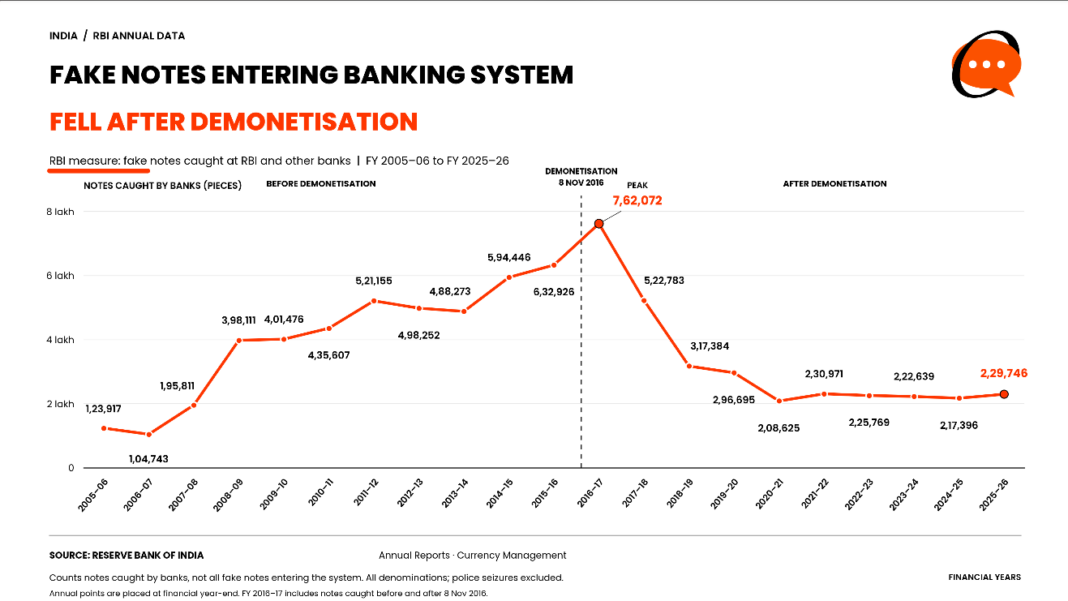
Overall, before demonetisation, counterfeit notes detected by banks rose from 1,23,917 in 2005-06 to 6,32,926 in 2015–16, with fluctuations along the way.
The trend changed after demonetisation. Following the 2016 announcement, banks caught a massive surge of hidden fakes, with detections rising sharply to a peak of 7,62,072 in the first year after demonetisation, 2016–17.
However, the curve bent downwards rapidly after that initial cleanup. The numbers fell to 5,22,783 in 2017-18 and 3,17,384 in 2018-19.
By 2020–21, the figure dropped to 2,08,625, remaining relatively stable thereafter, with 2,29,746 counterfeit notes detected in 2025-26. Without demonetisation, the circulation of fake currency in the open market would have reached uncontrollable levels.
The decline is even more noticeable when the number of fake notes is compared with the total currency in circulation. The number of counterfeit notes detected per one crore notes fell from 70.1 in 2015-16 to 13.4 in 2025-26. This means that the proportion of fake notes detected in the banking system has reduced considerably over the decade.
Opposition called demonestisation a ‘criminal financial scam’
When the policy was first rolled out, the opposition heavily criticised and slammed the Bharatiya Janata Party-led central government for its demonetisation move, famously terming it a “gimmick” and a “criminal act” that severely impacted common citizens and small businesses.
Congress leader Rahul Gandhi repeatedly attacked the government over the decision. In November 2016, he called it the world’s “biggest impromptu financial experiment”. Two years later, on the second anniversary of demonetisation, he went further and described it as a “carefully planned, criminal financial scam”.
However, looking back a decade later, the dramatic reduction in fake notes per crore from 70.1 down to 13.4 demonstrates how deeply needed the intervention was to sanitise India’s financial ecosystem and anchor the country firmly toward a secure digital future.
