

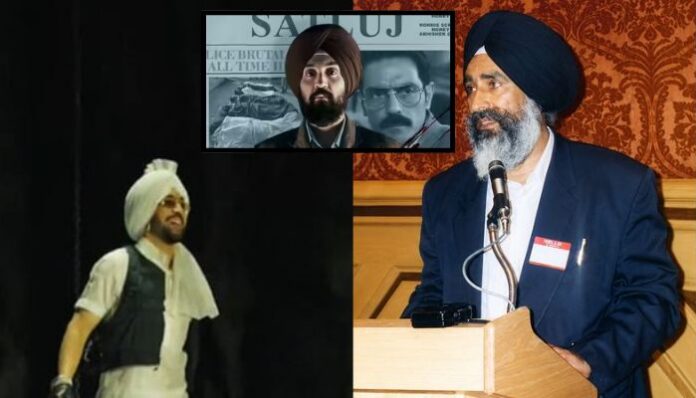
Punjabi singer and actor Diljit Dosanjh has once again found himself at the centre of a major political and cultural storm. During the opening day of his Aura India Tour 2026 at the Jawaharlal Nehru Stadium in New Delhi on Friday, 30th October, Dosanjh lionised Jaswant Singh Khalra and addressed the intense online trolling and controversy surrounding his film Satluj.
Addressing the crowd, the Dosanjh said, “Don’t teach Punjabis how to fight battles. The film you stood on stage and mocked, Jaswant Singh Khalra ji’s film (Satluj).”
Diljit Dosanjh hits back hard at the Modi govt and CBFC from his Delhi concert stage: “Don’t teach Punjabis how to fight battles. The film you stood on stage and mocked—Jaswant Singh Khalra ji’s film (Satluj). we fought for a very long time for that film. I stay quiet, I love everyone. If someone hates us, no problem, from our side it’s only love for everyone!” From 120+ censor cuts to blocking its release, they tried everything to bury the Jaswant Singh Khalra story. Diljit’s voice just proved the truth can’t be silenced. 👑🔥
— Rajat Jain (@RajatJain) October 30, 2026
The film, which focuses on Khalra’s investigations into alleged illegal killings and secret cremations in Punjab during the turbulent insurgency years of the late 1980s and early 1990s, has faced a turbulent journey. Initially titled Ghallughara and later renamed Punjab ’95, the movie was quietly released on the Zee5 OTT platform on 3rd July under the title Satluj. However, it was later removed from the platform for Indian audiences just three days later, on 6th July, while remaining accessible on Zee5’s international portal. In response to the controversy, the Ministry of Information and Broadcasting has established a three-member committee to examine the issue.
How Khalra’s narrative focused on one side of Punjab’s insurgency
While human rights violations and police excesses during the Punjab insurgency are serious matters that require honest discussion, Satluj presents an incomplete and skewed version of history. The problem with ‘Satluj’ is not that it discusses alleged police excesses or the illegal killings and secret cremations investigated by Khalra. His abduction and murder were crimes, and police personnel were convicted in the case. However, the film presents only one side of Punjab’s dark history, portraying the Indian state as the principal villain while softening the role of Khalistani terrorists and Sikh extremists.
Beyond the cinematic portrayal, Jaswant Singh Khalra’s actual historical investigation itself has long been viewed as fundamentally problematic due to its deeply selective and one-sided methodology. Rather than providing an objective accounting of the dark decade of Punjab’s insurgency, Khalra’s work focused almost exclusively on municipal cremation records and police excesses, completely ignoring the bloody context of Khalistani terrorism that preceded and triggered state crackdowns.
By isolating police abuses into a standalone narrative, his findings presented state actions as unprovoked persecution while completely erasing the thousands of innocent victims, both Hindu and Sikh, who were systematically slaughtered by militant groups.
Khalra’s partisan position was further evidenced by his overt ideological alignment. He served as the editor and primary contributor for the publication Liberation Khalistan, where he went so far as to describe the assassins of Prime Minister Indira Gandhi, Satwant Singh and Kehar Singh, as “Khalistani heeray” (diamonds of Khalistan).
Furthermore, his investigation conveniently left out the horrific reality of terrorist atrocities, the mass execution of bus and train passengers based on their religious identity, the roadside bombings, the assassinations of moderate Sikh leaders who sought peace, the murder of nearly 1,800 police personnel, and the beheading and killing of journalists who refused to publish separatist propaganda.
During the insurgency, Khalistani terrorists killed Hindu passengers after identifying them on buses and trains, targeted Sikh leaders who opposed separatism, murdered journalists who refused to follow their diktats and attacked police personnel. These victims, including Hindus and Sikhs, barely find space in the Khalra’s so-called investigation.
By presenting a narrative where only the state was on trial, Khalra’s work served to legitimise Khalistani terrorism violence under the guise of human rights activism.
Grassroots screenings by Amritpal Singh’s party
Following the film’s removal from digital streaming in India, pro-Khalistani elements and local regional groups have stepped in to sustain its visibility. Pro-Khalistani MP Amritpal Singh’s party, the Akali Dal (Waris Punjab De), has actively praised the film and begun organising public screenings across various villages in Punjab. Using projectors and large screens, downloaded copies of Satluj are being projected in community spaces and gurdwara compounds.
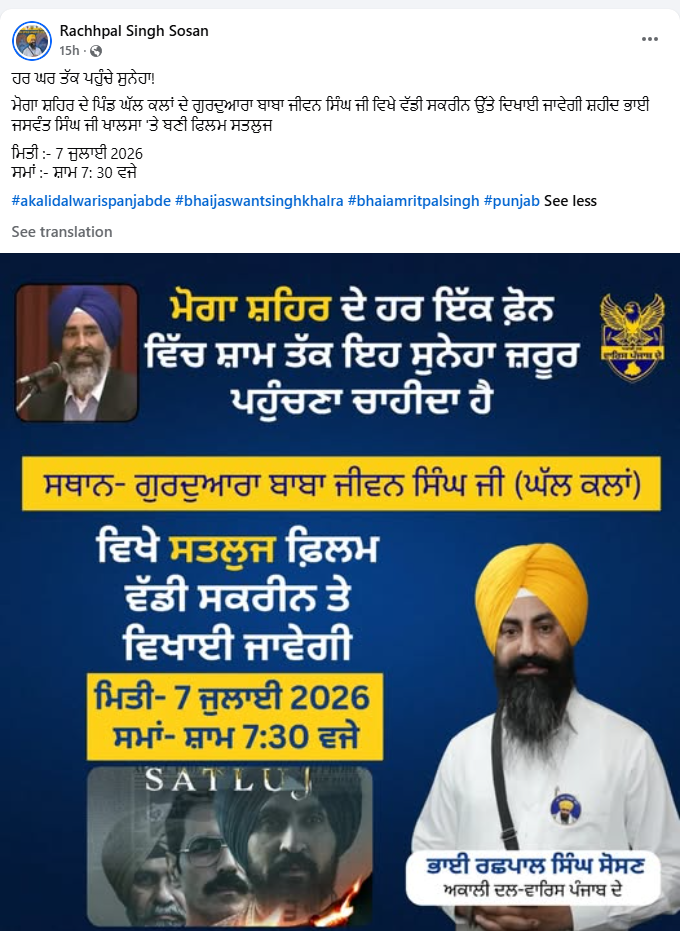
Rashpal Singh Sosan, a leader of the faction, confirmed that screenings were recently conducted in villages such as Daroli Bhai and Ghal Kalan, while also circulating archival footage of the jailed MP praising Jaswant Singh Khalra. Amritpal Singh himself remains lodged in a high-security jail in Assam, facing stringent charges under the National Security Act (NSA).
Gurpatwant Singh Pannun casts Khalra as a Khalistani separatist ‘activist’
The film’s narrative has also been co-opted by Global extremist elements. Gurpatwant Singh Pannun, founder and general counsel of the banned Khalistani terrorist outfit Sikhs For Justice (SFJ) explicitly recast Jaswant Singh Khalra not merely as a human rights documentarian, but as an ideological supporter of the Khalistani movement and a defender of Sikh separatism against India’s policies.
In an official communication, Pannun framed the state’s counterterrorism operations in communal terms, attacking central security personnel and deliberately attempting to reduce the multi-faceted insurgency into a polarising Hindu-versus-Sikh conflict. This rhetoric completely erases the historical sacrifices of Sikh police officers, political leaders, and ordinary citizens who stood firmly against terrorism to preserve peace in Punjab.
