

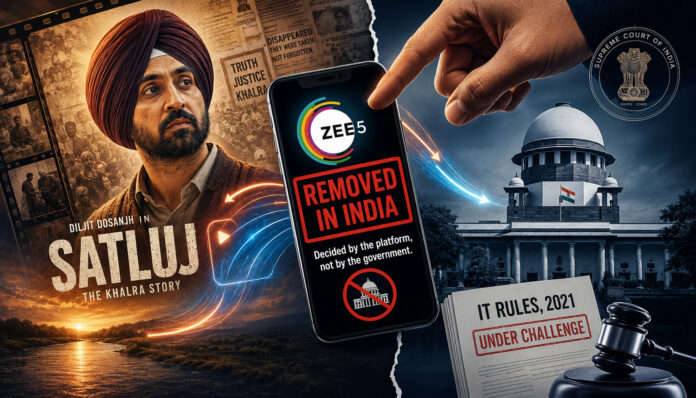
On the evening of 3 July 2026, after nearly four years of delays and three successive title changes from Ghallughara to Punjab ’95 and finally Satluj, Honey Trehan’s film about human rights activist Jaswant Singh Khalra appeared quietly on ZEE5, reaching audiences in India and across the world at the same moment. Within two days it had vanished from the Indian version of the platform while remaining fully available elsewhere, with ZEE5 citing only ‘current developments’ for the decision.
Satluj may have paused. But the conversation it started hasn’t.
— ZEE5Official (@ZEE5India) July 5, 2026
Thank you for the incredible love.
We hope to bring it back soon.#Satluj pic.twitter.com/Ox3MZIBvlT
Contrary to widespread assumptions, this was not the result of a government ban or any official prohibition. Instead, the removal stemmed from a single, obscure clause in India’s internet regulations, a provision that has largely remained suspended due to court orders and creates an uncertain environment in which platforms often choose caution when questions arise. ZEE5 has publicly affirmed its support for the film and stated that it is exploring all appropriate avenues to restore it, underscoring that the episode reflects the procedural complexities of digital content regulation rather than outright censorship. In essence, a story that had finally found its audience after years of waiting slipped from view again, not through an exercise of power but through the quiet mechanics of an unresolved legal framework.
Three years and 127 cuts
Certification troubles for the film began as soon as RSVP submitted it to the Central Board of Film Certification in late 2022. The initial six month process concluded with clearance granted only after 21 cuts and a mandated change in title, with the board expressing worries that the content displayed could provoke violence or influence Sikh youth. When RSVP challenged the decision in the Bombay High Court, the requirements reportedly intensified, climbing to as many as 127 cuts, as director Honey Trehan later recounted. The board is said to have sought the removal of ‘Punjab’ from the title despite the story being set in the state, objected to references to the Punjab Police, and requested that Indira Gandhi not be named, steps Trehan characterised as an attempt to erase elements of history. Amid these drawn out exchanges, the film was pulled from its scheduled world premiere at the 2023 Toronto International Film Festival, with reports pointing to political factors behind the move.
The real trivia: What rule 9 of Information Technology (Intermediary guidelines and and Digital Media Ethics code) 2021 says and why it is frozen still?
The story of Satluj’s release and removal has less to do with outright censorship and more to do with the actual plumbing of India’s content regulation. Films require certification from the Central Board of Film Certification under the Cinematograph Act, 1952, to play in theatres, yet streaming content has never fallen under this requirement. India’s Ministry of Information and Broadcasting reaffirmed this position in a December 2025 Lok Sabha reply, confirming that the CBFC’s mandate is limited strictly to theatrical exhibition and does not extend to OTT platforms at all.
What governs OTT content instead is Part III of the Information Technology (Intermediary Guidelines and Digital Media Ethics Code) Rules, 2021, specifically Rule 9. Rule 9(1) requires publishers of online curated content to observe a prescribed Code of Ethics, while Rule 9(3) creates the enforcement architecture through a three tier self-regulatory structure.
Level I self-regulation by the publisher itself through an in house grievance officer who fields complaints, Level II through an industry wide self-regulating body, and Level III through an Inter Departmental oversight committee under the Ministry. This is the self-regulation framework that platforms are expected to follow when they certify or later pull content.
The catch, however, is that Rule 9 has been under an interim court stay since almost the week it came into effect. On 14 August 2021, the Bombay High Court stayed Rules 9(1) and 9(3) in a challenge filed by journalist Nikhil Wagle and the digital outlet The Leaflet, holding that the Code of Ethics provisions were likely unconstitutional and beyond the government’s rule making power under the parent IT Act. The Madras High Court issued a similar stay weeks later and directed that the Bombay order should apply nationwide. The Supreme Court later transferred all pending challenges to the Delhi High Court in March 2024 for a consolidated hearing, but arguments on Part III of the rules only began there in November 2024. As of today, no final verdict has been delivered, which means the specific legal obligation for OTT platforms to self-regulate under the Code of Ethics has spent nearly its entire existence on hold, even as the government continues to cite it in Parliament as the governing framework for all streamed content in India.
Speaking plainly, the very rule that supposedly requires platforms to self-certify content and the rule that supposedly allows them to pull content through their own grievance process are, on paper, the same paused and still litigated provision. Satluj was released on a regulatory shelf that courts have been debating for five years, and it was removed from the same shelf.
The removal is a platform call, not a government order
The makers chose to release the complete, uncut version of Satluj globally on ZEE5 from the first day rather than negotiate further cuts. Their statements make the intent clear. To place the full film, exactly as screened at festivals years earlier with nothing removed, in front of audiences worldwide before any additional domestic pressure could force changes. This mattered especially for a story that ends with Jaswant Singh Khalra’s killing by police, where any softening would have weakened its core purpose. Two days later ZEE5 removed the film from its Indian catalogue, offering only a vague explanation while promising to pursue every appropriate avenue through due process to bring it back. No government order has been made public. The platform acted instead under its own Level-I self regulatory authority, the same unsettled legal framework, still under court stay, that had allowed the uncut film to reach viewers in the first place.
What the record actually shows?
None of this touches the harder question the film dramatizes. Who was responsible for Punjab’s disappeared? The record on that question is genuinely two sided, and neither half cancels the other. Khalra, a bank manager in Amritsar, traced firewood purchase receipts at local crematoria and exposed what he described as mass illegal cremations of unidentified bodies. He was abducted by Punjab Police in September 1995 and murdered, six police officials were later convicted and sentenced to life imprisonment. The CBI’s December 1996 report confirmed 2,097 illegal mass cremations in Amritsar district alone, of which 582 were identified and 278 partially identified.
The Supreme Court, hearing a petition from Khalra’s wife Paramjit Kaur, described this as a ‘flagrant violation of human rights on a mass scale’ and referred the matter to the NHRC, which eventually compensated 1,245 victims’ families by 2006. At the same time, Punjab’s counter insurgency followed roughly a decade of Khalistani militant violence that, by the movement’s own chronicler K.P.S. Gill’s count, claimed 21,469 lives before it was defeated, including close to 11,700 civilians killed by Sikh militant groups, among them thousands of Sikhs and roughly 4,500 Hindus. Human Rights Watch has documented both realities. Khalistani terrorists carried out civilian massacres and political assassinations, while government operations between 1984 and 1995 involved arbitrary detention, torture, and the disappearance of thousands. A film or an article that tells only one half of this record is not lying. It is simply presenting half the story.
Conclusion
The next time someone claims Satluj was banned, the sharper answer is not simply that a platform chose to pull it. The film reached audiences under Rule 9 of the Information Technology Rules, 2021, the very provision that requires OTT platforms to self-regulate, and was later removed under that same rule, a clause Indian courts have kept in legal limbo since 2021 without ever finally settling its validity. By launching the complete, uncut version globally on day one through ZEE5’s international service, producers Ronnie Screwvala’s RSVP Movies and MacGuffin Pictures ensured the film remained fully available to viewers worldwide even after its Indian availability ended within forty-eight hours. Five years on, with Rule 9’s legal footing still unresolved, platforms and creators continue to operate under it.
This development has secured global access to one account of Punjab’s past at the moment when its reach inside India could be swiftly curtailed, allowing this half-told story to shape perceptions among audiences abroad without the counterbalance of the fuller record.


