

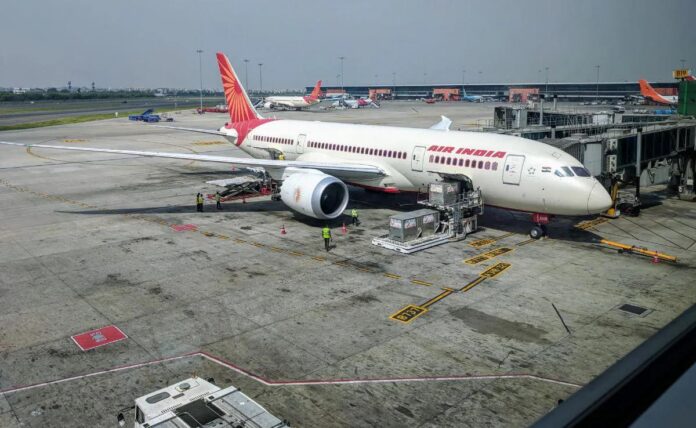
An Air India Boeing 787 Dreamliner was taken out of service after a potentially serious technical anomaly was reported during engine start-up at London’s Heathrow Airport, underscoring the airline’s heightened safety vigilance following last year’s fatal Dreamliner crash in Ahmedabad.
The aircraft, scheduled to operate flight AI-132 from Heathrow to Bengaluru, was grounded after the left engine’s fuel control switch failed twice to remain in the ‘run’ position and instead slipped back to ‘cutoff’ during start-up, according to an airline spokesperson.
Confirming the development, Air India said one of its pilots had flagged a “possible defect” in the fuel control switch of the Boeing 787-8. Acting on the report, the airline immediately grounded the aircraft and escalated the issue to the aircraft manufacturer for urgent examination.
“The aircraft has been grounded, and the OEM is being involved to address the pilot’s concerns on a priority basis,” the spokesperson said, adding that the matter has been formally reported to the Directorate General of Civil Aviation(DGCA).
Air India also clarified that it had already inspected fuel control switches across its entire Dreamliner fleet following a previous DGCA directive and had not detected any abnormalities at the time. “Safety of our passengers and crew remains our highest priority,” the airline reiterated.
Why fuel control switches matter
Fuel control switches play a critical role in aircraft operations. They regulate the flow of fuel to the engines and are used by pilots to start or shut down engines on the ground, or to manually cut off fuel in the event of an in-flight engine emergency.
On the Boeing 787, the two switches, one for each engine, are located just below the thrust levers. They are spring-loaded and designed to prevent inadvertent movement. To shift a switch between ‘run’ and ‘cutoff’, a pilot must first pull it upward before moving it sideways, a deliberate two-step action.
Aviation experts note that accidental movement of these switches is extremely unlikely, but if a switch is moved to ‘cutoff’, the impact is immediate: fuel flow stops and engine power begins to drop.
Shadow of the Ahmedabad crash
The incident has drawn attention because of parallels with the July 2025 Ahmedabad Dreamliner crash, in which 260 people were killed. A preliminary investigation report revealed that seconds after takeoff, the fuel control switches of both engines were briefly moved from ‘run’ to ‘cutoff’, one after the other, with a one-second gap, causing a sudden loss of engine thrust.
Cockpit voice recordings captured one pilot asking the other why the fuel had been cut off, to which the response was that he had not done so. The report did not specify which remarks were made by the captain or the first officer.
Moments later, the switches were returned to the ‘run’ position, triggering the aircraft’s automatic relight and thrust recovery sequence. Investigators found both switches in the ‘run’ position at the crash site.
Precautionary grounding
While the Heathrow incident did not progress beyond engine start-up, Air India’s decision to ground the aircraft and involve the manufacturer reflects a precaution-first approach amid heightened scrutiny of fuel control systems on the Dreamliner.
For now, the airline says the aircraft will remain grounded until the issue is fully examined and cleared, with regulators kept informed at every stage.
