

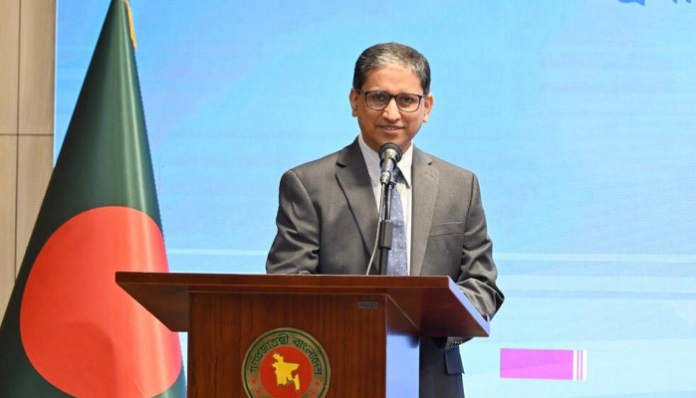
On 17th December (Wednesday) India submitted a formal diplomatic complaint (demarche) and summoned Muhammad Riaz Hamidullah, Bangladesh’s High Commissioner in New Delhi. The development followed recent threats against the Indian High Commission in Dhaka and provocative remarks made by prominent politicians in Bangladesh against India.
The official statement from the Ministry of External Affairs informed that the diplomat was “apprised of India’s strong concerns at the deteriorating security environment in Bangladesh. His attention was drawn, in particular, to the activities of some extremist elements who have announced plans to create a security situation around the Indian Mission in Dhaka.”
The release mentioned that the false narrative that extremist forces are attempting to fabricate about some recent events in Bangladesh is categorically rejected by India. The statement pointed out that it was “unfortunate” that the interim administration has not shared relevant evidence with India or carried out a comprehensive inquiry into the occurrences.
BREAKING: INDIA SUMMONS BANGLADESH HIGH COMMISSION RIAZ HAMIDULLAH OVER THREATS TO INDIAN HIGH COMMISSION, INFLAMMATORY STATEMENTS BY BANGLADESHI POLITICIANS @WIONews https://t.co/W7oX8BnHip pic.twitter.com/YhkejUKJ84
— Sidhant Sibal (@sidhant) December 17, 2025
India already vehemently denied claims made by Bangladesh’s interim government that anti-Bangladeshi activities were being conducted from Indian territory. It stated that New Delhi has never let its territory to be utilised for actions detrimental to the interests of the Bangladeshi people and continuously backed free, fair, and inclusive elections there.
The notification further read, “India has close and friendly relations with the people of Bangladesh rooted in the liberation struggle, and strengthened through various developmental and people-to-people initiatives. We are in favour of peace and stability in Bangladesh and have consistently called for free, fair, inclusive and credible elections, conducted in a peaceful atmosphere.”
“We expect the interim government to ensure the safety of Missions and Posts in Bangladesh in keeping with its diplomatic obligations,” the release concluded. Modi government had already removed non-essential employees from its High Commission in August 2024 due to growing unrest.
Bangladesh leader threatens India
The summons came after Hasnat Abdullah of the National Citizen Party (NCP) issued a warning that separatist organisations and other forces opposed to India would find refuge in Dhaka. He added that t he nation could assist in the separation of India’s “seven sisters” including Arunachal Pradesh, Assam, Manipur, Meghalaya, Mizoram, Nagaland and Tripura.
“We will shelter separatist and anti-India forces and then we will sever the seven sisters from India. I want to make it clear to India that if you provide shelter to forces that do not respect Bangladesh’s sovereignty, potential, voting rights, and human rights, Bangladesh will respond,” he threatened in front of a cheering audience during a speech at the Central Shaheed Minar in Dhaka.
Without specifically addressing New Delhi, Hasnat added that despite Bangladesh’s 54 years of independence, “vultures” still want to take control of the nation. Himanta Biswa Sarma, the chief minister of Assam, described the comments as “irresponsible and dangerous.” He further conveyed, “India is a very big country, a nuclear nation and the fourth largest economy of the world. How can Bangladesh even think about it?”
Bangladesh’s Foreign Ministry had earlier summoned Indian High Commissioner Pranay Verma to register protest over Sheikh Hasina’s alleged “provocative statements” and purported “anti-Bangladesh activities” by Awami League members living in India.
Strained ties between India-Bangladesh
For a considerable amount of time, India has highlighted militant and separatist groups operating in the Northeast of utilising Bangladesh as a base of operations, transit route and sanctuary. A number of such groups from Tripura and Assam had camps, safe houses or support systems outside the border.
Bangladesh is also home to Islamist networks that are active in India. Indian agencies identified groups like Harkat-ul-Jihad-al-Islami (HuJI) and later Jamaat-ul-Mujahideen Bangladesh (JMB) for their cross-border presence, facilitation of radicalisation and logistics networks that impacted the nation.
Following Sheikh Hasina’s removal, tensions between the two sides have been growing, with persistent hostile rhetoric directed at India, its media and diplomatic facilities. The nation has already seen horrific acts of anti-Hindu violence committed in the name of agitation and threats against the nation’s minorities.
Meanwhile, with jihadi forces on the increase, attempts to eradicate the history of 1971 and a total separation from India, Bangladesh is undergoing a radical transformation. Additionally, it has begun to display inclination towards Pakistan, which during the liberation war killed, raped and tortured thousands of Bangladeshis.
