

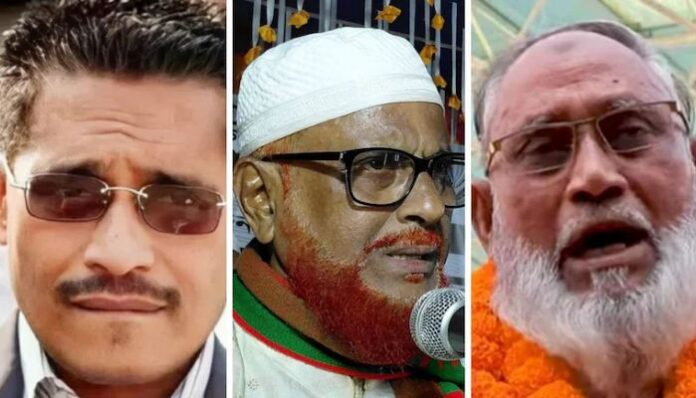
The 2026 general election in Bangladesh has delivered a huge victory for the Bangladesh Nationalist Party (BNP), which secured a two-thirds majority and defeated the Jamaat-e-Islami. However, what has made headlines is the comeback of three terrorist-turned-politicians, who were all previously sentenced to death and are now ready to enter Parliament as Members of Parliament (MPs).
All three Islamic terrorists were released from jail after the court rulings during the interim government led by Muhammad Yunus, which came into power after former Prime Minister Sheikh Hasina was forced to go into exile due to the 2024 uprising. Before the political turmoil, these three terrorists were already in jail and facing the death penalty. Two of them were also involved in anti-India terror activities.
From death row to Parliament: Lutfozzaman Babar
One of the most well-known is Lutfozzaman Babar of the BNP. He won the Netrokona-4 seat with over 160,000 votes in the 12th February election. Babar previously held the position of State Minister of Home Affairs in Khaleda Zia’s government from 2001 to 2006, during which the BNP-Jamaat alliance was in power.
In 2014, Babar was given the death penalty for his involvement in the 2004 Dhaka grenade attack that killed at least 23 people and injured around 500. The attack targeted Sheikh Hasina.
In 2018, he was given another death penalty for his involvement in the Chittagong arms smuggling case, in which 10 truckloads of arms for insurgents in India’s Northeast were confiscated. However, following Hasina’s ousting from power, the High Court acquitted him in January 2025, and he was released shortly thereafter.
Abdus Salam Pintu and his anti-India terror links
Another leader of BNP, Abdus Salam Pintu, also had a political resurrection. He won the Tangail-2 seat with close to 200,000 votes. Like Babar, Pintu was also given the death sentence in 2016 for his role in the 2004 Dhaka grenade attack.
Even Pintu was also charged with supporting the Pakistan-based terror organisation Harkat-ul-Jihad-al-Islami (HuJI), which carried out major blasts in India, such as the 2006 Varanasi court bombings, the 2007 Ajmer Sharif Dargah attack, and the Delhi bombs of 2011. Like Babar, courts released him on 24th December, 2025, after Hasina’s ouster.
War crimes accused ATM Azharul Islam
The third leader is ATM Azharul Islam of Jamaat-e-Islami. Azharul Islam won Rangpur-2 with close to 139,000 votes. He had contested there before in 1998, 2001, and 2006, and was the secretary general of the party until 2012.
In 2012, he was arrested for his crimes during the 1971 Liberation War, where he was accused of killing 1,256 people and raping 13 women. The International Crimes Tribunal gave him the death sentence in 2014. However, after the July 2024 uprising, Bangladesh’s Supreme Court acquitted him on 27th May last year.
It’s a wild shift in Bangladesh politics, with these controversial figures now set to take oaths in Parliament.
