

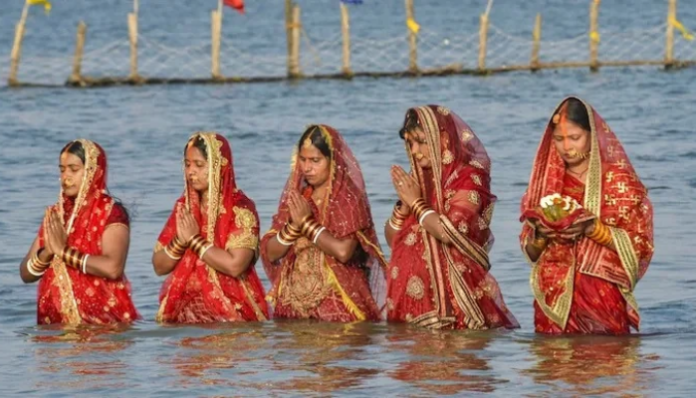
On Monday, 9 November, the Bombay High Court refused to grant urgent interim relief to an organisation seeking permission to perform Chhath Puja rituals at Girgaum Chowpatty in South Mumbai. The ruling said that the right to religious freedom is subject to public order, morality, and health.
A vacation bench of Justices Advait M. Sethna and Ranjitsinha Raja Bhonsale heard the petition filed by the Mithila Chhath Puja Sangh, which sought to hold celebrations at the beach on 15 and 16 November.
The Mithila Chhath Puja Sangh had approached the court after the DB Marg police station’s refusal to allow the construction of a stage and other arrangements for the religious event at the beach. The police cited an earlier High Court order that restricts programmes at Girgaum Chowpatty to a designated list of events: Ganeshotsav, Navratri Utsav, Ramlila, Krishnalila, and Christmas, subject to permission from the concerned departments.
In its ruling, the bench emphasised the constitutional limits on religious practice. “Undoubtedly, there is a freedom of conscience, and free profession, practice and propagation of religion. However, the same is subject to public order, morality and health as provided in the constitutional provision.”
In other words, there are checks and balances which are provided and required to be followed under such constitutional mandate,” the court observed. The judges further noted that India is a country of diverse faiths, and Article 25 mandates that the right to practice one’s religion is subject to public order, health, and morality, meaning “there are checks and balances carved out”.
The dispute traces back to a 2018 High Court order in the Adarsh Chowpatty Pragati Mandal case. It appointed a Monitoring Committee to oversee events and temporary structures at the beach. Under the interim directions issued on 21 June, 2018, functions at the site must be strictly confined to a designated 300 x 150 square foot area, and the court-appointed committee is a mandatory party to any proceedings regarding permissions.
The Mithila Chhath Puja Sangh’s advocate, Jogendra Thakur, informed the court that the organisation had submitted a representation to the Chief Minister on 7 October seeking the required permissions, but the plea remained pending. The petitioner also requested directions for an alternative venue to conduct the rituals. The bench declined to express any opinion on that request, leaving the Sangh free to pursue remedies available under the law.
The High Court directed that the matter be listed after the court reopens following the Diwali vacation.
