

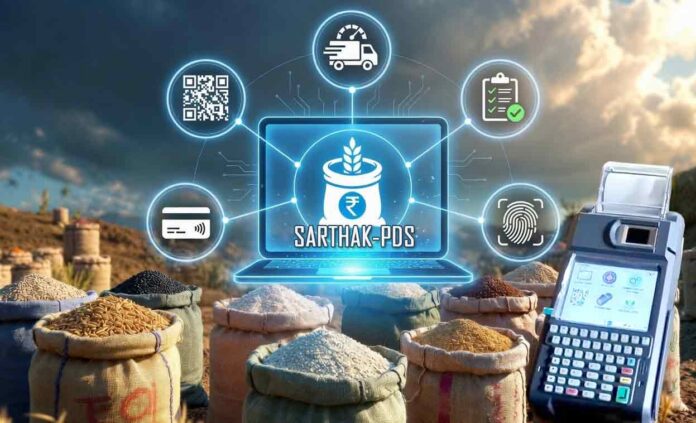
The Cabinet Committee on Economic Affairs (CCEA), chaired by Prime Minister Narendra Modi, has approved the integration and continuation of two key public distribution schemes under a new umbrella initiative called SARTHAK-PDS. The Centre will allocate ₹25,530 crore as its share over the next five years to strengthen the country’s food security architecture.
The decision announced on 27th May merges the “Assistance to State Agencies for intra-State movement of foodgrains and FPS dealers’ margin under NFSA” with the “Scheme for Modernization and Reforms through Technology in Public Distribution System (SMART PDS)”. The unified scheme will run until March 31, 2031, aligning with the 16th Finance Commission cycle.
SARTHAK-PDS aims to ensure efficient last-mile delivery of subsidised foodgrains to beneficiaries under the National Food Security Act (NFSA), 2013, which covers approximately 81.35 crore people. It will provide assured financial support for intra-state transportation, handling of foodgrains, and higher margins for Fair Price Shop (FPS) dealers.
A major focus is on technology-driven reforms. The scheme seeks to create a unified, citizen-centric, intelligent and interoperable PDS architecture using advanced tools such as Artificial Intelligence (AI), Machine Learning (ML), Natural Language Processing (NLP), and Blockchain. This includes real-time monitoring, unified databases, AI-driven grievance redressal, State Command Control Centres, and ISO-certified processes to reduce leakages and enhance transparency.
Cabinet Briefing by Union Minister @AshwiniVaishnaw https://t.co/JObtd4VXAF
— Ministry of Information and Broadcasting (@MIB_India) May 27, 2026
The move builds on a decade of digitisation efforts, including end-to-end computerisation of the Targeted Public Distribution System (TPDS), the Integrated Management of PDS (IM-PDS), and the existing SMART PDS scheme launched in April 2023. Citizen-centric apps such as Mera Ration, Anna Mitra, and Anna Sahayata have already improved access and accountability.
The government described the scheme as fulfilling both a social and legal commitment to provide dignified access to quality foodgrains while embedding financial assistance within a modern, tech-enabled ecosystem. The integrated approach is expected to optimise PDS operations, minimise leakages, and ensure sustainable food security. By revising norms for central assistance and continuing existing funding patterns, the Centre aims to support states and Union Territories in efficient grain movement and dealer incentives.
This decision comes as part of the government’s broader push for technology-led governance in welfare delivery, positioning SARTHAK-PDS as a comprehensive framework for the coming years.
