

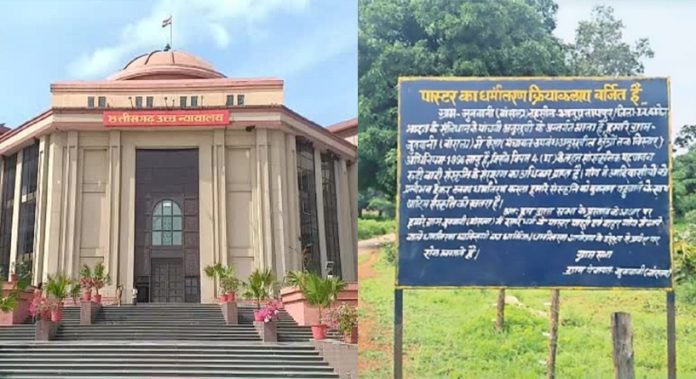
The Chhattisgarh High Court on Tuesday (28th October) refused to prohibit the tribals of 8 villages in the Kanker district from putting up hoardings to prevent forcible or fraudulent conversions. The High Court ruled that erecting banners cautioning tribals against illegal conversions cannot per se be termed unconstitutional.
A bench of Chief Justice Ramesh Sinha and Justice Bibhu Datta Guru disposed of a petition which sought the removal of the hoardings, alleging that they prohibited the entry of Christian pastors or converted Christians into the villages, thereby discriminating against them. The writ petition was filed by one Digbal Tandi, a resident of the Kanker district, alleging the segregation of the Christian community and their religious leaders from the mainstream village community. The petitioner requested that the hoardings erected in several tribal villages, including Kudal, Parvi, Junwani, Ghota, Ghotiya, Habechur, Musurputta and Sulagi, should be declared unconstitutional and ordered to be removed.
Moreover, the plea also alleged that the Panchayat Department instructed the Zila panchayat, Janpad panchayat and eventually the Gram panchayat to pass a resolution in the name of “Hamari Parampara Hamari Virasat (Our tradition, our heritage)” to prohibit the entry of Christian pastors and “converted Christians” in the village. After hearing the submissions of both sides, the High Court came to the conclusion that there was nothing in the Panchayat Department circular or the hoardings to indicate any kind of discrimination against the Christian community. “The hoardings appear to have been installed by the concerned Gram Sabhas as a precautionary measure to protect the interests of indigenous tribes and local cultural heritage,” the court noted in its judgment, analysed by OpIndia.
Ilegal conversions disturb social harmony: HC
The High Court acknowledged that mass religious conversions disturb social harmony and target the cultural identities of tribal communities. It added that in the garb of social service, missionary groups have been proselytising and enticing gullible people to convert to Christianity. “Missionary activity in India dates back to the colonial period, when Christian organisations established schools, hospitals and welfare institutions. Initially, these efforts were directed at social upliftment, literacy, and health care. However, over time, some missionary groups began using these platforms as avenues for proselytisation. Among economically and socially deprived sections, especially the Scheduled Tribes and the Scheduled Castes, this led to a gradual religious conversion under the promise of better livelihoods, education, or equality,” the Court observed.
Targeting poor communities for illegal conversion amounts to “cultural coercion”: HC
The High Court highlighted how illegal conversions carried out by Christian missionaries by targeting the poor and illiterate people create a divide in tribal societies and amount to “cultural coercion”. “In remote tribal belts, missionaries are often accused of targeting illiterate and impoverished families, offering them monetary aid, free education, medical care, or employment in exchange for conversion. Such practices distort the spirit of voluntary faith and amount to cultural coercion. This process has also led to deep social divisions within tribal communities, distancing them from traditional rituals and communal festivals. As a result, villages become polarised, leading to tension, social boycotts and sometimes even violent clashes,” the Court remarked.
The High Court rejected the petitioner’s allegation that the impugned circular discriminated against the Christian community. “No material has been placed on record to indicate that the circular authorises discrimination against any religious group,” the court said. Similarly, the court said that there is nothing in the hoardings that can be interpreted as discrimination against Christians. It added that the hoardings only prohibited the entry of certain Christian pastors if they intended to organise religious conversion activities.
‘Conversions by inducement’ are a social menace: HC
The court clarified that freedom of religion envisaged under Article 25 of the Constitution is not an absolute right and is subject to public order, morality and health. It added that the right is prone to misuse and therefore several state governments have enacted anti-conversion laws. The High Court cautioned that fraudulent or illegal conversion activities can disrupt the secular fabric of the country that thrives on the peaceful coexistence of different religions. “India’s secular fabric thrives on coexistence and respect for diversity.
Religious conversion, when voluntary and spiritual, is a legitimate exercise of conscience. However, when it becomes a calculated act of exploitation disguised as charity, it undermines both faith and freedom. The so-called ‘conversions by inducement’ by certain missionary groups is not merely a religious concern; it is a social menace that threatens the unity and cultural continuity of India’s indigenous communities. The remedy lies not in intolerance, but in ensuring that faith remains a matter of conviction, not compulsion,” the High Court stated.
Disposing of the petition, the High Court noted that the petitioner did not avail any alternate statutory remedy before approaching the High Court, and therefore, directed him to first exhaust alternate remedies. “A party must firstly exhaust the statutory alternative remedy available before approaching the High Court seeking redressal of any grievance,” the court said.
