

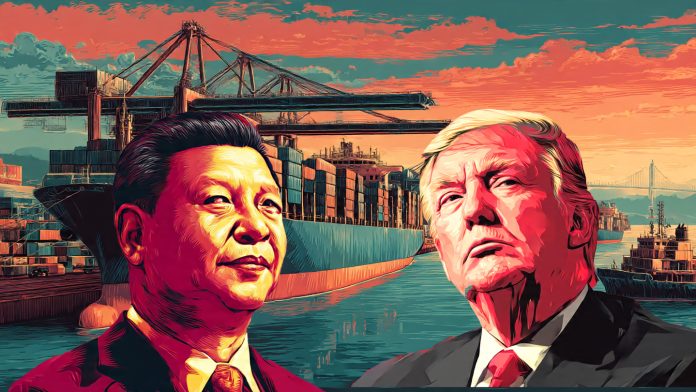
In a sharp escalation of the long-running US-China trade war, China’s Ministry of Transport has announced the imposition of special port fees on vessels owned or operated by US entities, effective October 14, 2025. The move is a direct retaliation to similar fees imposed by the United States on Chinese-linked ships, marking a new front in the bilateral tensions that have been going on since 2018.
The Chinese fees will start at 400 yuan (approximately $56) per net ton, escalating annually to reach up to 1,120 yuan (about $157) per net ton by 2028. The policy will take effect from 14th October, and will go through a structured four-stage escalation.
China's Ministry of Transport announced Friday that the country will charge special port fees on ships owned or operated by U.S. enterprises, organizations and individuals from Oct. 14. pic.twitter.com/Uiuufk65zO
— People's Daily, China (@PDChina) October 10, 2025
This structure mirrors the US measures, which could add up to $1 million in costs for a large container ship per docking. Affected vessels include those flying the US flag, built in the US, or owned/operated by American firms or individuals.
Chinese officials described the policy as a “counter-measure” against discriminatory US actions, with a four-stage rollout to align with the phased increases in American fees.
The US fees, imposed under a Section 301 investigation by the Trump administration, target China’s alleged unfair practices in the maritime, logistics, and shipbuilding sectors. Initiated in early 2025, the probe concluded that China employs non-market policies to dominate global shipbuilding, where Chinese yards produced over 1,000 commercial vessels last year compared to fewer than 10 in the US.
The US Trade Representative (USTR) finalized the actions in May 2025, imposing fees starting at $80 per net tonnage for Chinese-owned or operated vessels, and the higher of $23 per net ton or $154 per 20-foot equivalent unit (TEU) for non-Chinese operators of Chinese-built ships.
These charges are capped at five times per year per vessel and aim to fund the revival of American shipbuilding industry. Exemptions apply to US-flagged ships and certain categories like liquefied natural gas carriers, but the policy has been expanded to include non-US-built roll-on/roll-off auto carriers.
Estimated costs for the US measures are substantial, with the top 10 cargo carriers potentially facing $3.2 billion in fees in 2026 alone. Chinese carrier COSCO, including its OOCL fleet, could bear nearly half of that burden at $1.53 billion.
In contrast, China’s retaliatory fees are projected to have a lighter impact on US shipping, with American companies expected to pay around $180 million annually if mirroring the US structure, compared to over $1 billion for Chinese operators.
As Presidents Trump and Xi prepare to meet at the Asia-Pacific Economic Cooperation summit later this month, the port fees could become a bargaining chip in negotiations.
