

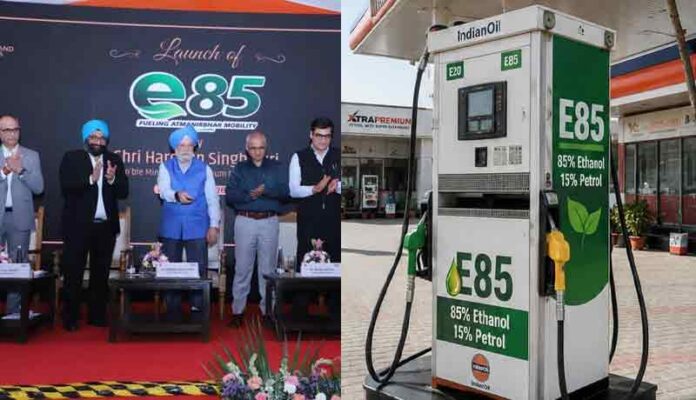
Union Minister for Petroleum and Natural Gas Hardeep Singh Puri launched E85 fuel at an Indian Oil retail outlet in New Delhi on World Environment Day, June 5, 2026. Senior officials from the Ministry and CMDs of public sector oil marketing companies (OMCs) attended the event. The launch marks the commencement of E85 rollout across 48 retail outlets of Public Sector OMCs, with plans for nationwide expansion to around 500 outlets by December 2026 and about 5,000 by December 2027, enabling flex-fuel vehicle users to access this cleaner fuel. This initiative is expected to help raise India’s aggregate ethanol blending levels to nearly 26 per cent by 2030-31.
E85 is a high-ethanol blended fuel comprising 80–85 per cent ethanol and 14–19 per cent petrol. It is specifically designed for use in flex-fuel vehicles (FFVs), which are capable of operating on ethanol blends ranging from E20 all the way to E100 without restricting consumers to a single blend. Ethanol for this fuel is produced domestically primarily from sugarcane and other agricultural feedstocks, supporting farmers and reducing reliance on imported crude oil.
Public sector OMCs such as Indian Oil Corporation (IOC), Bharat Petroleum, and Hindustan Petroleum are leading the production and distribution in collaboration with ethanol suppliers under the government’s Ethanol Blended Petrol (EBP) programme. This builds on the successful increase in ethanol blending from just 1.53 per cent in 2014 to 20 per cent today, achieved five years ahead of schedule, which has already saved over ₹1.84 lakh crore in foreign exchange and substituted nearly 302 lakh metric tonnes of crude oil imports.
In Delhi, E85 is priced nearly ₹20 per litre lower than conventional E20 petrol, passing on the economic benefits of domestically produced ethanol directly to consumers. For instance, it is available at around ₹82 per litre compared to higher prices for regular petrol. This lower price is the result of ethanol’s production economics, though its lower energy density means vehicles may experience a noticeable drop in mileage.
Beyond cost savings, E85 offers substantial environmental advantages. Flex-fuel vehicles running on E85 can reduce lifecycle greenhouse gas emissions by around 61 per cent compared to conventional petrol vehicles. With ethanol’s high Research Octane Number (RON) of about 108, it provides superior knock resistance, enabling engines to run at higher compression ratios and optimised ignition timing for better performance. Higher ethanol blends also promote cleaner and more complete combustion, resulting in near-zero particulate matter emissions that significantly improve urban air quality.
E85 compatible vehicles
Only specially designed flex-fuel vehicles (FFVs) can safely use E85. Standard petrol vehicles, including most E20-compliant models on Indian roads, are not compatible. Using E85 in non-FFVs risks corrosion of fuel system components, damage to seals and hoses, starting issues in cold weather, and overall performance degradation.
Flex-fuel vehicles feature modified engines, fuel lines, injectors, pumps, and sensors engineered to handle the corrosive properties and different combustion characteristics of high-ethanol fuels. They offer the flexibility to run on any blend from E20 to E85 (or even E100 in some cases) depending on availability.
Prominent flex-fuel models already introduced or showcased include Maruti Suzuki’s WagonR Flex Fuel, India’s first mass-market flex-fuel passenger car, which supports blends up to E85 and has been positioned for commercial buyers initially. Hero MotoCorp has launched flex-fuel variants of popular motorcycles such as the Splendor+ Flex Fuel and HF Deluxe Flex Fuel. A Toyota Innova flex-fuel model was also unveiled in 2023.
Other models like the Maruti Suzuki Fronx Flex Fuel are expected in the coming months, prototypes of which were already demonstrated. More two-wheeler and four-wheeler FFVs from various manufacturers are anticipated as the ecosystem matures. Automakers including Maruti Suzuki and Hero MotoCorp are actively supporting the transition, with industry associations on board. Most models contain the words Flex Fuel in their names, to avoid any confusion.
Minister Hardeep Singh Puri emphasised that E85 is meant exclusively for these specially designed flex-fuel vehicles and not for normal petrol cars. He addressed common misconceptions by noting that since E20 became the standard fuel, there has not been a single reported case of engine failure or vehicle breakdown due to ethanol blending. E20-compatible vehicles often deliver improved acceleration and better ride quality, especially in city conditions, and ethanol use does not affect vehicle insurance validity.
FFVs also remain competitive with electric vehicles due to lower upfront costs and utilisation of existing infrastructure, while relying on domestically produced ethanol from Indian farmers rather than imported batteries and minerals.
If 50 per cent of new two-wheelers and four-wheelers transition to flex-fuel technology, it could generate demand for over 312 crore litres of ethanol annually, directing nearly ₹12,403 crore directly to farmers, saving about ₹15,151 crore in foreign exchange, and reducing CO2 emissions by 66.4 lakh metric tonnes. The initiative draws inspiration from Brazil’s successful experience, where over 80 per cent of the light vehicle fleet operates on flex-fuel technology. States have been urged to support the shift through favourable taxation policies for E85 and FFVs.
This launch advances India’s broader biofuel strategy and Atmanirbhar Bharat goals by reducing oil imports, boosting rural economies, and promoting cleaner mobility. E85 will be dispensed from dedicated pumps to prevent misuse. While initial availability is limited and most existing vehicles will continue using E20 petrol, the expanding FFV options and infrastructure promise greater choices for consumers seeking cheaper, greener fuel.


