

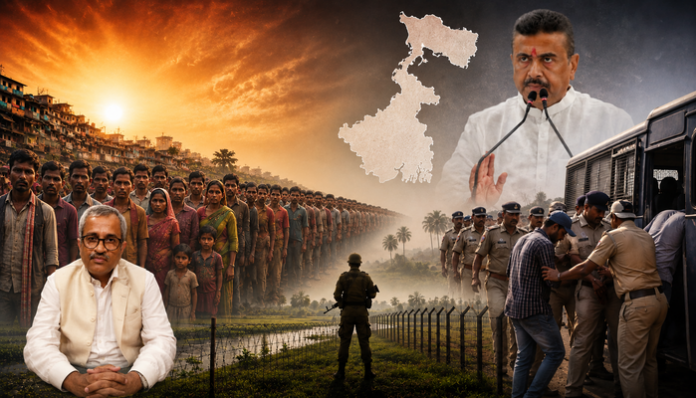
Recently, the newly elected BJP government in West Bengal intensified action against illegal immigrants in the state, directing the state authorities to ‘detect, delete and deport’ those residing in the state illegally. For decades, West Bengal has been reeling under the effects of rising population, crumbling law and order and a rapidly changing demography. The stiff stance of the state government against illegal immigrants has irked the usual suspects, the champions of selective human rights, whose idea of human rights never aligns with national interests.
Senior Advocate Sanjay Hegde recently wrote an article published in the Deccan Herald, lashing out at the West Bengal government for deporting illegal immigrants residing in the state. The article is nothing but a sophisticated rant against the Indian government’s hardened stance against illegal immigrants. The article contains every element of a catchy piece, from sob stories and emotional appeals to legal jargon, except reasonableness and common sense.
An emotional appeal to cover a legal wrong
In the article, Hedge picks out an example of an Indian family allegedly deported to Bangladesh by the Indian authorities on suspicion of being illegal Bangladeshi immigrants. To suggest that the Indian authorities displayed insensitivity in deporting immigrant families who entered and have been living in the country illegally, Hegde carefully picks out this story where the woman, as claimed by him, was pregnant. He writes how, when he approached the Supreme Court, challenging the action of the Indian authorities, the court allowed the pregnant woman to be brought back to India on humanitarian grounds.
The court’s decision to allow relief to an illegal immigrant on humanitarian grounds does not render the action of the authorities invalid. Just because the Supreme Court displayed empathy and sensitivity and permitted a pregnant illegal immigrant to stay in the country while clearly stating that the case should not be used as a precedent, does not strike at the core of the policy for the deportation of illegal immigrants. Courts often grant relief when procedural safeguards were not followed in a particular case. That does not establish that every person removed in the operation was an Indian citizen or that every action taken by authorities was unlawful.
The courts in India have time and again reiterated that illegal immigrants have no right to stay in India, noting that it causes a grave threat to the internal and external security of the country. Many of the illegal immigrants living in India have been found involved in serious criminal activities such as robberies, drug smuggling, and human trafficking. India, being a sovereign country, has every right to decide who enters its borders, who stays, and who should be deported in accordance with the law of the land. While Hegde tries to argue against the policy of deportation of illegal immigrants by highlighting legalities, he misses the broader logic underlying the policy, which is that no illegal immigrant can claim a right to remain on Indian territory.
Besides, it is a basic principle of law that ‘He who comes into equity must come with clean hands’. The legal principle implies that one cannot be allowed to benefit from one’s own wrong. The principle prevents people from exploiting the law to benefit from their wrongdoings or to achieve illegal ends. The illegal immigrants who manage to enter the borders of India by whatever means cannot later claim a right to continue to reside in the country just because they had lived in the country illegally for decades, or because their children were born here. Illegal presence on Indian territory cannot be a ground to claim citizenship or the right to stay in the country.
Burden on the country’s already strained resources
Hegde criticised West Bengal CM Suvendu Adhikari’s decision that women who were removed from the state’s electoral roll will not receive benefits under the Annapurna Yojana unless their appeals are under consideration by, or have been accepted by, the appellate tribunals. The rationale behind the CM’s decision was that the benefits under the scheme should not go to any non-citizen.
It should not be forgotten that illegal immigrants consume the country’s resources in a parasitic manner without making any contribution. They put a burden on the limited resources of the country, which has a sizable population to feed and maintain. It is not far-fetched to state that the resources do not reach the people they are meant for because they get exhausted by a large number of undeserving infiltrators. Their presence on the Indian territory is a continuing injustice to the people of the country, who toil to make the country what it is and do not infiltrate into other, more prosperous countries to feed on their resources.
The West Bengal government has made an exception for women who have appealed against their removal from the electoral rolls. If such women can prove their identities, they will be included within the ambit of the scheme. The caution taken by the state government is not uncalled for. Many reports have revealed how thousands of illegal immigrants have forged Indian identity cards with the help of local politicians and have even cast votes in local elections. In such a scenario, government scrutiny is warranted to make sure that the country’s resources are not squandered on illegal immigrants.
Procedures are important and necessary
Hegde rightly points out that removal from the electoral roll does not mean stripping of citizenship. He also laments how people have to go through lengthy procedures to get their names included in the electoral rolls or to get any other identity documents made. As far as Hedge’s lament regarding complex procedures is concerned, it cannot be stressed enough how procedures are important and necessary in a country with such a vast population.
The government cannot just assume that everyone residing in the Indian territory is an Indian citizen. No infiltrator or illegal immigrant living in the country would admit their real identity. There is no other practical way but to put the onus on the citizens of the country to produce evidence of their citizenship whenever they are asked to. This is not some arbitrary government diktat but has legal and statutory backing. Statutes like the Foreigners Act, 1946, the Citizenship Act, 1955 and the Indian Passport Act, 1920 lay down the framework for ascertaining the identities of citizens and non-citizens.
Procedures are not something unique to India; every sovereign country with a functioning democracy has a system in place to ensure people’s identities and regulate the movement of people across its borders. One cannot expect the government to verify the identities of people or conduct a background check every time they want to avail themselves of a facility. That’s where identity cards come in. Citizens go through procedures, get their identity cards made and show them whenever they are asked to so that they don’t have to keep proving their identities again and again. It can’t get simpler than that.
Procedures do not exist without a reason; they serve a purpose. There is a procedure to get a ration card, a birth certificate, a voter ID card, a passport and so on, because for a system to run efficiently, honesty or goodness cannot be assumed on people’s part. They can be complex and tiring, but they are a necessary evil.
A generous neighbour is not a permanent refuge
Be it Bangladeshis or Rohingyas or any other people from our neighbourhood, India cannot be used as a convenient backup for people who failed to make their countries worth living in. The people of India, after enduring decades of colonisation, built not just a functional but thriving democracy with their grit and determination, while most of their neighbours failed to do so. Despite facing hostilities from some neighbouring states, India has always acted like a generous and responsible neighbour and stood by its neighbours through thick and thin. But the country has every right to protect its people and resources from being exploited by non-citizens, and no law can prevent it from doing so.
Anything worth having requires time, effort and vigilance. In a country of billions of people, one cannot expect things to be delivered to oneself without the slightest inconvenience. India is a democracy, and in a democracy, it’s the people who make the system work. It is imperative for any functioning government to keep a watch on the movement of people in and out of the country. Because it is the government that is accountable in case of any mishap. Anything good or valuable needs to be safeguarded with constant vigilance, just like how our security forces safeguard the border without relying on the goodness or honesty of our enemies.


